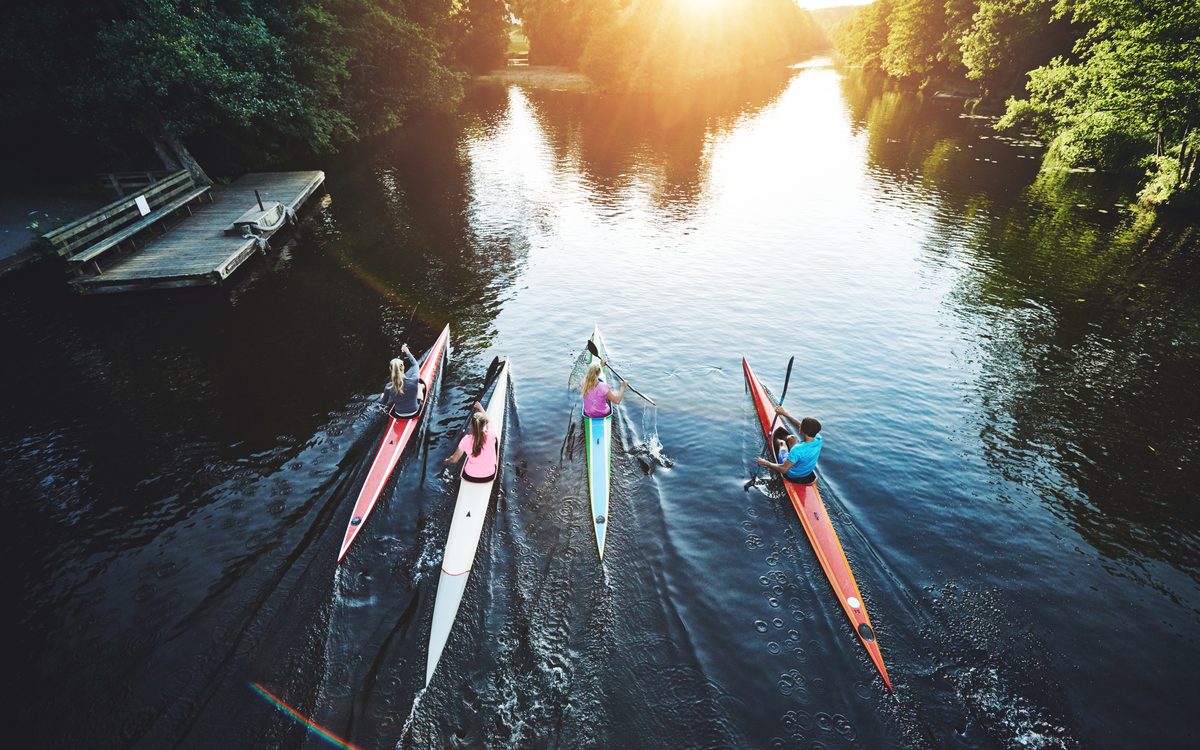
Eight boats are aligned on the start line, and in the stillness before “Set” a paddler can hear her own heartbeat. A second false start means disqualification, but a start that is too cautious loses boat lengths in the first ten strokes. Canoe sprint mental training is the set of skills, such as focus, routines, imagery and goal setting, that help an athlete perform under pressure. It is separate from mental health, which is a health matter and is covered in its own section below.
Quick answer: Pressure can help or hurt performance. A 2026 position statement from Exercise and Sports Science Australia (ESSA) lists pre-performance routines, attentional strategies, psychological skills training and mindfulness among the evidence-based tools. None of these guarantees a result. If anxiety, low mood, disordered eating or burnout are affecting you, that is a health matter: talk to a doctor or licensed professional, and in the United States the 988 Lifeline is open by call or text.
What pressure does
The ESSA statement says that pressure has both facilitative and debilitative effects on performance, and that training environments that include pressure and implicit learning opportunities can help athletes prepare. In sprint canoeing the pressure points are easy to name: the start, where a second false start disqualifies; the middle of the race, where fatigue arrives early; and the finish, where a lane position decides a medal. Crew boats add a different pressure, because your timing affects three other people.
Pre-race routines
A routine is a fixed sequence you can repeat. ESSA lists pre-performance routines among its evidence-based strategies. In general coaching practice, a sprint paddler’s routine might include arriving at the start area early (the ICF rules require being on the water at least three minutes before the race and lined up two minutes before), a few breaths, a cue word, and a check of equipment, then a final focus on the first strokes. The routine should be practiced in training so it feels normal on race day. Our rules page covers the start procedure.
Focus and the start
Under the ICF rules, athletes may only react to the “Go” signal, and paddling at “Set” is a false start. That puts a premium on attention: hold still, wait for a signal, then commit. ESSA describes “implicit attentional strategies” as a category of tools. In practice a coach may use a single cue (“long first stroke,” “eyes on the bow”) to keep attention on something simple, and may rehearse starts repeatedly in training. These are common coaching approaches, not guarantees.
Goal setting, confidence and motivation
- Goal setting. General coaching practice separates outcome goals (placing) from process goals (stroke rate, a clean first ten strokes, holding technique in the last 200 metres). Process goals are in your control.
- Confidence. It is usually built from preparation you can point to: sessions completed, times, and starts practiced. We did not find a trial showing that positive self-talk improves sprint paddling.
- Motivation. Winter ergometer blocks are long. Many athletes find short, specific targets and training partners helpful; a coach can help find a mix that suits the athlete.
Imagery and visualization
Imagery means rehearsing a race in the mind: the start, the first strokes, the finish. It is widely used and is one of the tools in psychological skills training, which ESSA lists, but we did not find a sprint canoe trial showing that it speeds boats. In general coaching practice, athletes keep it short, include what they will see, feel and do, and include how they will respond to a poor start as well as a perfect one.
Handling setbacks
Setbacks in this sport can be abrupt: a capsize eliminates a boat (DNF), a broken paddle is not replaced during the race, and a second false start ends your event. A common coaching approach is to prepare a plan for each: what you will do in the next stroke, how you will reset for the next round, and how you will debrief. Between a heat and a final in a world championship the rules allow at least 30 minutes for 500 and 1000 metre events, so a short reset routine is useful.
Teamwork in crew boats
In a K-2 or K-4 the speed of the boat depends on shared timing, so crews practice stroke rate, communication and seat order together. The ICF rules also let up to half the crew be replaced once between phases if illness or injury prevent a crew member from continuing, with a medical certificate, which means crews can face a sudden change in their lineup. A coach can help crews agree on calls and roles in advance. We found no sourced research on team-boat communication in canoe sprint, so this is general practice.
Race preparation
For logistics such as travel, schedule and equipment checks, see your coach and the canoe sprint hub. Mentally, a typical race-week plan includes a familiar sleep and food routine, a short list of cues, and knowing the course and lane. Keep the plan simple.
Young paddlers
We did not find sourced guidance specific to youth canoe sprint psychology. In general, a supportive coach, a focus on effort and technique rather than winning, and open conversations about nerves are sensible for children. If a child seems unusually anxious, withdrawn or stops enjoying the sport, talk to a doctor or a licensed professional.
Mental health is not the same as mental performance
Routines, imagery and cues are performance tools. Anxiety that will not settle, low mood, loss of interest, panic before training, restricting food or constant exhaustion are health matters. The 2026 IOC consensus statement on mental health in elite athletes says that mental health symptoms and disorders are common among elite athletes, can impact performance, and that with appropriate support and treatment many athletes can continue to train and compete safely. It also notes that elite Para athletes, young athletes and athletes transitioning out of sport deserve particular attention.
Start with a doctor, a licensed mental health professional or a trusted adult. In the United States, the 988 Suicide and Crisis Lifeline is available by call or text, and ANAD runs a free eating disorders helpline. The Association for Applied Sport Psychology (AASP) lists resources for finding a sport psychology professional.
Canoe sprint mental training FAQs
How do I stay calm on the start line?
The ESSA statement lists pre-performance routines and attentional strategies as evidence-based. A practiced routine and one simple cue are common approaches, but none removes nerves entirely.
Does visualization make a boat faster?
It is a standard part of psychological skills training, but we found no sprint canoe trial showing it speeds boats. Many athletes use it for confidence and rehearsal.
What if I false start?
The ICF rules give a warning for the first false start and disqualify the boat on a second. A coach can help you rehearse a calm, controlled start.
How do crews build trust?
Through shared practice of timing, calls and roles. We did not find sourced research on this in canoe sprint, so ask your coach.
When is nervousness a health problem?
If anxiety, low mood, panic or disordered eating persist or get in the way of daily life, see a doctor or licensed professional. The 988 Lifeline is available in the US.
Sources
- Performance Under Pressure in Sport: A Position Statement from Exercise and Sports Science Australia (Sports Med, 2026).
- Mental health in elite athletes: International Olympic Committee consensus statement (Br J Sports Med, 2026).
- ICF, Canoe Sprint Competition Rules 2025 (10.2, 10.3, 13.4.8).
- 988 Suicide and Crisis Lifeline, 988lifeline.org; ANAD, helpline; AASP, resources.
General information for education only, not medical advice. It does not replace a sports medicine doctor, physical therapist, athletic trainer, dietitian or coach who knows you. How we write: see our editorial policy.