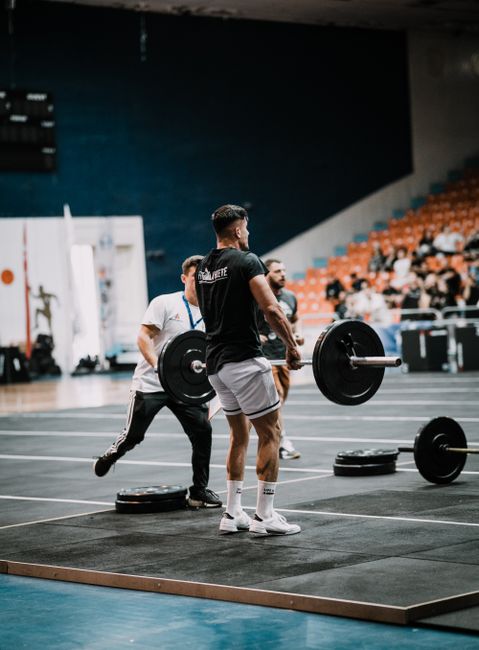
The clock says 3:00 and the barbell is on the floor. Twenty-one thrusters, then a bar-facing burpee, and you already know your lungs are going to hate the next eight minutes. The first few reps feel fine. That is the trap, and every CrossFit athlete knows it, from a Saturday in-house throwdown to the Open to a Semifinal floor. CrossFit mental training means practicing the skills between your ears (staying composed when a workout hurts, telling hard from harmful, settling nerves before a heat, showing up again next week) the way you practice double-unders. This page is about mental performance, which is different from mental health; there is a clear section on that difference below.
Quick answer: Mental skills are trainable habits: a short routine before each heat, imagery that focuses on how a lift should feel, goals you control, and a plan for a bad workout. Research on CrossFit athletes is promising but mostly observational, and no technique guarantees a better score. Discomfort in a hard workout is normal; sharp pain, dark urine or lasting exhaustion is not, so see a doctor, sports medicine clinician or other qualified professional. If worry, low mood or eating and exercise habits are taking over, that is a health matter too, and in a crisis you can call or text 988 (US).
Pushing through discomfort, or overreaching?
CrossFit culture prizes toughness, and a 2026 systematic review of 13 studies on the psychology of CrossFit participants (de Oliveira and colleagues, Frontiers in Sports and Active Living) describes the sport as one built around high intensity, competition and “overcoming physical and mental limits”. Mental toughness is a real skill. The skill that goes with it is knowing which kind of hard you are in.
The joint consensus statement of the European College of Sport Science and the American College of Sports Medicine on overtraining (Meeusen and colleagues, 2013) gives useful language. It says successful training involves overload but must avoid excessive overload combined with inadequate recovery. A short-term drop in performance after a hard block, followed by improvement after recovery, is called functional overreaching. When the balance of training and recovery is not respected, nonfunctional overreaching can occur, and the statement notes that telling that apart from the more serious overtraining syndrome is very difficult and depends on the clinical picture. Fatigue, performance decline and mood disturbance are among the symptoms it lists. In practice, that means a bad week is information, but weeks of falling scores, heavy fatigue and low mood are a reason to talk to a coach or a doctor, not to grind harder.
Some “pain” is a medical emergency. Severe muscle pain with swelling and dark, cola-colored urine can be rhabdomyolysis, and the CrossFit Level 1 training guide says to seek medical attention immediately for those symptoms. Mental toughness never means ignoring them. Our CrossFit injuries guide covers the warning signs, and our training guide covers scaling and progressions.
Pacing and staying composed in a workout
We did not find a CrossFit-specific pacing trial to cite, so this section is limited to what the research does support. A 2026 laboratory study of 35 adults doing high-intensity functional training (Bullert and colleagues, European Journal of Applied Physiology) measured effort with both heart rate and the rating of perceived exertion. Women and men reported similar ratings of exertion, but the women’s heart rates were relatively higher. Your internal feeling of effort is a useful signal, and it is not the same thing as how hard your body is working, so two athletes can feel the same workout very differently.
- Write down how you felt at the halfway point and the end of each benchmark workout. Over months you will learn your own pattern of starting too fast.
- Decide your first break before the clock starts (for example, “set down the bar at 10, not at 6”). Plans like this are common coaching practice; no CrossFit trial we found tests them.
- Pick one cue per workout (breathe out on the way up, hips first) and return to it whenever your mind drifts.
- If the plan is not working, scale the load or reps. Deliberately choosing a smaller weight is a decision, not a failure.
Competition nerves and pre-performance routines
Nerves are part of the sport. The 2026 systematic review above found that competitive settings were associated with higher anxiety and negative mood changes. A prospective study of 239 CrossFit athletes across a national season in Brazil (Zanini and colleagues, Frontiers in Sports and Active Living, 2026) found that athletes who advanced to later stages had, on average, lower anxiety, tension and total mood disturbance and higher recovery scores than those eliminated. The authors stress that this is an observational study, in an elimination-based competition, so it shows links and not causes. It suggests that how you feel and recover across a season is worth tracking, not that calming down will win you a heat.
A 2026 position statement from Exercise and Sports Science Australia on performance under pressure (Schweickle and colleagues, Sports Medicine) lists pre-performance routines among evidence-based strategies, along with psychological skills training and mindfulness-based approaches. It also says pressure can have both helpful and harmful effects, and that training with some pressure can help prepare athletes. Build a short routine you can repeat in the minute before the floor: a slow breath, a quick check of your standards, one cue word. Rehearse it at your gym in practice workouts, such as a benchmark with a judge counting your reps, a partner workout or a mock heat with others watching.
Imagery: think about the feel, not the technique
Imagery, the mental rehearsal of an action, is common before a lift. A 2026 study of 120 national-level CrossFit athletes (Piveteau and colleagues, Human Movement Science) had them do cleans and snatches after four conditions. Imagery focused on general activation or on how the specific lift should feel was followed by better power output and technical accuracy than no imagery. Imagery of technical details, such as step-by-step body positions, was followed by worse performance. The authors suggest that thinking through technique can interfere with smooth movement by adding too much conscious control. It was a single study of experienced athletes, so treat it as a useful lead.
A 2023 systematic review across sports (Reinebo and colleagues, Sports Medicine) found moderate effects for imagery and other psychological skills training, but reported that the effects were not stable once non-randomized trials and subjective outcomes were removed. Use imagery as a low-cost addition to real training, not a substitute.
Consistency and motivation
The 2026 systematic review found that intrinsic, self-determined motivation (training because you value it and enjoy it) predominated among CrossFit participants and was strongly associated with passion for the sport. A 2025 survey of 568 CrossFit participants in China (Ji and Wu, Frontiers in Psychology) found that intrinsic motivation was linked to the intention to keep participating, partly through commitment to the sport. In that study a sense of community belonging did not significantly explain the link, so do not assume that a friendly gym alone keeps people training. These are surveys of what people report, not trials of ways to keep you training.
What to do with that: set goals you control, such as process goals (all warm-ups done, every rep to standard), alongside outcome goals (a qualifying score or a first muscle-up). A pattern of scaled work you repeat for months is also consistency. Our training guide has a sensible week, and our recovery guide covers sleep and rest days.
When a workout or a competition goes badly
Every athlete has a day with a missed lift, a no-rep that costs the heat or a score that misses the cut. Many coaches teach a simple order: acknowledge it, take one lesson (“I went out too hard on the first round”), then move to the next job, whether that is the next event or the cool-down. Judge the workout against your plan and your standards, not only the leaderboard. This is coaching practice, not a result from a CrossFit trial.
Preparing for competition
In the week before a competition, put the mental pieces next to the physical ones: read the movement standards, practice your routine, write one or two process goals per event, and protect sleep. Warm-up timing, food, fluids and heat safety belong on our competition day guide; food and supplements are covered on CrossFit nutrition and supplements. If an injury is part of why you feel anxious, talk to a sports medicine doctor, physical therapist or athletic trainer first.
Mental performance is not the same as mental health
Everything above is about performance skills. Anxiety disorders, depression, disordered eating, exercise dependence and burnout are health matters, not mindset problems, and a better routine does not fix them. The 2026 International Olympic Committee consensus statement on mental health in elite athletes (Reardon and colleagues, British Journal of Sports Medicine) treats them as medical and psychological care issues.
CrossFit research gives reasons to pay attention. The 2026 systematic review reported exercise dependence prevalence of 14.4% to 25.2% across studies and said the findings highlight the importance of professional monitoring and training load management. A 2025 survey of 325 female CrossFit athletes (Reno-Smith and colleagues, Eating Behaviors) found that 37.2% were at risk for disordered eating, and the authors recommend screening in evaluations for Relative Energy Deficiency in Sport. These are self-report surveys, not diagnoses, and they do not say how common the problems are in your gym. Signs worth taking seriously include worry or low mood lasting weeks, panic before training, training through injury or illness because skipping feels intolerable, big changes in eating or sleep, or dread of workouts you used to enjoy.
Start with your doctor, a licensed psychologist or another qualified mental health professional. In the US, you can call or text 988 (Suicide & Crisis Lifeline) at any time.
CrossFit mental training: FAQs
How do I know if I’m pushing through discomfort or overreaching?
Short-term tiredness after a hard block that improves with rest is what the ECSS and ACSM consensus calls functional overreaching. Falling performance, heavy fatigue and low mood that do not clear are warning signs; see a coach or doctor. Sharp pain or dark urine needs medical attention now.
Should I visualize the technique of a lift before I go?
One 2026 study of national-level athletes found that imagery of how a lift should feel was followed by better performance, while step-by-step technical imagery was followed by worse performance. It is one study, so experiment in training first.
Is competition anxiety normal in CrossFit?
Research links competitive settings with higher anxiety, and the ESSA statement says pressure has helpful and harmful effects. If worry is constant, causes panic or disrupts sleep and eating, talk to a doctor or licensed mental health professional.
How do I stay motivated to train week after week?
Surveys of CrossFit athletes link intrinsic motivation (training because you value and enjoy it) to staying with the sport. Process goals you control and enough recovery help. No study here proves any one method.
When is it more than motivation?
If you cannot take a rest day without distress, train through injury, or your eating or mood is suffering, see a doctor or qualified mental health professional. These are health matters, not weaknesses.
Sources
- de Oliveira HS et al. Psychological variables of CrossFit participants: an up-to-date systematic review. Frontiers in Sports and Active Living, 2026. PMID 42382449
- Zanini GS et al. Psychobehavioral profiles, competitive progression, and nutritional characteristics in CrossFit athletes across a national competitive season. Frontiers in Sports and Active Living, 2026. PMID 42903712
- Piveteau E et al. Think positive, perform better: the detrimental effect of technical motor imagery before action. Human Movement Science, 2026. PMID 42335567
- Ji X, Wu Q. Continuous participation intention in Chinese CrossFit participants. Frontiers in Psychology, 2025. PMID 41079850
- Reno-Smith A et al. Disordered eating, exercise dependence, body dissatisfaction, and fueling practices in female CrossFit and CrossFit plus endurance participants. Eating Behaviors, 2025. PMID 41313842
- Bullert BJ et al. Sex differences in cardiometabolic and perceptual responses to high-intensity functional training and kettlebell complexes. European Journal of Applied Physiology, 2026. PMID 42828709
- Meeusen R et al. Prevention, diagnosis, and treatment of the overtraining syndrome: joint consensus statement of the European College of Sport Science and the American College of Sports Medicine. Medicine and Science in Sports and Exercise, 2013. PMID 23247672
- Reinebo G et al. Effects of Psychological Interventions to Enhance Athletic Performance: A Systematic Review and Meta-Analysis. Sports Medicine, 2023. PMID 37812334
- Schweickle MJ et al. Performance Under Pressure in Sport: A Position Statement from Exercise and Sports Science Australia. Sports Medicine, 2026. PMID 42271117
- Reardon CL et al. Mental health in elite athletes: International Olympic Committee consensus statement (2026). British Journal of Sports Medicine. PMID 42580854
- CrossFit Level 1 Training Guide, Responsible Training
- 988 Suicide & Crisis Lifeline
General information for education only, not medical advice. It does not replace a doctor, psychologist or other qualified professional. See how we work in our editorial policy. Back to the CrossFit hub.