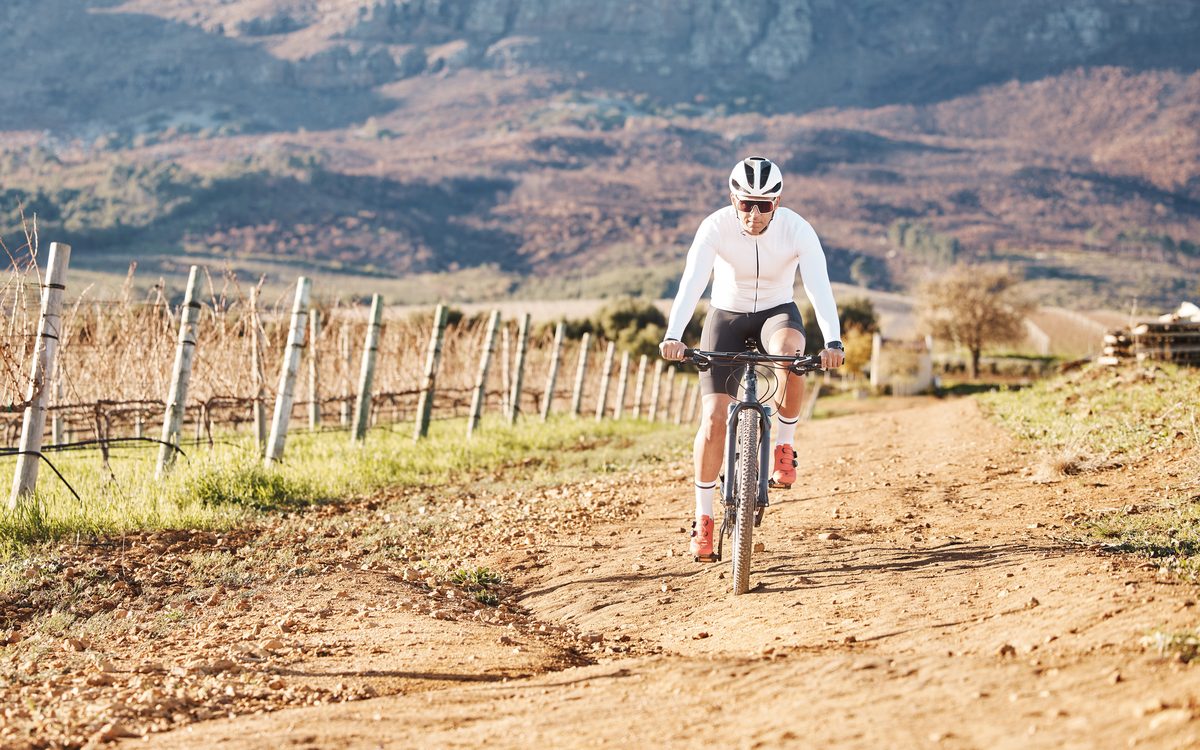
Hour seven of a gravel race, alone on a headwind stretch with nobody in sight. The legs are fine, the head is the problem: every mile marker says there is a long way to go. Gravel cycling mental training is the set of skills riders use to stay confident, focused and motivated through long, solitary, unpredictable efforts: goal setting, pacing, self-talk, imagery, routines and responding to setbacks. It is separate from mental health care, which this page also points to.
Quick answer: Long gravel events test patience and pacing as much as fitness. Skills with research support in endurance sport include sensible goals, self-talk and a pacing plan, though no technique guarantees performance. If anxiety, low mood, disordered eating or burnout are affecting you, those are health matters: talk to a qualified professional, and in the US call or text 988 in a crisis.
General information, not medical advice. Part of the gravel cycling hub; see also the cycling hub for race-day logistics. The physical side is on our training page.
Confidence and goal setting
Confidence on gravel grows from preparation: long rides done, a bike you trust and a plan you have rehearsed. A simple goal ladder, general coaching practice rather than a sourced method, uses three goals: an “A” goal if everything goes well, a “B” goal for an average day and a “C” goal for a bad day, such as finishing safely. Process goals, such as eating every 30 minutes, are in your control; a finishing time is not, since weather and wind decide a lot. A 2026 review in Sports Medicine (Swann and colleagues) covers goal-setting research in sport more broadly.
Focus and pacing
Perception of effort and pacing are central to endurance performance. Tucker’s 2009 paper in the British Journal of Sports Medicine argues that athletes regulate pace in advance and during exercise, using expectations of how long the effort will last. In plain terms, knowing the course, checkpoints and cutoffs helps you pace. Mental fatigue is also real: in a 2009 study (Marcora, Staiano and Manning, 16 participants), time to exhaustion in cycling was shorter after a demanding mental task, 640 versus 754 seconds. Looking after your sleep and mental load before an event helps.
Self-talk and motivation
A 2011 meta-analysis (Hatzigeorgiadis and colleagues, 32 studies) found self-talk was effective for fine and novel tasks. In cycling, a 2014 study (Blanchfield and colleagues, 24 participants) found time to exhaustion was longer, 750 versus 637 seconds, with motivational self-talk. A 2015 study of a 10-kilometre cycling time trial (Barwood and colleagues, 14 men) found the content and tone of the self-talk mattered: one motivational group improved from 1120 to 1078 seconds, while a neutral group did not. Small studies, short efforts, not gravel races, so treat them as signals. Try short phrases such as “smooth” or “next 10 minutes”.
Imagery and routines
Imagery means rehearsing the ride in your head: the start, a hard climb, a flat tire handled calmly. A 2026 Frontiers in Psychology study (Zhao, Wang and Anuar) is among recent research on imagery, though we are not citing a gravel finding. A pre-ride routine, general practice, can include checking the bike, laying out food, a short warm-up and a few minutes of calm breathing. Keeping the routine the same on training and event days reduces surprises.
Handling pressure, setbacks and solitude
- Break the ride into sections. Think checkpoint to checkpoint, not 100 miles at once. General practice.
- Have a plan for problems. A flat, a missed turn or a bad patch is part of gravel. Knowing your repair routine and your next decision point keeps small problems small.
- Bad patches pass. Many riders say low moods during long events lift with food and fluid. That is common experience, not a sourced finding; check fuel first.
- Falls and nerves. After a crash, many riders feel nervous on descents. A gradual return, with easy pace and familiar roads, is sensible; ask a clinician before you ride if you hit your head.
- Tactics and teamwork. Group decisions, such as when to work together, matter in fast events. We found no gravel-specific study on tactics, so treat what coaches say as experience, not evidence.
Competition preparation
Study the route and cutoffs, plan food and water stops, and practice your fueling on long training rides. Pack your spares and kit the day before. Logistics for events are on the cycling hub, and our rules and getting started page explains how events differ.
Mental health is different from mental performance
Mental skills are about performing. Anxiety, depression, disordered eating, burnout and thoughts of self-harm are health matters, and they are not fixed by a mindset trick. The 2019 IOC consensus statement on mental health in elite athletes (Reardon and colleagues) is a starting point for how sport recognizes these issues. Talk to a doctor, therapist or other qualified mental health professional. In the US, call or text 988 (the 988 Suicide and Crisis Lifeline) if you are in crisis. The Association for Applied Sport Psychology lists resources for finding a sport psychology professional.
Gravel mental training FAQs
How do I stay motivated on a very long gravel ride?
Many riders break the ride into sections, eat on a schedule and use short self-talk phrases. Studies of self-talk in cycling are small and short-term, so treat these as options, not guarantees.
Does self-talk really help?
A 2011 meta-analysis of 32 studies found it effective for fine and novel tasks, and small cycling studies found longer time to exhaustion with motivational self-talk. Results vary.
How should I handle nerves before an event?
A routine, a rehearsed plan and calm breathing are common practice. If nerves are overwhelming or constant, talk to a professional.
What if I crash and feel scared to ride?
Fear after a crash is common. We found no cycling-specific study on it; a gradual return, with a clinician’s okay after a head injury, is sensible.
Where do I get help for mental health?
See a doctor or qualified mental health professional. In the US, call or text 988 in a crisis.
Sources
- Tucker 2009, the anticipatory regulation of performance
- Marcora, Staiano and Manning 2009, mental fatigue and endurance
- Hatzigeorgiadis et al. 2011, self-talk and sports performance
- Blanchfield et al. 2014, self-talk and endurance performance in cycling
- Barwood et al. 2015, motivational self-talk in a 10-km cycling time trial
- Swann et al. 2026, goal setting in sport (Sports Medicine)
- Zhao, Wang and Anuar 2026, Frontiers in Psychology
- Reardon et al. 2019, IOC consensus statement on mental health in elite athletes
- 988 Suicide and Crisis Lifeline
- Association for Applied Sport Psychology: resources
General information for education only, not medical advice. It does not replace a sports medicine doctor, physical therapist, athletic trainer or registered dietitian. See our editorial policy for how we write and update pages.