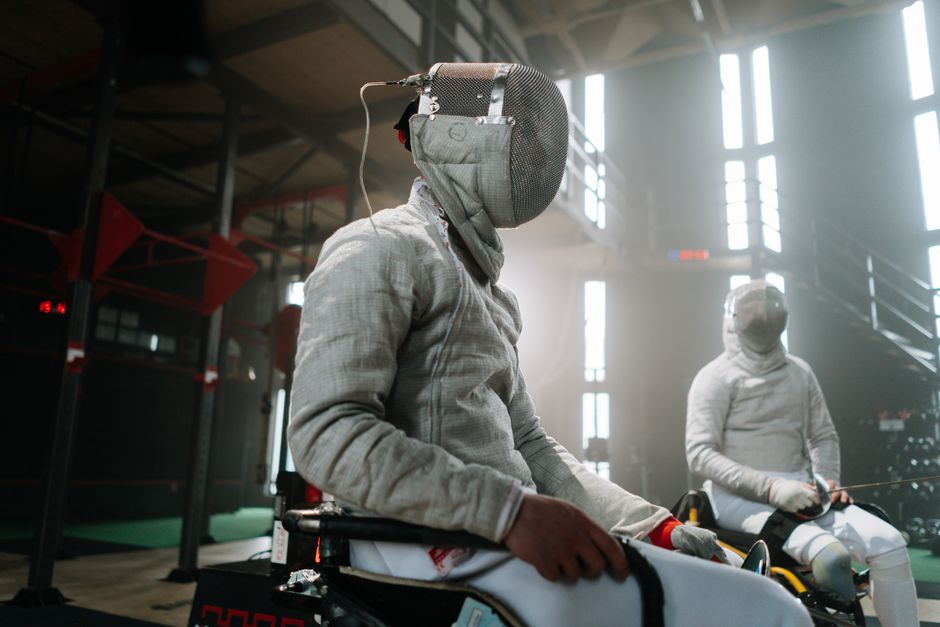
The score is 14-14 in a direct-elimination bout. Your opponent has just parried your fourth lunge in a row, the referee calls “En garde,” and the whole room seems to have gone quiet. One touch decides who goes home. Nothing about your footwork has changed in the last thirty seconds, but what you decide to do in the next three is a skill, and it can be practiced. Mental training for fencers is the deliberate use of routines, attention, goals, imagery and reset habits so you can make clear tactical choices when the bout is fast and the stakes feel high.
Quick answer: Research on fencers points to a few useful habits: keep your attention on the opponent’s distance and timing, use a short routine between touches, practice decisions while tired, and plan how you will reset after a lost touch or bout. None of these guarantees a result. See a doctor or a licensed mental health professional, not only a coach, if worry, low mood, disordered eating or exhaustion are affecting daily life.
General information for fencers of every weapon and level. Back to the fencing hub. The physical side, including how to practice while tired, is on our fencing training page, and food, heat and logistics are on the tournament day page. This page goes deeper on the thinking side and avoids repeating those.
Why the mind matters in a sport decided touch by touch
Fencing asks for a fresh decision every few seconds against someone actively trying to trick you. A 2025 study of national-level Chinese fencers found mental fatigue was rated higher in direct elimination than in pools, and linked it to timing decisions and attacking actions. A day of 5-touch pool bouts followed by a 15-touch DE (see fencing rules for formats) is a long stretch of concentration, so it makes sense to treat your attention as something to protect and train. A 2015 laboratory study also found experienced fencers were better than non-fencers at holding back a prepared response when a signal told them not to act. That is one lab task, not a bout, but it matches what coaches ask for: do not fire the attack just because you started to think about it.
Focus: what elite fencers actually pay attention to
In 2024, French researchers interviewed 22 épée fencers from a national team after two simulated tournaments, replaying video of their bouts. The fencers’ attention fell into three groups: cues from the opponent, strategies and tactics, and extraneous thoughts. Touches where fencers focused on environmental cues, especially distance and timing, were associated with more touches won and fewer lost, and focusing on internal sensations did not hurt in this group (Bracco and colleagues, Psychology of Sport and Exercise). The authors suggest building routines before and after each touch that pair a practical response with a useful focus. This was a small sample of one weapon, so treat it as a direction, not a rule. Ways coaches use it:
- Pick one thing to watch per touch, for example the distance you and your opponent keep, or the rhythm of their steps, instead of the scoreboard.
- Name the extraneous thoughts (the score, the referee, the crowd, your parent on the barrier) and send them away with a breath and a look at the blade.
- Practice in the same mask and uniform so the feel of the day is familiar.
Tactical decisions under time pressure
Bouts leave little time to think. Most of the work happens before the touch. Fencers often rehearse a small set of plans for each opponent: a first action to test the distance, a second if they respond one way, and a third if they respond another. Fewer options chosen in advance are easier to access when your heart is pounding. Ways to build this:
- Footwork and lesson games. Ask your coach for drills where you choose between two or three actions in response to a cue, so decisions become habit.
- Tired decisions. Because mental fatigue showed up more in DEs, practice bouting at the end of a session, not only at the start (see training).
- Video review. Watching your own bouts and asking “what did I see just before I chose that?” is a common coaching method. We have not cited a study showing how much it improves results.
Reading opponents
Fencing is one of the sports where how you look at an opponent has been studied. In a 2020 eye-tracking study of 12 top-level right-handed female foil fencers, who included Olympians and junior world team champions, the fencers fixated on the armed hand and the guard more when facing a left-hander than a right-hander, and looked more at the upper torso against right-handers (Witkowski and colleagues, BioMed Research International). The authors say this may point to different perceptual strategies against left-handers and could support perceptual training in foil. It is a small study in one weapon and one sex, so it does not tell you where to look. A practical takeaway many coaches draw is to expect a left-handed opponent to feel different and to give yourself a few touches, or a lesson beforehand, to adjust. Between bouts, many coaches suggest watching your next opponent’s bouts and noting distance habits and what they do when behind; that is coaching practice, not a tested method.
Confidence, motivation and goals
Confidence is steadier when it rests on proof: bouts you finished, drills you hit, actions that worked in practice. Many fencers keep a short log with a line per bout, and reread it before a tournament. That is common practice, not a tested method. For goals, an expert statement for Exercise and Sports Science Australia (Swann and colleagues, Sports Medicine 2026) is a good place to read about setting goals well. A practical ladder is a process goal you control (“run my routine before every touch”), a performance goal (“win the first touch of each period”) and an outcome goal (“make the table of 16”). Hold the outcome goal loosely: it depends on pool draws and opponents. For young fencers, a 2025 paper in the British Journal of Sports Medicine (Goddard and colleagues) asks whether goal setting in youth sport can unintentionally contribute to dropout, which is one reason to keep goals flexible and focused on effort and learning.
Imagery and visualization
Imagery means rehearsing in your mind: stepping onto the strip, the salute, the distance, a first action, and how you will respond when the score is close. A 2026 scoping review (Zhao, Wang and Anuar, Frontiers in Psychology) mapped how athletes use mental imagery to manage stress, which shows researchers take it seriously, but we have not found a fencing-specific study to cite for how much it helps. Imagery does not replace practice.
A routine between touches
Routines give a nervous mind a job. Based on the 2024 interview study’s suggestion to build routines around each touch, a workable shape is:
- After the touch: one honest word (late, short, good), a slow exhale, and let it go.
- Walking back: pick your focus for the next touch (distance, rhythm or a specific action).
- On guard: settle your stance and look at the opponent, not the scoreboard.
A review of slow breathing (Zaccaro and colleagues, Frontiers in Human Neuroscience 2018) linked breathing under about ten breaths a minute with higher heart rate variability and feeling calmer and more alert. That supports a slow breath as part of a routine; it does not prove it improves results.
Composure at 14-14
We found no study that looks at 14-14 specifically, so what follows is general coaching practice built on the research above. A DE of 15 touches is long enough that the last touch feels no different from the first in the rules (it is worth one touch), even though it feels enormous. Many coaches suggest:
- Run the same routine, not a new one. The last touch is not the time to invent an action you have never tried.
- Choose your focus first, such as the distance, and a plan you trust, rather than fighting the fear of losing.
- Expect your heart to race. In a 2024 simulated épée competition, fencers’ heart rates averaged about 87% of age-predicted maximum in pools and about 91% in the first DE (Oates, Price and Bottoms, Temperature). Feeling revved up is normal and is not proof the bout is going badly.
- Practice it. Start club bouts at 14-14, or play a single sudden-death touch for something small, so the feeling is familiar.
- Use the one-minute break between periods for one tactical point with your coach, as covered on the tournament day page.
After a lost touch or a lost bout
Because the 2024 study found coping was mostly task-oriented, a reset after a lost touch can be as small as a breath, a cue word and back to the routine. After a lost bout, there is often another one soon, so keep the review short on the day: one thing that worked, one thing to fix, then eat, drink and re-warm. Save the full video and score analysis for after the tournament, when you are calm. Pool bouts to 5 touches finish quickly, and in a pool a bad bout does not end your day, but a DE loss does, so allow yourself time to be disappointed and then separate the result from your worth as a fencer.
Tournament-day mental routine
Mentally, preparation is mostly removing surprises. Logistics such as equipment check, food, hydration and heat are on the fencing tournament day page; here is the thinking layer:
- The night before: pack, test your weapons, picture the first bout, and keep bedtime as normal as you can.
- Between pool bouts: note the result, reset, and watch upcoming opponents.
- After pools, before DEs: accept your seed, ask what the table looks like, and agree one or two tactical goals with your coach.
- Before each DE: re-warm, run your imagery or breathing, and salute with your routine.
The order of these steps is a common pattern among coaches rather than a researched protocol. See fencing recovery for the evening after.
Mental performance is not mental health
Routines, imagery and focus cues are performance skills. Anxiety that will not settle, low mood, loss of interest, disordered eating, constant exhaustion or burnout are health matters, not weaknesses of technique. The International Olympic Committee consensus statement on mental health in elite athletes (Reardon and colleagues, British Journal of Sports Medicine 2019) treats them as health concerns that need appropriate assessment and care. If these are affecting your sleep, school, work or relationships, talk to a doctor or a licensed mental health professional. In the United States, you can call or text 988 (the 988 Suicide and Crisis Lifeline) at any time if you or someone you know is in distress. The Association for Applied Sport Psychology lists resources on finding a sport psychology professional. Outside the US, contact your national emergency or crisis service.
Fencing mental training: FAQs
How do I stay calm at 14-14?
Run the routine you already trust, choose one thing to watch (distance or timing), and expect your heart to race. We found no study of 14-14, so practice it in club bouts. In a simulated épée competition, fencers’ heart rates reached about 91% of age-predicted maximum in the first DE, so a racing pulse is normal.
What should I focus on during a bout?
In a 2024 study of 22 national-team épée fencers, focusing on distance and timing cues from the opponent was associated with more touches won and fewer lost. It is a small study, so ask your coach what to watch for your weapon.
How do I recover after losing a bout?
Take a few minutes, then name one thing that worked and one to fix. If you have more bouts that day, eat, drink and re-warm and keep the full analysis for later.
Does visualization help fencers?
Many athletes use imagery and researchers study it for stress management, but we have not found a fencing study that shows how much it helps. Use it as one tool next to real practice.
When are nerves a health problem?
Pre-bout nerves are common. If worry, low mood, avoiding tournaments or disordered eating are frequent or interfere with daily life, speak to a doctor or licensed mental health professional. In the US, 988 is available by call or text.
Sources
- Mental fatigue in national-level fencers, pools versus direct elimination. 2025 (PMID 40297602)
- Bracco M et al. Behind the mask: attentional focus and coping strategies of elite level fencers. Psychol Sport Exerc 2024 (doi, PMID 39557375)
- Witkowski M et al. Fighting left handers promotes different visual perceptual strategies than right handers: eye movements of foil fencers. BioMed Res Int 2020 (doi, PMID 32420345)
- Zhang D et al. Enhanced response inhibition in experienced fencers. Sci Rep 2015 (doi, PMID 26541899)
- Oates, Price and Bottoms. Thermoregulatory demands of epee fencing during competition. Temperature 2024 (PMID 39583904)
- Zaccaro A et al. How breath-control can change your life: slow breathing review. Front Hum Neurosci 2018 (PMID 30245619)
- Swann C et al. Goal setting: an expert statement for Exercise and Sports Science Australia. Sports Med 2026 (doi)
- Goddard SG et al. Goal setting in youth sport and dropout. Br J Sports Med 2025 (doi)
- Zhao L, Wang Y, Anuar N. Mental imagery for stress management in athletes: a scoping review. Front Psychol 2026 (doi)
- Reardon CL et al. Mental health in elite athletes: IOC consensus statement. Br J Sports Med 2019 (doi, PMID 31097450)
- 988 Suicide and Crisis Lifeline (988lifeline.org)
- Association for Applied Sport Psychology resources (appliedsportpsych.org)
General information for education only, not medical advice. It does not replace a doctor, licensed mental health professional or qualified coach. See our editorial policy for how we research and write.