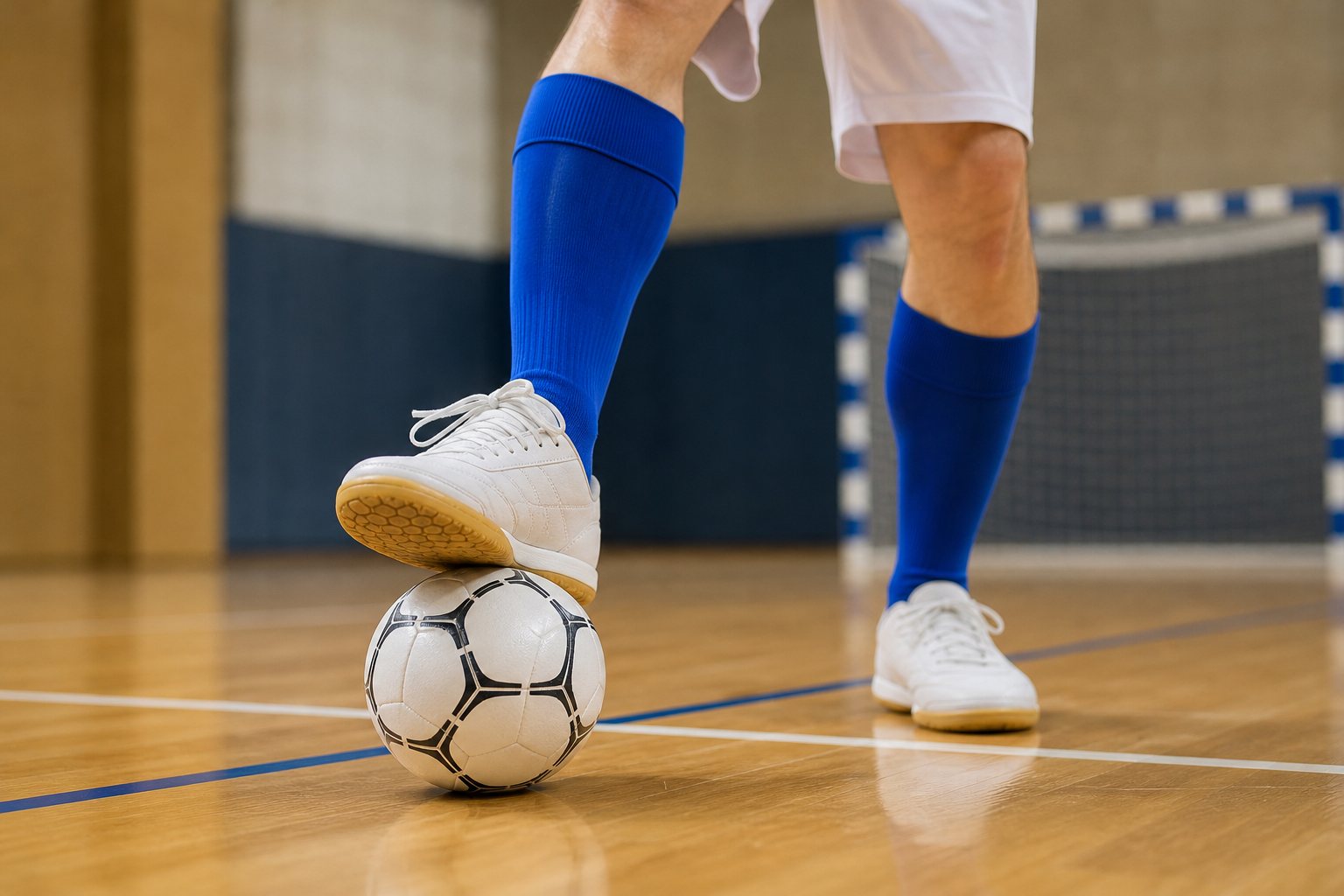
Second period, a quick turn off the left foot, and a player’s ankle rolls on the hard floor. Nothing is broken, but she sits out, and the next week she plays a little less sure of her footing. Futsal injury prevention is the set of habits around a player, a proper warm-up, strength and landing work, a sensible load, shoes and gear that fit, that aim to lower the chance of getting hurt. They lower the odds; they cannot promise anything. What each injury looks like is on our futsal injuries page, so we do not repeat it here.
Quick answer: The best-supported habits are a structured warm-up such as FIFA 11+, strength and landing practice, gradual load and rest days. Futsal-specific proof is thin: a 2026 review found only two studies measuring injuries and rated the certainty very low. Most of the strongest evidence comes from outdoor soccer. See a sports medicine doctor, physical therapist or athletic trainer for pain that stays in one spot, and call emergency services for head-injury danger signs.
Warm up with a plan
FIFA 11+ is a free warm-up built by FIFA’s medical research centre: three parts, 15 exercises, about 20 minutes, meant to be done at least twice a week. In soccer it has good support: a 2008 trial of 1,892 Norwegian female players aged 13 to 17 (Soligard and colleagues, BMJ) found lower injury risk (overall relative risk 0.68), and a 2017 review (Thorborg and colleagues, British Journal of Sports Medicine) reported about 39% fewer injuries; a 2018 review found 48% fewer with the child version, 11+ Kids (Rossler and colleagues).
In futsal the picture is thinner. A 2026 systematic review in Healthcare (12 studies, 405 players) found only two studies that measured injuries directly: one reported lower injury rates after FIFA 11+, the other a non-significant difference. The reviewers rated the certainty of the injury evidence as very low. So treat a warm-up as a sensible habit, not a shield. Do it before every session, even short ones, and build up from walking and jogging to sprints and sharp cuts.
Cutting, landing and technique
The American Academy of Orthopaedic Surgeons (AAOS) describes pivoting, cutting and jumping with a straight leg as common ways ACL tears happen. Futsal is full of those movements. Coaches typically teach soft, bent-knee landings, knees tracking over the toes, and slowing down before a sharp turn. These points are common coaching practice; we did not find a futsal study testing them. A 2018 meta-analysis (Webster and Hewett, Journal of Orthopaedic Research) found that ACL prevention programs, which combine strength, balance and landing training, about halve ACL injuries overall in sport. That analysis was not futsal-specific.
Strength and conditioning
Strong hamstrings, hips and calves protect the joints that futsal stresses. Nordic hamstring programs were linked to up to 51% fewer hamstring injuries in a 2019 meta-analysis of 8,459 athletes (van Dyk and colleagues), and a 2019 trial (Haroy and colleagues) linked the Copenhagen adduction exercise to 41% lower risk of groin problems. Both are soccer evidence. The 2026 Spanish under-19 futsal study (see our injuries page) ended by calling for strength, neuromuscular control and load management. Add exercises slowly; unfamiliar strength work can itself leave you sore.
Load and rest
The IOC consensus statement on load and injury (Soligard and colleagues, 2016) names poor load management, including rapid changes in training and competition load, as a major injury risk factor. A 2010 Champions League study (Dupont and colleagues) recorded 25.6 injuries per 1,000 hours for players with two matches a week against 4.1 with one. Futsal players who stack league nights on school or outdoor games should watch their total week. Our training page shows a sample weekly shape, and the American Academy of Pediatrics (AAP) suggests at least one to two days off a week for young athletes.
Floors, shoes and the court
Futsal is played on hard floors, and the Spanish under-19 study found injuries were mostly in the lower limbs (80.1%), with ankle 23.4% and knee 20.7%. We did not find a study that compares floor types for futsal injury, so we make no claim about a best surface. What is practical: wear shoes made for indoor courts, keep the playing area clear of bags and bottles, and ask the facility about wet or slippery spots. See our futsal gear page for shoe labels.
Protective gear and fit
- Shin guards are compulsory under the FIFA Futsal Laws: suitable material, appropriate size, covered by socks. That is the verified standard. For soccer in US colleges and high schools, rule guides call for guards meeting the NOCSAE standard; whether your youth league does, we did not check.
- Ankle braces or tape. The National Athletic Trainers’ Association (NATA) ankle-sprain position statement recommends that athletes with a previous sprain tape or brace for practices and games, and says previous sprain is the most consistent risk factor. Ask an athletic trainer or physical therapist which support fits you.
- Head protection. A 2026 study found futsal had 122.3 potential head injuries per 1,000 match-hours against 76.4 in football, mostly from contact with opponents. We found no protective headgear recommendation, so the authors’ suggestion of drills in safe blocking is the practical takeaway.
What prevention cannot do
No warm-up, brace or strength program guarantees an injury-free season, and the futsal-specific evidence is weak. Match injury rates in the Spanish study were far higher than training rates, because matches bring contact, speed and fatigue that practice rarely matches. Prevention is about stacking small advantages.
When to see a professional
See a sports medicine doctor, physical therapist or athletic trainer if pain stays in one spot, appears at rest or at night, makes you limp, or changes how you move. For an ankle, AAOS says to have it checked if you cannot put weight on it or swelling is marked. After a head blow, the CDC HEADS UP program says to remove the player from the game that day and let a health care provider decide on return; call 911 for danger signs such as repeated vomiting, a seizure or a worsening headache.
Futsal injury prevention FAQs
Does FIFA 11+ work for futsal players?
It has strong support in soccer. For futsal, a 2026 review found two injury studies, one positive and one not significant, with very low certainty. It is a sensible warm-up either way.
Should I wear an ankle brace for futsal?
NATA recommends taping or bracing for athletes with a previous ankle sprain. If you have never sprained an ankle, ask a professional whether one makes sense; a brace is not a treatment.
How long should a futsal warm-up take?
FIFA 11+ takes about 20 minutes. Even a shorter one should build gradually from jogging to fast cuts and finish with ball work.
Are shin guards really needed in futsal?
Yes. Shin guards are compulsory under the Laws and must be covered by socks. Choose a size that stays in place.
Can strength training prevent futsal injuries?
Not proven in futsal. In soccer, Nordic hamstring and Copenhagen groin programs were linked to fewer injuries. Start slowly with a coach or physical therapist.
Sources
- FIFA Futsal Laws of the Game 2025/26
- Epidemiology of injuries in male under-19 futsal players in Spain, 2026 (PMID 42421836)
- Potential head injuries in football, futsal and beach soccer, 2026 (PMID 41144707)
- Exercise-based programmes and injury incidence in futsal players, systematic review 2026 (PMID 42651353)
- FIFA Medical Network: injury prevention (FIFA 11+)
- Soligard et al. 2008, BMJ (PMID 19066253)
- Thorborg et al. 2017, BJSM (PMID 28087568)
- Rossler et al. 2018, Sports Med (PMID 29273936)
- Webster and Hewett 2018 (PMID 29737024)
- van Dyk et al. 2019 (PMID 30808663)
- Haroy et al. 2019 (PMID 29891614)
- Soligard et al. 2016: IOC consensus on load (PMID 27535989)
- Dupont et al. 2010 (PMID 20400751)
- NATA position statement: ankle sprains, Kaminski 2013 (PMID 23855363)
- AAOS OrthoInfo: ACL Injuries
- AAOS OrthoInfo: Sprained Ankle
- CDC HEADS UP: Signs and Symptoms of Concussion
- NOCSAE soccer standards
- NFHS 2024-25 Soccer Guide
General information for education only, not medical advice. It does not replace a sports medicine doctor, physical therapist, athletic trainer or dietitian who knows you. See how we write and check our pages in our editorial policy. Back to the futsal hub.