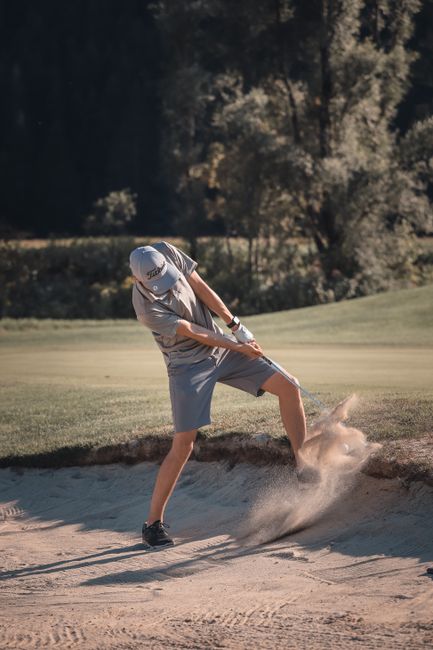
You’re one over standing on the 14th tee, a pond runs down the whole left side, and the last hole is still replaying in your head: a three-putt you’d like back. Golf is the sport that gives you the most time to think. Nobody tackles you, the ball doesn’t move until you move it, and in between swings you walk, wait and talk to yourself. That is why golf mental training matters to juniors, college players, tour pros and weekend foursomes alike. It means practicing the skills between your ears (a pre-shot routine, a plan for each hole, a way to put a bad hole behind you, a calm stroke over a putt that matters) the same way you practice a bunker shot.
Quick answer: Build one short routine you can repeat before every shot, decide your plan for a hole before you swing, and agree with yourself in advance how you’ll reset after a bad one. Studies of mental tools in golfers are encouraging but mostly small, and none can promise a lower score. If worry, low mood, trouble sleeping or eating, or loss of enjoyment lasts more than a couple of weeks, talk to a doctor or licensed mental health professional.
What researchers say matters in golf
A 2009 review in Sports Medicine looked at what is known about skilled golfers (professionals and amateurs with handicaps of 4 or better). It found that task focus, confidence, imagery, patience, the ability to focus on one shot at a time and performing automatically were important during competition, but it also said these areas needed more research. The same review found that the effect of mood on golf scores seems to be individual, so there is no single “right” mindset to copy.
For the bigger picture, a 2026 systematic review and meta-analysis in BMC Sports Science, Medicine and Rehabilitation pooled 15 studies with 606 golfers. Psychological interventions were associated with a small reduction in competitive anxiety and an improvement in performance, but results varied a lot from study to study, and the effects looked stronger in some groups (male and amateur golfers, sessions two to three times a week of up to 30 minutes) in exploratory analyses only. Treat that as a reason to try these tools, not a promise.
Pre-shot routines
A pre-shot routine is the same sequence of steps you take before every full swing, chip or putt. Exercise and Sports Science Australia (ESSA), in a 2026 position statement on performance under pressure, lists pre-performance routines first among the strategies with evidence behind them. The golf evidence is more cautious. The 2009 review found that a pre-shot routine is associated with performance, but said it is not clear whether keeping the same length and steps actually causes better results, since a routine may also reflect a different focus of attention. And in a small 2020 study of 15 amateur golfers, a six-week pre-shot routine program (alone or combined with a warm-up program) did not produce a statistically significant change in driving distance, clubhead speed or accuracy.
So think of a routine as a tool for steadiness, not a magic trick. Many coaches suggest something like the steps below (this is common coaching practice, not a finding from the studies above):
- Decide behind the ball: read the lie, pick the target and the shot, and commit before you step in.
- Rehearse once: one practice swing or one practice stroke, with a clear picture of the shot.
- Step in, breathe, go: a single easy breath, a glance at the target, then swing without a second round of thinking.
- Practice it everywhere: on the range and on the practice green, not only on the first tee.
Keep it short. The Rules of Golf (Rule 5.6b) recommend making a stroke in no more than 40 seconds once you are able to play without interference or distraction, and say you should usually be able to play faster. A routine that fits inside that window keeps your group moving. Our golf rules page covers pace of play in more detail.
Course management: deciding before you swing
Course management is simply choosing the shot and the target that fit your game on that day. One 2026 study in Frontiers in Psychology put numbers on one kind of choice. Eighty-one male university golfers (average handicap about 26) played three dogleg holes and declared before each tee shot whether they would take the aggressive line across the corner or the conservative line down the fairway. When the same player chose the aggressive line, his score on that hole was about half a stroke higher on average. The researchers also said the pattern differed from player to player, and that the stable difference between aggressive and conservative players was inconclusive. It was a small study on three holes, so it describes a tendency, not a rule.
Practical takeaways, offered as suggestions and not as study findings: write your plan for the hole on the tee (where a miss is safe, which club gets you there), play to the part of the green with the most room, and ask “what is my worst realistic miss?” before you pick the aggressive line.
Handling a bad hole
Everyone makes a double bogey. The danger is the second one. A 2026 study in Behavioral Sciences held focus groups with 12 athletes who said they had choked, and described patterns such as building a negative personal story about themselves, reacting to cues linked to earlier failures, rigid “I must” rules, and efforts to escape uncomfortable feelings. With 12 athletes and no golf-only sample, it is a lens for noticing your habits, not proof of what works.
Here is a simple reset many players use (common practice, not a tested protocol):
- Give it a short, fixed ending: a breath, a walk to the next tee, a quick word such as “next shot.” Then the hole is over.
- Talk about the next action: in a 2026 study of 40 novices on a putting task, a group that practiced strategic self-talk improved more than a control group. It was a small study with beginners, so test it on yourself before relying on it.
- Check the basics: a long round can wear down your focus as well as your legs. A 2025 systematic review found that duration of play and walking distance are linked to mental fatigue in golf. See round day for fuel, water and heat.
- Review later, not on the course: write down one thing that went right and one thing to practice, once you have eaten and cooled down.
Putting under pressure
The ESSA position statement says pressure can help or hurt performance, and that training environments with implicit learning and well-designed pressure training can prepare athletes for it. Golf studies on putting are small and mostly use novices, but they point in a similar direction:
- Pressure costs putts. In a 2026 trial of 32 novice college students, scores were lower in a high-stress condition than a low-stress one. A putting program built on positive feedback, some choice over practice and an external focus (thinking about where the ball goes rather than the body) improved putting in both conditions, but the researchers found no stress-specific protection and no change in anxiety.
- Where you point your attention matters. In a 2026 pilot study of 24 boys aged 10 to 12, internal, external and combined focus cues all improved putting accuracy compared with no cue, and no cue type beat the others. Simple cues helped.
- Make practice a little uncomfortable. Common coaching ideas (not from the studies above) include putting for small stakes with a friend, finishing a drill only after you hole a set number in a row, and rehearsing your full routine on every practice putt.
Some golfers describe a loss of control that goes beyond nerves, such as jerks or freezing in the stroke, often called the yips. A 2025 study of 14 golfers was too small to draw conclusions, and its authors called for more research into causes and treatments. If it happens to you, a golf professional can help with technique, and a sports medicine doctor can help work out whether something else is going on.
Confidence, goals and imagery
We found no golf-specific study strong enough to support particular numbers for goal setting, motivation or visualization, so we stay general here. The 2009 review lists imagery and confidence among the qualities linked to skilled play, and ESSA includes psychological skills training and mindfulness-based approaches among its strategies. Many coaches split goals into three kinds: results (the score), performance (fairways hit, putts inside six feet) and process (the routine on every shot). Process goals are the ones fully in your control, and that is a coaching suggestion, not a research result.
Getting ready for competition
Match and tournament preparation is mostly practical. Learn the pin sheet and local rules, plan your warm-up (see golf training for a 10-minute routine), pack food and water, and have your routine ready for the first tee, where nerves are often highest. For fuel, hydration, heat and lightning, see round day.
Junior golfers
The best golf-specific youth evidence we found is the small 2026 putting study of boys aged 10 to 12 mentioned above, which suggests young players respond to simple focus cues. See our junior golf page for programs, and golf injuries for the physical side of too much practice.
Mental performance is not mental health
Routines, imagery and self-talk are performance skills. Anxiety disorders, depression, disordered eating, burnout and thoughts of self-harm are health matters, and they belong with a doctor, psychologist or other qualified professional, not with a mental-skills app or a better pre-shot routine. A 2026 International Olympic Committee consensus statement addresses mental health in elite athletes, and the same principle applies at every level. Signs to take seriously include low mood or dread that lasts weeks, losing interest in golf or things you used to enjoy, changes in sleep or eating, panic, or using alcohol to cope.
If you are in the United States and in crisis or worried about your safety, call or text 988 to reach the 988 Suicide & Crisis Lifeline, free and open 24 hours a day. Outside the US, contact your local emergency number or crisis service. If you play college golf, ask your athletics department about the support it offers.
Questions golfers ask
How do I stop choking on short putts?
No method removes nerves completely. ESSA lists pre-performance routines, implicit attentional strategies, psychological skills training and mindfulness as strategies with evidence, and says pressure training can help. Practice your routine with something at stake, keep your focus on a target, and accept that some nerves are normal.
Does a pre-shot routine really lower my score?
It is associated with better performance in skilled golfers, according to a 2009 review, but that review said it is not clear that the routine itself causes the improvement. A small 2020 study of amateurs found no significant change after six weeks. A routine is best seen as a habit that keeps you steady.
How do I forget a bad hole?
Give the hole a clear ending, such as a breath and a walk to the next tee, then focus on the next shot’s target. Check that you’ve eaten and had water, since long rounds are linked to mental fatigue. Review the hole after the round, not during it.
Should I play aggressively or conservatively?
It depends on your skills and the hole. In a 2026 study of 81 amateur golfers on three dogleg holes, aggressive tee-shot choices were associated with scoring about half a stroke worse on average, but results varied by player. Decide in advance, play to your strengths and avoid the miss that costs the most.
Should I see a sport psychologist?
It can help if you compete seriously or are stuck on one problem, but it is optional. For distress or illness, start with a doctor or licensed clinician.
Sources
- Rules of Golf, Rule 5.6b (Prompt Pace of Play), R&A and USGA
- Hellström J. Psychological hallmarks of skilled golfers. Sports Medicine, 2009. PMID 19757862
- Schweickle MJ et al. Performance Under Pressure in Sport: A Position Statement from Exercise and Sports Science Australia. Sports Medicine, 2026. PMID 42271117
- Li L et al. Effects of psychological interventions on competitive anxiety and athletic performance in golfers: a systematic review and meta-analysis. BMC Sports Science, Medicine and Rehabilitation, 2026. PMID 42681654
- Yeemin W, Kemarat S, Theanthong A. Post activation potentiation warm-up and pre-shot routine programs on driving performance in amateur golfers. PLoS One, 2020. PMID 33079942
- Ai G et al. Pre-shot strategy selection and scoring performance in golf. Frontiers in Psychology, 2026. PMID 42440779
- Svoboda ST et al. Skill Breakdown and Symbolic Relating: A Functional Contextual Exploration of Choking in Sport. Behavioral Sciences, 2026. PMID 42510173
- Tzormpatzakis E et al. Strategic Self-Talk Through Heart-Rate Variability in a Golf-Putting Task Among Novices. Behavioral Sciences, 2026. PMID 42651524
- Pan et al. Mental fatigue in golf: a systematic review. PLoS One, 2025. PMID 39977446
- Chang CY et al. Effects of OPTIMAL-based training on golf putting performance under stressful conditions. Human Movement Science, 2026. PMID 42933155
- Wang K et al. Internal vs. external vs. holistic attentional focus in golf putting performance among children. Frontiers in Psychology, 2026. PMID 42199276
- Afrassiabian KC et al. The yips: an investigation of the causes and treatments in the context of golf. Frontiers in Sports and Active Living, 2025. PMID 40313784
- Reardon CL et al. Mental health in elite athletes: International Olympic Committee consensus statement (2026). British Journal of Sports Medicine. PMID 42580854
- 988 Suicide & Crisis Lifeline
General information for education only, not medical advice. It does not replace a doctor, psychologist or other qualified professional. See how we work in our editorial policy. Back to the golf hub.