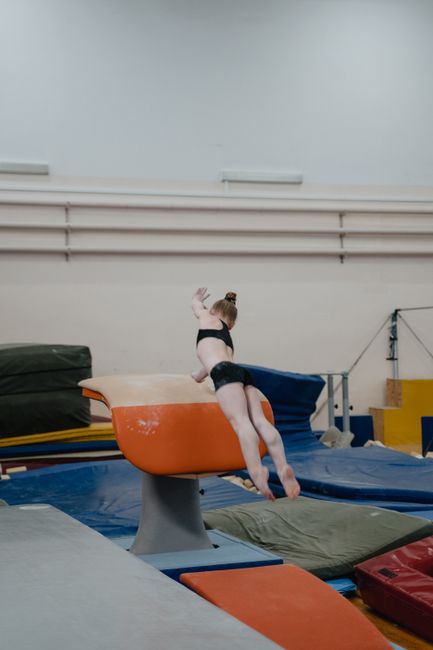
The gymnast stands at the end of the beam, chalk on her hands, and something is off. The skill she has done a thousand times in training suddenly feels like a stranger’s. She has to decide, in about two seconds, whether to go. Every gymnast, from a Level 4 on her first vault to an Olympian, knows a version of that moment. Mental training for gymnasts means practising attention, routines, self-talk and honest planning so you can meet that moment with more control. It is separate from mental health care, and it cannot promise a score.
Quick answer: The mental skills with the most gymnastics-specific support are a repeatable pre-routine, imagery and building confidence one apparatus at a time, though the research is mixed and no skill guarantees a result. A sudden fear of a skill, or “the twisties,” is a safety issue: stop doing the skill alone and tell your coach. See a doctor or licensed mental health professional if fear, low mood, restricting food or exhaustion are affecting daily life, and report any coach behavior that frightens or humiliates you to a trusted adult.
General information for gymnasts, parents and coaches. Back to the gymnastics hub. Meet-day food, warm-up and bag logistics are on our meet day page, and the physical side is on the training page and injuries page.
Confidence, one apparatus at a time
A 2026 systematic review in Sports (Basel) looked at self-efficacy, the belief that you can do a specific task, in artistic gymnastics. Across nine studies it found a possible positive but inconsistent link with performance, and rated the certainty as low. In plain words: believing “I can do this beam routine” probably helps a bit, but it is not a switch. Confidence is easiest to hold when you can point to proof, such as the clean routines in practice this month. Many coaches keep a simple log of completed routines for this reason; that is common practice, not a tested method.
It also pays to think apparatus by apparatus. A gymnast can feel strong on floor and shaky on bars, and a 2026 study of 17 young artistic gymnasts found concentration was linked to floor-exercise performance. That was a small study with a correlation, not proof that training attention fixes anything.
Fear of skills and the twisties
Some fear is normal and even protective. Gymnasts throw skills with no second chance in mid-air. But sometimes fear stops being a feeling and becomes a block. The best-known version is the twisties, which the Cleveland Clinic, as quoted by TIME, describes as a mental block that creates a dangerous disconnect between mind and body while a gymnast is airborne. The gymnast loses the sense of where she is in the air. After Simone Biles withdrew from events at the Tokyo Games in 2021, the term reached a wide audience. Gymnasts told TIME that it can last from one turn to weeks or months.
We found no peer-reviewed study of the twisties in gymnasts, so what follows is what sport psychologists quoted in press coverage describe, not tested treatment:
- Safety first. A gymnast who has lost air sense can be badly hurt. TIME reports that foam pits can lower the fear while practising. Do not push through a block on a hard surface.
- Allow a break. Jamie Shapiro, a University of Denver sport psychologist quoted by TIME, compares the brain’s need to reset with a physical injury.
- Rebuild in small steps. Return to simple parts of the skill and to skills the gymnast trusts, then add pieces back.
- Take pressure off. The same article suggests parents and coaches let the gymnast decide when she is ready.
- Ask for help. A licensed mental health professional or sport psychologist can work on breathing, imagery and routines, and can check whether something larger is behind the fear.
A block can also follow an injury or a bad fall. If a head impact was involved, follow the CDC HEADS UP rule, “when in doubt, sit them out,” and read our gymnastics injuries page. Fear that keeps coming back, or that spreads to everyday life, belongs with a professional.
Routines and imagery under pressure
Gymnastics is a closed-skill sport: you start when you are ready, on an apparatus that does not move, with the judges and the crowd watching. A 2026 meta-analysis of 21 studies on choking under pressure (Zeng et al., Psychology of Sport and Exercise) found that tools like pre-performance routines, quiet eye, mindfulness and self-talk reduced the drop in performance under pressure, with larger and more consistent effects in closed-skill sports. It is not gymnastics-only, and it does not mean any one tool works for every gymnast.
- Build the same routine in practice and at the meet. Chalk, a breath, a look at the apparatus, one cue word, salute, go. If it is only used at meets it will not feel automatic.
- Use imagery. A 2026 systematic review in Frontiers in Psychology (Yang) covered 16 studies of imagery in gymnasts across disciplines. Several controlled studies reported better judged performance; others found no performance benefit even though confidence improved. The review rated the study quality as weak overall, so treat imagery as a reasonable addition, not a guarantee.
- Reset between events. A fall on beam does not have to follow you to floor. A breath and your normal routine start the next event fresh. This is common coaching advice.
- Plan the waiting. Long sessions mean long gaps. Decide beforehand what you will do between rotations; see the meet day page for fueling and warm-up.
Perfectionism and falls
Gymnastics scoring rewards precision, so perfectionism is common. Research suggests the kind matters. A 2024 study in Psychology of Sport and Exercise (St-Cyr et al.) surveyed American gymnasts and artistic swimmers. It found that perfectionism driven by other people’s expectations was linked to obsessive passion and, through that, to disordered eating, while self-set high standards were also linked to a healthier, “harmonious” passion tied to better well-being. The authors say more study is needed. The plain-language takeaway: high standards you choose for yourself are different from a feeling that you are never allowed to make a mistake.
- Set goals on things you control, like landing position, a steady routine, or fewer rushed approaches, not only on score or placement.
- After a meet, name one thing that went well and one thing to work on. Scores come later.
- Parents: “I loved watching you” is usually safer than a score replay in the car. Let the coach coach.
Coaches and a healthy gym culture
A good coach can be the biggest help in a gymnast’s mental game. A 2023 survey study of artistic gymnasts in Germany (Greither and Ohlert) found that a more disempowering coaching climate predicted more experiences of psychological violence, and that psychological violence was linked with more depressive symptoms and lower well-being. The authors recommend that coach education focus on preventing it. A study of former NCAA female athletes (Kernan et al., 2025) likewise found coach relationships could be a source of support or of stress.
Signs of a healthy culture are easy to describe: skills are progressed when the gymnast is ready, pain and injuries are reported without punishment, food, water and sleep are never used as leverage, and gymnasts can say “I’m scared of this” without being shamed. The USA Gymnastics Safe Sport Policy lists “actions interfering with hydration, nutrition, food or sleep”, conditioning used to induce fear or undue stress, and returning to training prematurely after serious injury without medical clearance as physical misconduct. If you coach, see our youth gymnastics page for age-appropriate expectations.
When it is a health or safeguarding matter
Mental performance skills help with focus and nerves on competition day. They are not treatment for mental health conditions, abuse or eating disorders, and a mental skills coach is not a substitute for a clinician. The 2026 IOC consensus statement on mental health in elite athletes says mental health symptoms and disorders are common in elite athletes, can have sport-related causes, and can affect performance. It also says factors in the training and competition environment should be addressed, and that with appropriate support many athletes can continue to train and compete.
- Abuse and misconduct. A 2025 British Journal of Sports Medicine study interviewed 19 former elite women gymnasts who reported being abused by coaches, and described wide-ranging psychological, behavioral and physical effects. If a coach hits, humiliates, threatens, touches you in ways that feel wrong, or controls food, report it to a parent, a trusted adult or the U.S. Center for SafeSport (uscenterforsafesport.org). It is never your fault.
- Disordered eating. A 2025 study in Nutrients of 84 adolescent female artistic gymnasts found 20.2% scored above the cutoff on an eating disorder questionnaire, 35.9% of high-level versus 6.7% of lower-level gymnasts. A study of eating disorders and perfectionism in rhythmic gymnasts found a similar pattern in international-level athletes. The 2023 IOC consensus on Relative Energy Deficiency in Sport (REDs) describes health effects of too little fuel. See our nutrition page, and talk to a doctor if you notice restricting, fear of weight gain, hiding food or extra workouts. The ANAD helpline is 1-888-375-7767.
- Burnout and depression. Ongoing exhaustion, dread of the gym, low mood or loss of enjoyment are worth a conversation with a doctor or licensed mental health professional, not just more mental training. Rest and recovery also matter; see the recovery page.
- Crisis. In the United States, call or text 988 (Suicide and Crisis Lifeline) any time. Outside the US, use your local emergency number or crisis line.
For performance skills such as routines and imagery, the Association for Applied Sport Psychology lists resources at appliedsportpsych.org.
Gymnastics mental training: FAQs
What are the twisties in gymnastics?
The Cleveland Clinic, quoted by TIME, describes the twisties as a mental block that causes a dangerous disconnect between mind and body while a gymnast is in the air. It can make it hard to know where you are mid-skill. Stop the skill, tell your coach, and ask about a professional; do not try to force it.
How can a gymnast get over fear of a skill?
Sport psychologists quoted by TIME suggest rebuilding in small steps, safer equipment such as foam pits, and removing pressure. A coach and, if needed, a licensed professional can guide it. There is no guaranteed timeline.
Does visualization help gymnasts?
Possibly. A 2026 systematic review of 16 studies found several reporting better judged performance and others finding none, with weak study quality overall. Many gymnasts use it as part of a routine, alongside real practice.
How can I handle meet nerves?
Use a short routine you also practise in the gym, with a breath and a cue word. Research on choking under pressure supports routines and self-talk, especially in closed-skill sports. If anxiety is constant or affects sleep, eating or enjoyment, talk to a doctor or licensed professional.
Is it normal for a coach to yell or control what I eat?
Controlling food, water or sleep is listed as physical misconduct in the USA Gymnastics Safe Sport Policy. If you are worried, tell a parent or trusted adult, and consider reporting to the U.S. Center for SafeSport.
Sources
- TIME, “What Are the Twisties?” (time.com)
- Marzoli et al. 2026, Self-Efficacy and Performance in Artistic Gymnastics, Sports (doi)
- Zeng et al. 2026, choking under pressure meta-analysis (PubMed)
- Yang 2026, Mental imagery and performance in gymnasts (PubMed)
- St-Cyr et al. 2024, perfectionism, disordered eating and well-being in aesthetic sports (PubMed)
- Greither and Ohlert 2023, empowering and disempowering climate in artistic gymnastics (doi)
- Kernan et al. 2025, coach-athlete relationships and mental health (PubMed)
- Barker-Ruchti 2025, interpersonal violence for women’s artistic gymnasts, Br J Sports Med (PubMed)
- Eating disorder symptoms in adolescent artistic gymnasts, Nutrients 2025 (PubMed); Donti et al. 2021, rhythmic gymnasts (PubMed)
- IOC consensus statement on mental health in elite athletes 2026 (PubMed); IOC REDs consensus 2023 (PubMed)
- USA Gymnastics Safe Sport Policy (PDF); U.S. Center for SafeSport (site)
- Concentration and floor performance, Front Sports Act Living 2026 (PubMed); CDC HEADS UP (cdc.gov)
- 988 Suicide and Crisis Lifeline (988lifeline.org); ANAD helpline (anad.org); AASP (appliedsportpsych.org)
General information for education only, not medical advice. It does not replace a doctor, licensed mental health professional or qualified coach. See our editorial policy for how we research and write.