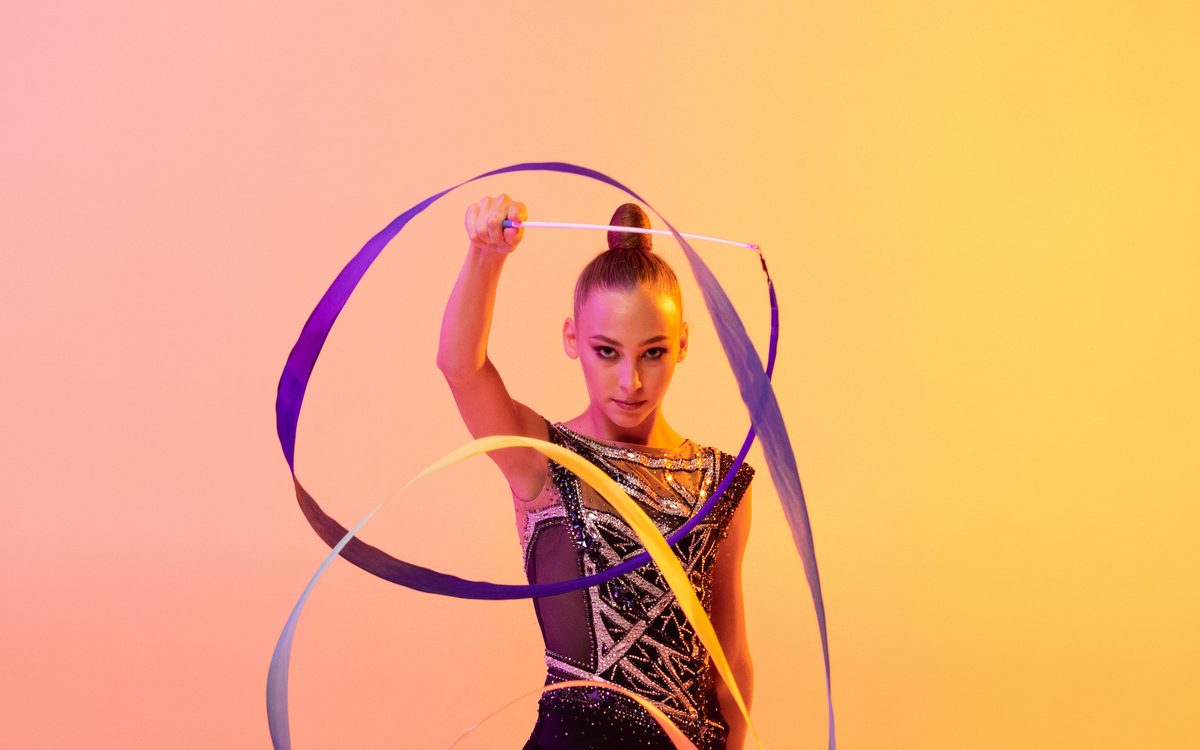
Practice ended at 8 p.m., homework starts at 8:30, and the alarm is set for 6 a.m. tomorrow. By Thursday the 14-year-old in the back seat has stopped talking, her calves are tight and she says she is “fine.” Rhythmic gymnastics recovery is everything that lets the body and mind absorb a heavy training week: sleep, rest days, food, easy movement, mobility work and the plain act of noticing fatigue. This page covers what recovery research says for gymnasts, where the evidence for popular methods is weak, and how to tell ordinary soreness from an injury.
Quick answer: Sleep, rest days and eating enough do the most for recovery, and they are also the best supported. Massage may ease muscle soreness and perceived fatigue, while cool-downs, foam rollers and massage guns have modest or mixed evidence. Soreness that fades in a day or two is expected; pain that is sharp, one-sided, lingering or gets worse during practice should be checked by a sports medicine doctor, physical therapist or athletic trainer.
Sleep comes first
The American Academy of Sleep Medicine pediatric consensus, endorsed by the AAP, recommends 9 to 12 hours of sleep for children aged 6 to 12 and 8 to 10 hours for teens aged 13 to 18; the CDC gives similar guidance. Elite rhythmic gymnasts often fall short. In a Portuguese study of 67 high-performance rhythmic gymnasts (mean age 18.7, 36.6 hours of training a week), 67% reported mild daytime sleepiness and 78% reduced sleep quality just before an international competition. A bedtime at 11 p.m. or later had a 6.62 odds ratio for short sleep, and menstruating gymnasts and those training more than 30 hours a week also had higher odds, though with wide confidence ranges. In a companion analysis of the same group, gymnasts with severe daytime sleepiness scored worse in competition and reported higher pre-competition stress, and those who travelled long distances were at higher risk of short sleep.
Practical steps (general sleep-hygiene advice): a regular bedtime and wake time, screens away before bed, no caffeine or energy drinks late in the day (the AAP says energy drinks have no place in the diets of children and adolescents), and a plan for homework so late practices do not push bedtime later.
Rest days and load management
The 2024 AAP overuse report recommends at least 1 to 2 days off sport-specific training each week and 2 to 3 months off per year in blocks of about a month, and the 2018 recovery and performance consensus statement (Kellmann and colleagues) describes recovery as balancing stress against rest, with monitoring to prevent underrecovery, non-functional overreaching, injury and illness. Signs a gymnast may need more recovery are general: persistent fatigue, falling performance, irritability, trouble sleeping, frequent minor illness and loss of enthusiasm. A Norwegian cohort and others link younger age and previous injury with higher injury risk, so early signs should not be waved away. See our training page for how load is built.
Mobility and flexibility
Because flexibility is part of the sport, recovery for rhythmic gymnasts includes gentle mobility work. But more stretching is not always better. In a study of 95 collegiate rhythmic gymnasts, low back pain was associated not with tight muscles but with side-to-side differences in hip flexion strength and hip external rotation range, and the authors suggested paying attention to those. That fits the practical rule: build strength through the range and do not push into pain. USA Gymnastics’ Safe Sport Policy discourages laying or sitting on top of an athlete when stretching and lists painful stances or positions as physical misconduct.
What the evidence says about recovery methods
| Method | What we found | Honest read |
|---|---|---|
| Massage | A 2018 systematic review of 99 studies (Dupuy and colleagues, Front Physiol) concluded massage was most effective for muscle soreness and perceived fatigue. | Reasonably supported for feeling less sore. Coaches should not massage minor athletes under SafeSport guidance. |
| Active cool-down | A 2018 review (Van Hooren and Peake) found cool-downs largely ineffective for next-day performance, injury and soreness, though they may help cardiovascular recovery. | Optional. Easy movement can still feel good. |
| Foam rolling and percussion guns | A 2026 meta-analysis of percussive therapy (12 randomized trials) found improved countermovement jump recovery but no clear benefit for strength or soreness. | Comfort tools, mixed evidence. |
| Cold-water immersion | A 2016 review (Machado and colleagues) compared cold-water immersion with passive recovery; a 2015 study in adults found that cold-water immersion after strength sessions blunted strength and muscle gains over 12 weeks. | Not for children and teens without medical advice; best saved for tournaments if at all. |
We found no recovery-method trial specific to rhythmic gymnasts. A foam roller or a pair of recovery slides can feel good after practice, but they do not replace sleep and food. See our gear page for equipment, and note that no device treats an injury.
Refuel and rehydrate
The ACSM, Academy of Nutrition and Dietetics and Dietitians of Canada joint position suggests carbohydrate and protein soon after hard sessions (about 0.25 to 0.3 g of protein per kg body weight, or 15 to 25 g, early in recovery) and replacing fluid losses. Young gymnasts should not diet to meet a body ideal, and low energy availability undermines recovery. Our nutrition and athlete health page discusses this carefully, including the 2023 IOC REDs statement. USA Gymnastics’ policy lists actions that interfere with hydration, nutrition, food or sleep as physical misconduct.
Soreness or injury?
- Usually normal soreness: both sides, dull, muscle-belly, builds the day after, fades in one to three days, and eases with warming up.
- Worth a check: sharp or pinpoint pain, pain in one place that returns each practice, pain that wakes her at night, swelling, limping or changing the way she lands.
- Urgent: a head injury with warning signs, numbness or weakness, a joint that looks wrong or cannot bear weight.
This list is general guidance, not a diagnosis. Details on injuries are on our injuries page, and ways to reduce the chance of getting hurt are on injury prevention.
Rhythmic gymnastics recovery FAQs
How much sleep does a young rhythmic gymnast need?
The AASM pediatric consensus endorsed by the AAP recommends 9 to 12 hours for ages 6 to 12 and 8 to 10 hours for ages 13 to 18. Elite gymnasts in one study often had reduced sleep quality.
Is an ice bath good for gymnasts?
Evidence is mixed in adults and not studied well in gymnasts. One 2015 study found cold-water immersion after strength training blunted gains. For kids and teens, ask a doctor first.
Do foam rollers and massage guns work?
They can feel good and may reduce perceived soreness, but evidence for strength or performance benefit is mixed. They are optional extras.
How many rest days does a gymnast need?
The AAP recommends at least 1 to 2 days off sport-specific training per week and 2 to 3 months per year from it, in blocks of about a month, for young athletes.
Should a gymnast stretch every day?
Gentle daily mobility is common practice, but it should never be painful or forced. Strength through the range matters as much as range, so ask a coach or physical therapist.
Sources
- Silva and Paiva, risk factors for precompetitive sleep behavior in elite female athletes, 2018
- Silva and Paiva, sleep, energy disturbances and pre-competitive stress in female traveller athletes, Sleep Sci 2019
- AASM pediatric sleep duration consensus, endorsed by the AAP and CDC sleep
- AAP, overuse injuries, overtraining and burnout in young athletes, Pediatrics 2024
- Kellmann et al., Recovery and Performance in Sport: Consensus Statement, 2018
- Tsutsui et al., low back pain in Japanese collegiate rhythmic gymnasts, 2025
- Dupuy et al., recovery strategies, systematic review, Front Physiol 2018
- Van Hooren and Peake, cool-down, Sports Med 2018
- Percussive therapy meta-analysis, 2026
- Machado et al., cold-water immersion, Sports Med 2016 and Roberts et al., J Physiol 2015
- Thomas, Erdman and Burke, ACSM/AND/DC nutrition and athletic performance position, 2016
- IOC consensus statement on REDs 2023
- AAP, energy drinks and sports drinks in children and adolescents, Pediatrics 2011
- USA Gymnastics Safe Sport Policy and 2025 MAAPP
General information for education only, not medical advice. It does not replace a visit with a sports medicine doctor, physical therapist, athletic trainer or registered dietitian. See how we write and check our pages in our editorial policy.