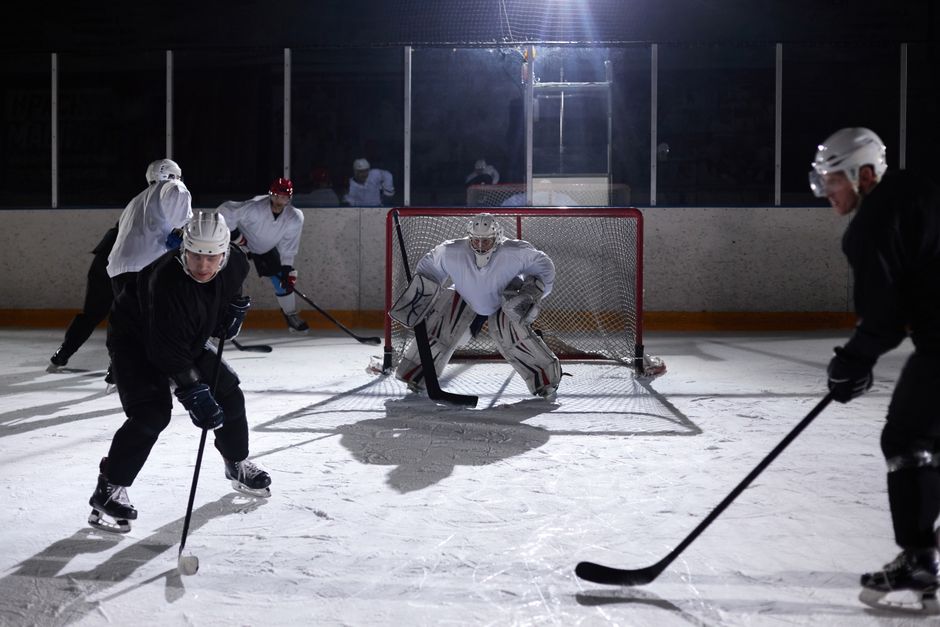
Third period, tied game, and your team just took a penalty. You are sitting on the bench with a minute and a half of shifts ahead that will feel like ten. Hockey packs a lot into short bursts: 30- to 80-second shifts, a loud bench, a referee’s arm going up, and a goalie who may not touch the puck for ten minutes and then has to be perfect. Ice hockey mental training means practicing the skills between your ears (focus, routines, composure, bouncing back) the same way you practice skating and shooting. This page is about mental performance for skaters, goalies and coaches. Mental performance is not the same as mental health; see the section below.
Quick answer: Mental skills are habits you can practice: a short reset between shifts, a plan for staying composed after a penalty or a goal against, simple imagery, and goals you control. Research on these tools is promising but mixed, and none of them guarantees better results. If worry, low mood, or trouble eating or sleeping lasts more than a couple of weeks or gets in the way of daily life, see a doctor, licensed psychologist or other qualified professional, and in a crisis call or text 988 (US).
Focus: one shift at a time
Because hockey is played in short shifts, many coaches treat the bench as a mental reset zone: a breath, a drink, one thing to fix, then forget the last shift. That is common coaching practice, not a studied formula, so keep it only if it helps you. What research does show is that attention matters in the sport. A 2025 study of 348 junior A players in British Columbia (Kirby and colleagues, Open Access Journal of Sports Medicine) measured brain responses and found that goalies showed higher attention-related brain-wave amplitude than other positions. It was a retrospective look at players tested for concussion management, so it describes differences, not a way to train focus.
- Skaters: pick one cue for the bench, such as “next shift, first puck battle,” so the last mistake does not ride along on your next change.
- Between periods: use the intermission to pick one or two things to do, not a list of ten. For fueling, hydration and tournament-day logistics, see our ice hockey game day guide.
Routines, goals and motivation
A pre-performance routine is a short, fixed sequence that gets you ready and shuts out noise, like the same stick tape, the same stretch and a breath before the puck drops. A 2026 position statement from Exercise and Sports Science Australia on performance under pressure (Schweickle and colleagues, Sports Medicine) lists pre-performance routines among its evidence-based strategies, along with psychological skills training and mindfulness-based approaches. It covers sport in general, not hockey in particular, and promises no result.
Coaches often split goals into outcome (make the playoffs), performance (cut turnovers this month) and process (win my first board battle every shift). Process goals are fully in your control, so they still count on a night the puck does not go in. That split is coaching practice rather than one study’s result. For a hockey-specific example, a 2026 study in Frontiers in Sports and Active Living (Sun and colleagues) built a mental program around goal orientation, emotional regulation, positive self-talk and teamwork for 22 players on the Chinese national women’s 3v3 team. Players’ reported burnout and perceived stress dropped and decision-making accuracy under pressure improved after the program. The abstract describes no comparison group, so it cannot show the program caused the changes.
Visualization and imagery
Imagery means rehearsing a skill in your mind with as many senses as you can: the sound of the blades, the feel of the stick, the pass arriving on your tape. A 2026 brain-imaging study of eight elite female hockey players experienced in visualization (Potts and colleagues, Frontiers in Human Neuroscience) had them imagine a scripted hockey play and found activity in the same region of the brain in all eight players. It shows what the brain does during imagery in a very small sample, not that imagery makes you a better player.
- Try 3 to 5 minutes on the bus or before bed: see yourself through your own eyes, using your routine, and making the play you want. That length is a coaching suggestion, not a researched dose. Treat imagery as an add-on to real ice time, never a replacement.
Handling penalties, aggression and pressure
Penalties are partly a skill problem and partly an emotion problem: the late hit after a whistle, the retaliation, the stick when you are beaten. Researchers in Toronto (Cusimano and colleagues, PLOS ONE, 2016) interviewed 61 minor hockey players, parents, coaches and officials and found that coaches, parents, teammates and the media strongly shaped how players behaved, and that revenge for a hit on a teammate was often seen as loyalty, especially in body-checking leagues. In the same group’s systematic review (CMAJ, 2013), rule changes, mainly restricting body-checking, were linked to fewer penalties for aggression in 11 of 13 studies. Educational programs also lowered penalty rates in all three studies, and two studies of cognitive behavioural interventions saw less aggressive behaviour. These were mostly minor hockey studies, and the review could not say how much education changes injury rates.
What that means in practice is up to teams, but these ideas fit the research and common coaching sense:
- Decide before the game: agree as a team that nobody takes a retaliation penalty. The Toronto interviews suggest the team environment drives much of the behavior, so this is a team job, not just a “control yourself” lecture.
- Have a trigger and a response: when you feel the heat rising, take a breath, look to the next faceoff, say your cue. This is a coaching suggestion, not a hockey-tested technique.
- Pressure training: the ESSA statement lists practicing under game-like stress, such as scrimmages with a score and a clock, among its strategies.
For the physical risks of dirty play and contact, see our ice hockey injuries page.
Responding to a bad game or a blowout
A study of 285 NHL blowouts from 2005-06 to 2018-19 (Chachad and colleagues, Frontiers in Sports and Active Living, 2023) found no significant over- or under-performance in the next game for teams that won or lost by about six goals. That is a reassuring sign that one ugly night does not necessarily follow a team around, though it describes pro teams, not any one player’s confidence. A useful habit: watch the video once, take one lesson, then move on.
Goalie mindset
A goalie lives with the sharpest version of the hockey problem: the whole game can turn on one shot, and the next one is coming whether you want it or not. Sport psychology research aimed only at goaltenders is thin. What we found is a 2024 Swedish qualitative study (Reinebo and colleagues, Frontiers in Sports and Active Living) in which four national-level players took an internet-based acceptance and commitment training course. They found it understandable and usable, and some said some exercises could be better adapted for goaltenders. With four players and no performance results, it points to a gap, not a method.
- Reset cue after a goal against: the same one every time (a tap of the post, a breath, a word). It is a common coaching idea, not a studied one.
- Low-shot games: a goalie in a quiet game still needs a way to stay engaged, such as tracking the puck in the other zone and rehearsing the next play.
Teamwork and the youth player
Teamwork was one of the modules in the Chinese women’s 3v3 program above, but we did not find studies isolating team cohesion in hockey, so we leave it there. For young players, a 2026 interview study of eight current and former players (Ryman Augustsson and colleagues, Sports) found that early specialization in elite hockey was linked with feelings of pressure, isolation and growing up too soon, with support from family and teammates playing a big role. A 2026 study of 145 Norwegian national team players aged about 16 (Sæther and colleagues, Frontiers in Psychology) found that those who scored higher on worry about others’ evaluation of them reported more everyday stress, and hockey players reported more than handball players. Both are small studies of elite players, so they apply loosely to the average youth team. For age-level guidance, see our youth ice hockey page, and for how to train alongside this work, our ice hockey training page.
Mental performance is not mental health
Everything above is about performance skills. Anxiety, depression, disordered eating, burnout, substance use and sleep problems are health matters, and the tips on this page are not treatment. A 2025 scoping review of elite ice hockey players’ well-being (Veillette and colleagues, Sports) reported that stigma, a strong hockey culture and past bad experiences of seeking help can keep players from asking for support, and that concussions and retirement were among factors tied to well-being. The 2026 IOC consensus statement on mental health in elite athletes (Reardon and colleagues, British Journal of Sports Medicine) says mental health symptoms are common in athletes, can affect performance and are treatable.
If low mood, constant worry, changes in eating or sleep, or loss of interest in hockey last more than a couple of weeks, talk to a doctor, licensed psychologist or other qualified professional. A hockey player who feels off after a head hit should follow the CDC HEADS UP steps: stop playing and see a health care provider. If you or someone you know is in crisis, call or text 988 (the US 988 Suicide & Crisis Lifeline, free and open all day and night); outside the US, contact your local emergency or crisis line.
Frequently asked questions
How do I stay focused during a hockey game?
Break the game into shifts. Use the bench for one breath and one cue, then forget the last shift. This is common coaching practice; research on attention in hockey shows position differences but not a proven focus method.
How do I stop taking bad penalties?
Treat it as a team habit. Research on minor hockey suggests players’ behavior is shaped by coaches, parents and teammates, and a 2013 review linked rule changes and some education programs to fewer penalties. Agree on a no-retaliation plan, practice a breath-and-cue response, and talk to your coach.
Does visualization really work in hockey?
Elite players use it, and brain-imaging work shows the brain is active during hockey imagery, but we found no hockey study showing it improves game results. Use it as a supplement to on-ice practice.
How should a goalie handle letting in a soft goal?
Use one repeatable reset cue and go to the next shot. Goalie-specific research is thin, so a goalie coach is the best source for drills. Brooding that does not ease after a couple of weeks is worth raising with a doctor or counselor.
Is a bad game or slump a sign of a mental health problem?
Usually a slump is a performance problem. If it comes with ongoing low mood, worry, appetite or sleep changes or loss of interest, see a qualified professional. A head hit that leaves you foggy needs medical care first (CDC HEADS UP).
Sources
- Schweickle MJ et al. Performance under pressure in sport: ESSA position statement. Sports Medicine, 2026. PMID 42271117
- Sun Z et al. Mental training driven by a winning mindset in the Chinese national ice hockey team. Frontiers in Sports and Active Living, 2026. PMID 42145461
- Potts AA et al. Complex motor imagery in elite female ice hockey players (magnetoencephalography). Frontiers in Human Neuroscience, 2026. PMID 41834909
- Kirby ED et al. Objective neurophysiological measures of cognitive performance in elite ice hockey players. Open Access Journal of Sports Medicine, 2025. PMID 39877760
- Cusimano MD et al. Aggression, violence and injury in minor league ice hockey. PLOS ONE, 2016. PMID 27258426
- Cusimano MD, Nastis S, Zuccaro L. Effectiveness of interventions to reduce aggression and injuries among ice hockey players: a systematic review. CMAJ, 2013. PMID 23209118
- Chachad R, Pradhan S, Medina AP. “This is fine”: the impact of blowouts on subsequent game performance in the NHL. Frontiers in Sports and Active Living, 2023. PMID 38260815
- Reinebo G et al. Internet-based acceptance and commitment training in ice hockey players: a qualitative feasibility study. Frontiers in Sports and Active Living, 2024. PMID 38584684
- Ryman Augustsson S et al. Formed on ice: motivation, pressure and identity in early ice hockey specialization. Sports, 2026. PMID 42347459
- Sæther SA et al. Perceived psychological stressors in female age-specific national team players. Frontiers in Psychology, 2026. PMID 42317706
- Veillette PL et al. Elite ice hockey players’ well-being: a scoping review. Sports, 2025. PMID 40711110
- Reardon CL et al. IOC consensus statement on mental health in elite athletes. British Journal of Sports Medicine, 2026. PMID 42580854
- CDC HEADS UP: concussion response
- 988 Suicide & Crisis Lifeline
General information for education only, not medical advice. It does not replace a doctor, psychologist or other qualified professional. See how we work in our editorial policy. Back to the ice hockey hub.