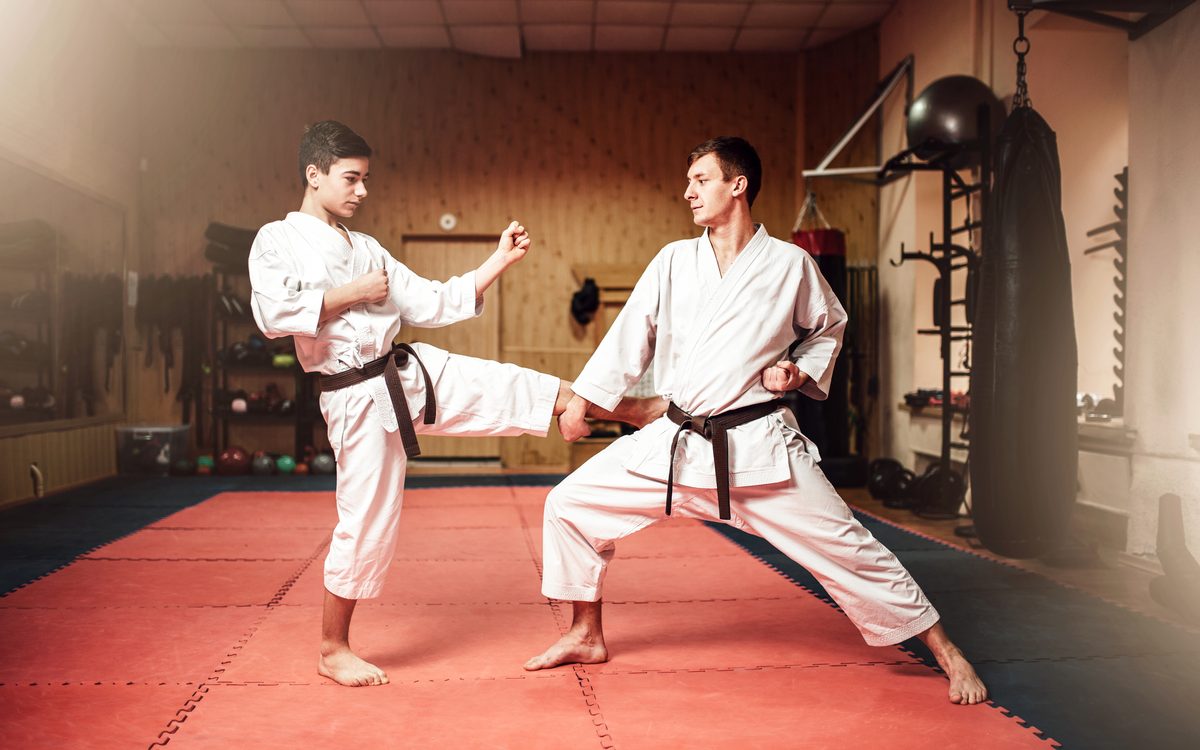
The whistle for a junior kumite bout has barely gone when a kick lands on the face of the athlete in blue. In one national junior championship, more than half of all recorded injuries happened in the first minute of a bout. Karate injury prevention is the set of habits around practice and competition, a proper warm-up, controlled contact, protection that fits, a load that grows slowly and honest reporting of pain, that aim to lower the chance of getting hurt. They lower the odds. They cannot promise anything.
Quick answer: The steps best matched to karate’s injury pattern are control of contact (the sport’s own rules require it), a mouthguard and the sparring protection your rules list, a training load that rises slowly, rest days, and stopping when something hurts. Competition injuries cluster in the face, so contact rules and protection matter there. Evidence for any single prevention program in karate is thin. See a sports medicine doctor, physical therapist or athletic trainer if pain stays in one place, and call emergency services for danger signs after a head injury.
Know the pattern you are preventing
Competition surveillance gives a map. At four World Karate Championships (2010 to 2016, Orthopaedic Journal of Sports Medicine, 2019), 1.4% of athletes had a time-loss injury, and fractures made up 41% of them, dislocations 20% and concussions 12%. At the 2023 Iranian junior national championships, the face accounted for 46% of injuries, contusions for 48%, 52% happened in the first minute of a bout and losing athletes took 59% of the injuries. In Japanese university competitions from 2000 to 2014, the largest number of treatments were for the face, then the lower limbs. Details are on our injuries page; this page covers the habits.
Warm-up
No karate-specific warm-up program has been tested in a trial that we could find. The closest martial arts example is IPPON, a 36-exercise warm-up for judo covering shoulders, knees and ankles; a trial in 269 judoka reported 23% injured with the program against 28% without, a difference that was not statistically significant (Br J Sports Med, 2023). So a warm-up is sensible and cheap, but the evidence does not show it prevents karate injuries. A sensible one includes light aerobic work, dynamic movement for hips, ankles, shoulders and spine, a few progressively faster kicks and punches, and stance practice. Save long static stretches for after class.
Technique and control
Karate competition is built on controlled strikes. The WKF 2026 kumite rules, as recorded in our notes, require skin touch to the head, short fingernails and, for athletes under 14, a helmet and chest protector. The American Academy of Pediatrics (AAP) clinical report on martial arts recommends qualified instructors, delaying contact until a child has the maturity and skill, and notes that rule changes to remove head blows lower risk. Teaching points that follow:
- Stop the strike at the target and practice distance control before power.
- Block and keep the guard up; the face is the most injured site in the studies above.
- Kick with a landing that spreads load through the whole foot, not on the toes or a bony edge. The AAP report names landings on bony prominences as a risk.
- In partner drills, agree on speed and contact level before starting and tap or say stop when you want to.
Progressive training load
The International Olympic Committee consensus on load (Soligard and colleagues, 2016) links sudden spikes in training load to injury and illness and recommends gradual build-ups. In practice: add volume or intensity in small steps, add sparring in stages, and treat the week before a tournament as a time to hold steady, not to cram. The AAP notes some evidence that more than three hours a week of martial arts raises injury risk in children and adolescents, with more study needed. We found no source for a safe weekly limit for adults.
Strength, mobility and balance
The American College of Sports Medicine (ACSM) position stand recommends flexibility work for each major muscle-tendon group, with at least two days a week. The AAP supports supervised resistance training for young people. Leg strength for stances, hip and trunk control for kicks, and ankle balance work are reasonable priorities, though no study we found tests them as karate injury prevention. A 2026 study of elite karate athletes found sex-related differences in jumping and hip range of motion, a reason to tailor programs rather than copy one plan for everyone.
Protection and fit
Equipment ranges from rules to maker claims. Rules first: WKF sparring requires mitts, a gum shield (mouthguard) and other listed protection, and under-14 athletes wear a helmet and chest protector. The AAP says mouthguards reduce dental and mouth injuries and that there is no evidence headgear reduces concussion. A 2026 Brazilian study of martial artists found that most of those with dental trauma were not wearing a mouthguard when it happened (15 of 19). Maker claims such as “WKF approved” on a retail listing are not the federation’s own list, so check the current WKF equipment list for your event. Details and fit tips are on the gear page. Replace mitts and pads when the foam flattens or cracks.
Mat, hygiene and environment
Mats should be clean, flat and free of gaps. The National Athletic Trainers’ Association (NATA) skin infection position statement recommends showering after every practice, not sharing towels or bar soap or gear, and washing clothing after each use. Ankles and toes catch on seams, so check the floor before barefoot work. Train in cool conditions where you can and drink fluids; karate is usually in a heated or air-conditioned hall but outdoor sessions in heat need water breaks.
What prevention cannot do
Even with every habit above, the studies show injuries occur in well-run events, including fractures and concussions at world championships. A face strike in sparring can happen to a careful athlete. Prevention lowers risk; it does not remove it, and no product removes it either.
When to see a professional
See a sports medicine doctor, physical therapist or athletic trainer for pain that lasts or sits in one spot, pain at rest or at night, swelling, a joint that gives way, or numbness. After a blow to the head, the CDC HEADS UP approach is to recognise the signs, remove the athlete from activity and have a healthcare provider decide on return. Call emergency services for repeated vomiting, a seizure, one pupil larger than the other, or worsening confusion.
Karate injury prevention FAQs
Does a warm-up prevent karate injuries? It is a sensible habit, but the best martial arts trial we found (a judo warm-up program) did not find a statistically significant difference. No karate trial exists that we could find.
Do mouthguards prevent concussion? No evidence says so. The AAP says mouthguards reduce dental and oral injuries and that headgear has no evidence for reducing concussion.
Is karate safer than taekwondo for kids? The AAP reports lower and less severe injury rates for karate than taekwondo, largely because most karate is non-contact or light contact. Risk is not zero.
How do I protect my hands and feet? Use mitts that fit for sparring, keep nails short, trim toenails and keep the floor clean. Ask a doctor about any pain that does not go away.
Should I train when something hurts? Stop and have it checked if pain is sharp, stays in one place or changes how you move. Soreness across large muscles a day or two after a hard class is different, but when unsure ask a professional.
Sources
- Time-loss injuries at 4 World Karate Championships, OJSM 2019 (PubMed 31489331)
- Injuries in junior karate athletes, Iran, 2026 (PubMed 41582186)
- Rescue records in Japanese university karate competitions, 2026 (PubMed 42835481)
- Dental trauma in martial arts practitioners, Brazil, 2026 (PubMed 42645484)
- IPPON judo warm-up trial, Br J Sports Med 2023 (PubMed 36717214)
- AAP: Youth Participation and Injury Risk in Martial Arts (2016)
- WKF Kumite Competition Rules 2026 (PDF)
- IOC consensus statement on load in sport, Soligard et al. 2016 (PubMed 27535989)
- ACSM position stand, Garber et al. 2011 (PubMed 21694556)
- NATA position statement on skin diseases (PDF)
- CDC HEADS UP: signs and symptoms
- Sex-specific differences in elite karate athletes, 2026 (PubMed 42197970)
General information for education only, not medical advice. It does not replace a visit with a doctor, physical therapist or athletic trainer. See how we write and check our pages in our editorial policy.