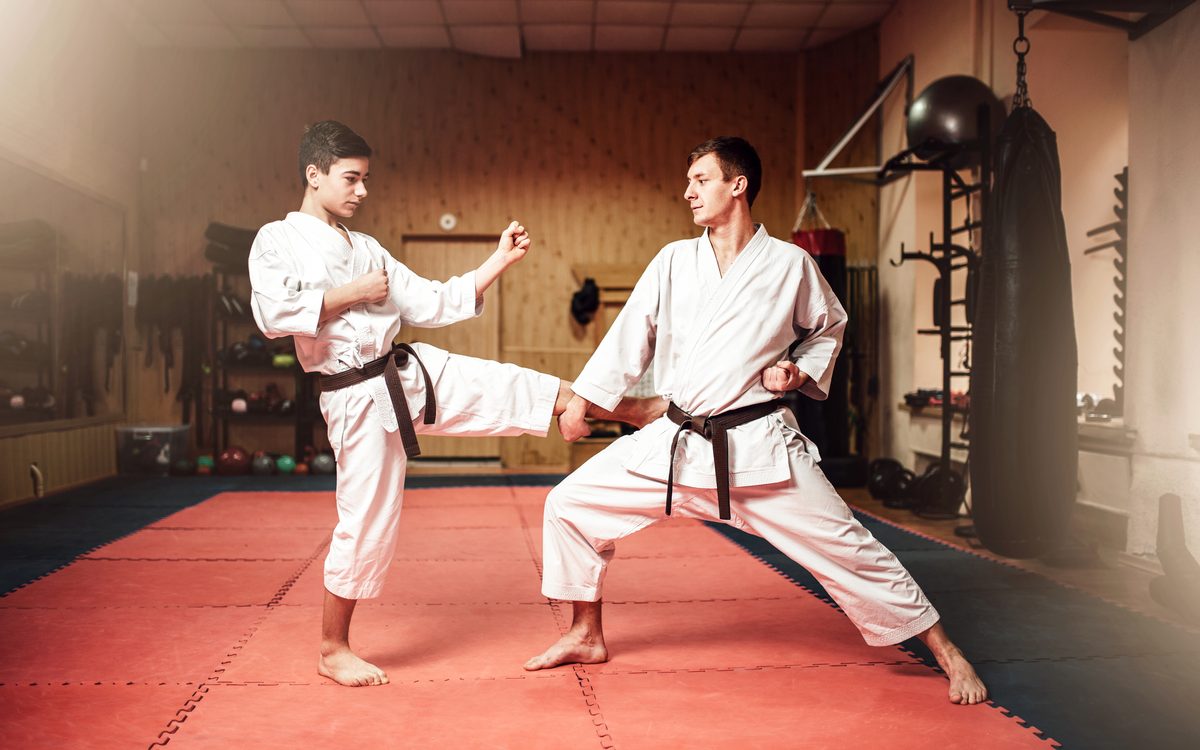
The athlete in the kata final walks to the center of the floor, bows and waits a full breath before the shout. Three seconds earlier her hands were shaking. Mental training in karate is the set of skills, focus, confidence, routines, imagery and ways of handling nerves and mistakes, that help a karateka perform in the dojo and under competition pressure. Like physical skills, they are practiced. Unlike a medical treatment, they promise nothing.
Quick answer: Research on karate and other combat athletes suggests that confidence in your own ability, calm focus and a simple routine go together with handling competition stress better, although most studies are surveys that show association, not proof. Practice one skill at a time: a breathing cue before the bow, one focus word per drill, imagery of the kata or a scoring exchange, and a plan for a lost point. Anxiety, depression, disordered eating and burnout are health matters to take to a qualified professional.
What the research says, and its limits
Karate-specific studies are small and mostly observational. A 2025 study of 110 karate, taekwondo and judo athletes (Di Corrado and colleagues, Frontiers in Psychology) found that self-efficacy, confidence in your ability to do the task, explained part of the link between imagery and stress. A 2026 study of 176 young Tunisian karate athletes found that anxiety, mood and sleep changed between a week before competition and competition day, with higher anxiety associated with sleep disturbance. A pilot study of 30 elite female karate athletes in 2026 found that somatic anxiety, the body-based side such as tension and a racing heart, was associated with the stress hormone cortisol and predicted competition outcome in their sample; it is small and does not show cause. A 2022 survey of 371 Lithuanian kyokushin karate athletes found that higher mindfulness went with lower stress, anxiety and depression scores. A 2026 scoping review of 13 karate studies in children and adolescents concluded that effectiveness cannot yet be established.
The Exercise and Sports Science Australia position statement on performance under pressure in sport (Schweickle and colleagues, Sports Medicine, 2026) is a broader summary of what is known. We use its general direction only: pressure can be trained for, but no technique guarantees results.
Confidence
Confidence grows from honest evidence: repetitions done well, small goals met, feedback from the instructor. Keep a short log of three things that went right in each class. Avoid declaring that a bout will be won; focus on what you can control, such as distance, timing and returning to your guard.
Focus
Pick one cue for each drill, for example “heels down” in a stance or “exhale on the strike”. In kata, many athletes use a breath at the start and a fixed point on the floor for the first move; in kumite, a cue such as “eyes up, guard up”. Single cues are common instructor practice rather than a tested karate method.
Goal setting
Use three kinds of goal. Process goals are within your control (hold the stance, relax the shoulders). Performance goals are about your own standard (clean kata, no penalty). Outcome goals are about results (a medal, a belt). Put most attention on the first two. The belt and the result follow from the work; they are not the work.
Imagery and visualization
Imagery means rehearsing the performance in your mind with as many senses as possible: the floor under your feet, the sound of the shout, the pace of the kata. The Di Corrado study above links imagery to stress through self-efficacy, which is a reason to try it. We found no study giving the size of the benefit for karate, so treat it as an extra, not a replacement for practice. Ten minutes before sleep or on a train is enough.
Pre-competition routines
A routine is a fixed sequence that you repeat: warm-up, a breath, the same words, the same walk to the floor. For kata athletes, the moment between the bow and the first movement is the most useful place for a routine. For kumite athletes, a routine for the minute before the call and the reset after each exchange helps. Routines are common coaching practice; our sources do not test a specific one. Logistics for the day, such as packing, weigh-in and warm-up area, are on our rules and getting started page and are not repeated here.
Handling nerves and pressure
Nerves are normal. The pilot study above suggests watching the body: shaking, tight shoulders, shallow breathing. Slow breathing, a loose shake of the arms, and one calm cue can help many athletes. Rather than “do not be nervous”, try “I am ready and my body is up for it”. Practice this under mild pressure first: perform kata for the class, spar with a new partner.
Kata versus kumite
Kata is a solo performance in front of judges; the pressure is perfection and memory. Kumite adds an opponent and a short bout: the Iranian junior study found 52% of injuries happened in the first minute, so early focus and control matter. Kumite athletes need to read the opponent, decide fast and recover mentally after a point against. Team kata adds timing with partners, and team kumite adds trust. We found no study comparing the mental demands of the two events directly, so these are practical observations.
Responding to losses and mistakes
After a loss, many instructors suggest a short review the next day: one thing that worked, one thing to change, one drill for it. Avoid replaying the bout over and over. In kata, a stumble is not the end of the form: keep going and finish clean. In kumite, a point against is a reset, not a verdict.
Young athletes
We found no study testing a mental training program for young karate competitors. The AAP martial arts report supports qualified instructors and waiting for contact until children are ready. In practice, look for a school that praises effort, keeps competition optional and welcomes parents. A 2026 study in 120 adolescents found a 12-week school martial arts program was associated with benefits compared with PE and a control group, but it was quasi-experimental and not specific to competition.
Mental performance is not mental health
Mental skills help performance. They do not treat anxiety, depression, an eating disorder, burnout or trauma. The International Olympic Committee consensus statement on mental health in elite athletes (Reardon and colleagues, 2026) treats these as health conditions that need qualified care. If you or a young athlete you know is struggling, speak to a doctor or a licensed mental health professional. In the United States, the 988 Suicide and Crisis Lifeline offers call or text help at 988. The Association for Applied Sport Psychology lists resources for finding a sport psychology consultant. Heavy weight cutting or fear of losing a place are reasons to ask for help earlier, not later.
Karate mental training FAQs
How do I stop shaking before a bout? Some shaking is normal and often eases once you start. Slow breaths, a routine and a single focus cue help many athletes; the 2026 pilot study suggests body signs of anxiety are worth noticing. If anxiety feels overwhelming or lasts, talk to a professional.
Does visualization work for karate? Research links imagery to lower stress in combat athletes through confidence, but we found no study that measures how much it improves karate results. Treat it as an addition to practice.
How do I handle a bad kata? Finish the form, bow, and review it later with your instructor. One stumble rarely decides everything.
Should my child compete? Competition can be optional. The AAP advises waiting until a child has the maturity and skill, with qualified instructors. Choose a school that praises effort.
When is it more than nerves? If worry affects sleep, eating or school and work, or you feel hopeless, see a doctor or mental health professional. In the US, call or text 988 in a crisis.
Sources
- Di Corrado et al., self-efficacy, imagery and stress in karate, taekwondo and judo athletes, Front Psychol 2025 (PubMed 40040664)
- Competitive anxiety, mood and sleep in young Tunisian karate athletes, 2026 (PubMed 42065146)
- Psychophysiological responses to competitive anxiety in elite female karate athletes, 2026 (PubMed 42238605)
- Mindfulness and kyokushin karate athletes, 2022 (PubMed 35409684)
- Scoping review of karate studies in children and adolescents, 2026 (PubMed 42719739)
- School martial arts program in adolescents, Front Psychol 2026 (PubMed 42996393)
- ESSA position statement, performance under pressure in sport, Sports Med 2026 (PubMed 42271117)
- IOC consensus statement on mental health in elite athletes, 2026 (PubMed 42580854)
- Injuries in junior karate athletes, Iran, 2026 (PubMed 41582186)
- AAP: Youth Participation and Injury Risk in Martial Arts (2016)
- 988 Suicide and Crisis Lifeline
- Association for Applied Sport Psychology: resources
General information for education only, not medical advice. It does not replace a visit with a doctor, physical therapist or athletic trainer. See how we write and check our pages in our editorial policy.