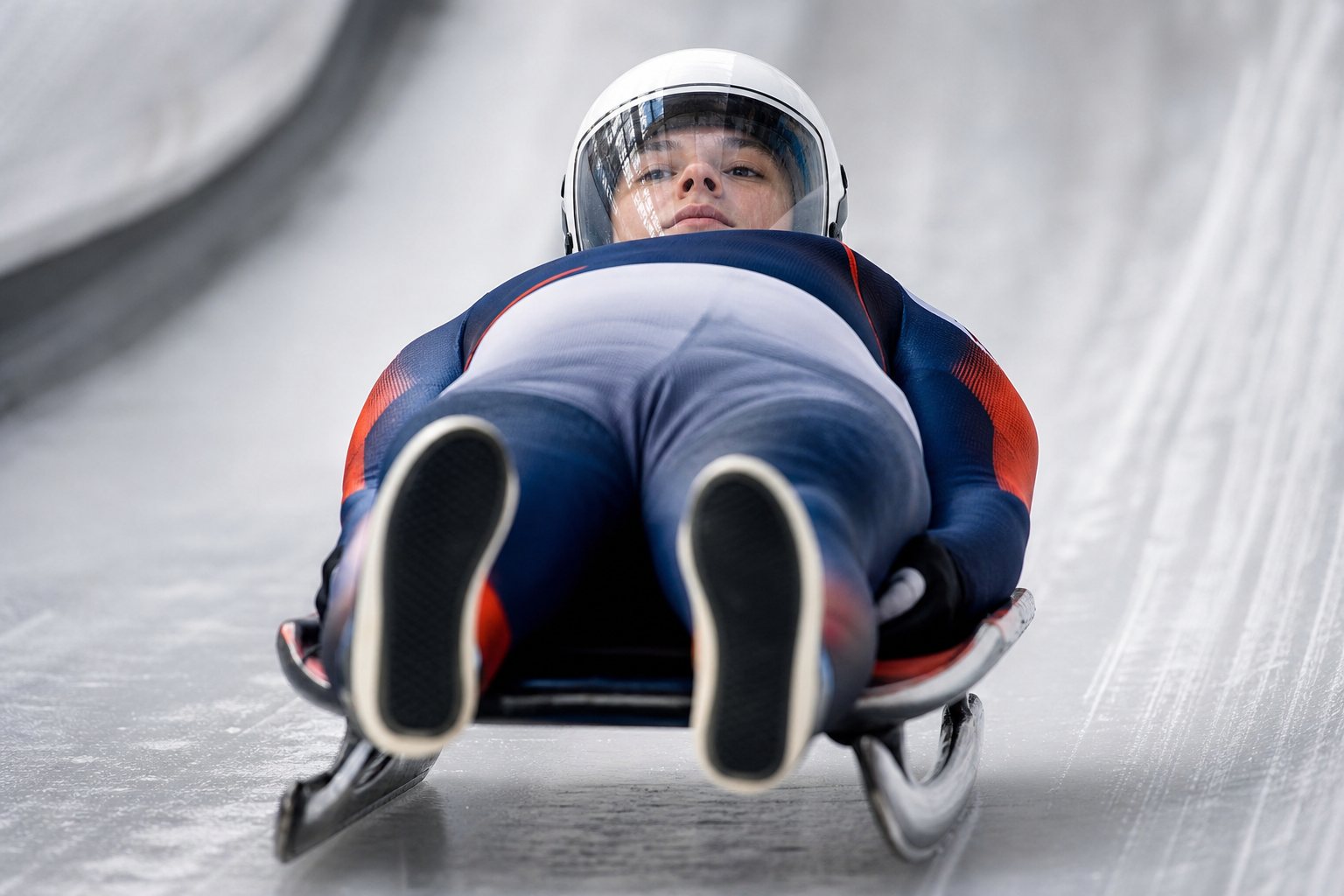
The start house is quiet, and the slider is rocking forward and back, hands tight on the handles, waiting for the green light. In the next two seconds the run is partly decided. Luge training is the work done to make that start fast, the body steady on the sled, and the athlete healthy enough to do hundreds of runs. This page covers what the sport asks of the body, a sensible week, and how training changes across the year, using only numbers we could source.
Quick answer: A 2026 review of Olympic ice sports says luge results are strongly shaped by the start, and that luge asks for explosive upper-body strength. Training therefore centres on starts, upper-body and trunk strength, neck and shoulder care, general fitness and time on the sled. We found no published fitness test standards for luge, so we give none. See a sports medicine doctor, physical therapist or athletic trainer before starting heavy strength work, especially under 18.
General information, not a training plan. The sport itself is explained on the rules page, and injury detail is on the injuries page.
What luge asks of the body
Max Langenhan’s four Olympic runs added up to 3:31.191 (FIL), roughly 53 seconds a run by our arithmetic, so no single run is long. A 2026 narrative review of Olympic ice sports groups bobsleigh, skeleton and luge as sports where results are driven overwhelmingly by start velocity, with the first 15 to 65 metres contributing disproportionately. It says bobsleigh and skeleton training looks like sprint training with lower-body power, while luge demands explosive upper-body strength. After the start, the athlete holds a still lying position with small steering movements. A 2025 clinical commentary on sliding athletes also describes differences in technique between the three sliding sports, from the start to the slide.
Injury data tell a similar story. In a 46-week study of 40 elite luge athletes (Tomaselli and colleagues, 2024), the shoulder was the most common site of overuse problems (20.9%), followed by the lumbar spine (16.3%). Training that builds shoulder and trunk capacity is therefore both a performance and a health question.
Building blocks of a training week
We found no published weekly template for luge athletes, so what follows is a general shape built from the demands above, not a prescription. A coach who knows the athlete should set the details.
- Start work. Practice of the rock, pull and paddle, on the ice or a dry start ramp. USA Luge lists an indoor start training facility in Lake Placid, so such facilities exist.
- Strength and power. Pulling, pressing and trunk work for the upper body, plus leg strength for general athleticism. A 2025 analysis of 1,544 participants across sports found maximal squat strength was linked to jump height, with signs of diminishing returns at higher strength, so more is not always better.
- Neck and shoulders. Because head impacts and neck strains show up in luge studies, discuss neck conditioning with a physical therapist or strength coach. No source we read shows that neck training prevents luge concussions.
- General fitness. A 2026 review of endurance training in winter sports puts sliding sports in a group where aerobic fitness mainly supports recovery, training tolerance and resilience, not the race itself.
- Sled time. Track sessions, with video and coach feedback, are limited by track access and weather.
Periodisation: how the year is organised
Periodisation means changing the type and amount of training across the year. For luge the broad shape comes from the calendar: ice runs in winter, wheeled-sled sessions in summer and fall, and strength and fitness building in between. The 2024 elite-athlete study followed both a preparation period and a competition period over 46 weeks, so national-team athletes do work in distinct phases. Exact programs are not published in the sources we read.
Training load for young sliders
Young athletes need slower progression. The American Academy of Pediatrics (Brenner, 2016) recommends one to two days off a week from the main sport and about three months a year away from it in blocks, and a study by Jayanthi and colleagues (2015) found young athletes training more hours a week than their age in years had about twice the odds of a serious overuse injury. Neither study was about luge. A 2014 international consensus (Lloyd and colleagues, British Journal of Sports Medicine) considers supervised, well-taught resistance training safe and beneficial for youth. A 2025 study of 101 Team USA athletes at the Winter Youth Olympic Games found overuse was the most common mechanism of injury among all athletes there, which is a reason to watch load.
Using technology and tracking
A 2026 review of technology on snow and ice discusses sensors and monitoring and stresses checking whether tools work in real field conditions before using them for coaching or medical decisions. That is a good habit for any wearable or app. A 2025 paper describes a virtual-reality luge simulator built with Austrian Luge Federation experts, who rated its realism between 3 and 4 out of 5; the authors suggest it could let users learn techniques before real-world runs, but it is a research prototype, not a training standard.
Luge FAQs
What is the most important part of a luge run?
A 2026 review of Olympic ice sports says results in sliding sports depend heavily on start velocity, with the first 15 to 65 metres counting for more than their share of the final time.
Do luge athletes lift weights?
Sources say luge needs explosive upper-body strength, and strength training is standard for sliding athletes, but we found no published luge-specific program. Ask a coach or physical therapist.
How often should a young slider train?
No luge-specific rule exists in our sources. The American Academy of Pediatrics advises one to two days off a week and several months a year away from a single sport for young athletes.
Is cardio important for luge?
A 2026 review treats endurance in sliding sports as a supporting quality that helps with recovery and handling training load, not the main limiter.
Can I train for luge without a track?
Strength, power and general fitness work can be done off the ice, and USA Luge describes wheeled sleds and an indoor start facility. Real sled skills need a coach and an approved track.
Sources
- Olympic Ice Sports: A Narrative Review (2026)
- Interdisciplinary Health and Performance Management of the Sliding Athlete (2025)
- Tomaselli and colleagues: health problems in elite luge athletes (2024)
- Endurance Training in Olympic Winter Sports: A Narrative Review (2026)
- Strength and jump performance across 1,544 participants (2025)
- Injury and illness, Team USA at the 2024 Winter Youth Olympic Games (2025)
- AAP: sports specialization and intensive training in young athletes (Brenner, 2016)
- Jayanthi and colleagues: intensive training and injury risk (2015)
- Lloyd and colleagues: youth resistance training consensus (2014)
- Technology on Snow and Ice, Milano Cortina 2026 (2026)
- Building a Realistic Virtual Luge Experience Using Photogrammetry (2025)
- FIL: Max Langenhan wins Olympic gold in Cortina
- USA Luge: Luge 101
General information for education only, not medical advice. It does not replace a visit with a doctor, physical therapist or athletic trainer. See how we write and check our pages in our editorial policy.