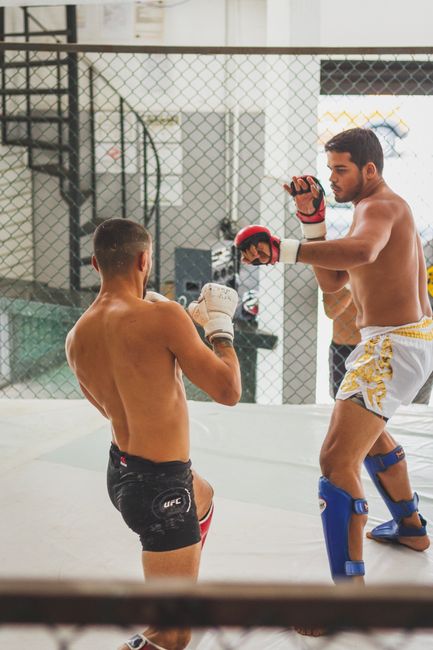
Walk-out music, a long tunnel, a cage door that closes behind you. For a few minutes before a bout, nobody can help you except the people in your corner, and then even they go quiet. MMA mental training is the practice of building the skills that work in that moment, such as steady nerves, focus, calm decisions and a way to come back from a loss, with the same patience you give your grappling. This page covers amateurs and professionals alike. It is about mental performance. Stress, low mood and eating problems around making weight can be health matters, so they have their own careful sections below.
Quick answer: Treat the mental side like a skill: a short, repeated routine before bouts, one simple job for each round, and one written lesson after every fight, win or lose. Studies of these skills in combat athletes are mostly surveys and small samples, so none of it promises a result. If a weight cut leaves you foggy, irritable or afraid of food, or if anxiety, low mood, panic or burnout will not lift, see a doctor, sports medicine physician or licensed mental health professional.
Fight-camp discipline
A camp is weeks of repeating hard work when you do not feel like it. Two findings help explain why this is tiring for the mind as well as the body. In a 2025 study of ten professional MMA athletes followed through a three-week strength and conditioning block, blood markers of stress and muscle damage partly recovered, but fatigue, tension and confusion ratings rose and vigor fell, and the athletes still reported tiredness after the markers had settled (Ostapiuk-Karolczuk and colleagues, Scientific Reports). The authors suggest tracking both body and mood. It is ten men in one program, so treat it as a prompt, not a rule.
A 2026 survey of 489 university combat sport athletes in Turkey found that athletes who trained for their own interest in the sport (intrinsic motivation) reported better psychological wellbeing, partly through higher mental toughness (Duyan and colleagues, Frontiers in Psychology). It is a one-time snapshot and cannot show cause. Habits coaches often suggest, none of them tested in MMA:
- Process goals: “hit every scheduled session and sleep window” is in your control. “Win by finish” is not.
- A weekly check-in: three questions, such as sleep, mood and soreness, so a bad week is spotted by you and your coach before it becomes a bad month.
- Planned easy days: rest on the calendar is easier to take. See recovery and training.
Nerves and composure
Nerves before a fight are normal and are not a sign you are unready. The Exercise and Sports Science Australia (ESSA) position statement on performance under pressure (Sports Medicine, 2026) says pressure can help or hurt performance, and lists pre-performance routines, attentional strategies, psychological skills training and mindfulness-based approaches among the strategies with supporting evidence. It is not MMA-specific, so the steps below are a common coaching template, not a tested formula:
- Name it: “I’m nervous because this matters.” Labeling the feeling is often easier to work with than fighting it.
- Lengthen your exhale: a slow breath out before the walk and again in your corner between rounds.
- Same warm-up, same order: a familiar sequence leaves less room for worry.
- One job for the first exchange: “jab and move” or “touch hands, check range.” One instruction beats a list.
Imagery, meaning rehearsing a skill in your head, is also used widely in martial arts. In a 2025 study of 110 competitive karate, taekwondo and judo athletes, clearer imagery went with lower reported stress, and the link ran through self-efficacy, which is belief in your own ability (Di Corrado and colleagues, Frontiers in Psychology). Because it measured athletes at one time point, it cannot show that imagery causes calm. A few minutes the night before, picturing one or two situations you expect, such as your first clinch or a takedown defended, is a low-cost thing to try.
Decision-making under pressure
A fight is a string of choices made in seconds: whether to throw, shoot, clinch or defend, and when to change the plan. We did not find a study of MMA decision-making under pressure that we could cite with confidence, so this section is coaching practice and common sense, not research. The ESSA statement above is the best general source we have on how pressure changes performance, and it points toward practice under pressure as one of the supported approaches. Ideas coaches commonly use:
- Pressure sparring: add stakes to a controlled round (a scoreboard, a coach calling the round, fatigue at the end) so decisions are practiced when you are tired.
- If-then plans: “if I am taken down, my first job is to get back to my feet or to a safe position.” A pre-decided response saves thinking time.
- Corner reset: in the minute between rounds, take water, listen to one or two cues from your corner and pick one change. A long list is hard to use when you are tired.
- Know the rules cold: see the rules page. Less guessing leaves more attention for the fight.
Two safety limits matter here. First, tapping, or telling the referee you cannot continue, is always a decision you can make. Second, a fighter who is dazed or confused is in a medical situation, not a mental toughness test. Concussion signs are covered on our injuries page.
Resilience after a loss
Every fighter loses, and many lose a lot while they learn. We did not find a study of how MMA athletes cope after a defeat, so what follows is a common coaching approach, not a tested protocol:
- Rest first, review second. Watch the film a few days later, not in the locker room. Medical checks and rest after a fight come before any film study; see recovery.
- Pick one lesson. A range you lost, a habit when tired, a plan you dropped. Write it down and give it to your coach.
- Separate the fighter from the result. A loss tells you what to train, not who you are.
- Talk to people. Your coach, a teammate or family. Losing alone is heavier.
A 2026 survey of Olympic combat sport athletes (379 people) found that more mindfulness in sport went with less burnout, partly through self-compassion, with emotion regulation shaping the link (Kaçay and colleagues, Frontiers in Psychology). It is a one-time correlation, but it fits the advice above. If a loss leaves you low or hopeless for weeks, that is a health matter and belongs in the section below.
Weight-cut stress: a health matter for professionals
This section is separate on purpose. Making weight is a mental pressure, but when it drives severe food restriction, fluid restriction or dehydration, it is a health matter, not a mindset problem. Please do not treat it with visualization or toughness.
- A 2018 pilot study of 12 professional male MMA athletes found that those who used rapid weight loss (9 of the 12) reported more confusion and greater total mood disturbance at each of four time points than those who did not, along with higher anger at the weigh-in. Their performance did not appear worse, but the authors say rapid weight loss is associated with potentially dysfunctional mood states (Brandt and colleagues, Journal of Strength and Conditioning Research). Only three athletes were in the comparison group.
- A 2026 study of professional MMA fighters’ self-reported diets found that the day before the weigh-in was marked by severe carbohydrate and fiber restriction and lower fluid intake (Evans and colleagues, Nutrients).
- The 2025 International Society of Sports Nutrition (ISSN) position stand on MMA and combat sports weight cuts says the long-term effects of frequent cuts are unknown. We cover its details on the nutrition page rather than repeat them here.
- The 2023 International Olympic Committee consensus statement on Relative Energy Deficiency in Sport (REDs) describes health and performance problems from low energy availability and notes the interplay with mental health.
Warning signs worth taking seriously include constant thoughts about food or weight, fear of eating, secret fasting or purging, bingeing after weigh-ins, dizziness or fainting, missed periods, and losing interest in training. These are general warning signs, not a diagnosis. If you notice them in yourself or a teammate, tell a coach you trust, an athletic trainer or a doctor, and ask for a sports medicine physician and a registered dietitian. A fighter who is fainting, confused or unable to keep fluids down needs medical help, not a pep talk. Weigh-in rules and how a commission checks fighters are on the fight day page.
Mental performance vs. mental health
Mental training sharpens skills in people who are otherwise well. It is not a treatment. Anxiety that stays after the fight, depression, panic, trouble sleeping or eating, burnout, thoughts of self-harm and loss of enjoyment are health matters to take to a doctor, psychologist or other licensed professional. The 2026 International Olympic Committee consensus statement on mental health in elite athletes says mental health symptoms and disorders are common among elite athletes, may have sport-related causes and can affect performance. A 2026 scoping review of 12 studies on repetitive head impacts in MMA and other combat sports reported links with executive function problems and increased depressive symptoms (Stern and colleagues, Cureus), another reason to mention changes in mood, memory or thinking to a doctor and not to push through. In the United States you can call or text 988 (the 988 Suicide & Crisis Lifeline) any time, free and confidential. If you are in immediate danger, call your local emergency number.
Competition preparation
Mental preparation sits on top of the basics: sleep, a weight plan made with qualified people, food and fluids you trust, a packed bag. Weigh-ins, rehydration and the hours before a bout are on the fight day page, so we will not repeat them. To compare organizations and pathways, see leagues and associations.
Young athletes
A 2026 survey of 108 youth MMA athletes aged 8 to 17 found low depression scores (4 athletes, 3.7%, screened positive) and higher resilience scores than reported for similar-age peers in the literature, with no differences by weight-cutting practices, age or injury history (Fujimoto and colleagues, Cureus). Only 39% of those approached completed the surveys, and it was one event at one time, so it is baseline data, not proof that MMA builds resilience. For young fighters, keep the focus on enjoyment, effort and learning, keep weight talk out of it, and ask a pediatrician about concerns. See the youth page.
MMA mental training questions
How do I stay calm before a fight?
Use the same warm-up every time, lengthen your exhale, and give yourself one simple job for the first exchange. Nerves are normal. If anxiety feels overwhelming or constant, talk to a doctor or licensed professional.
How do I come back after a loss?
Rest and get medical checks first, then take one lesson from the fight and write it down. Your coach can help you decide what to fix. If you are low or anxious for weeks, see a professional.
Does visualization help fighters?
Imagery is widely used in martial arts, and one 2025 study of karate, taekwondo and judo athletes linked clearer imagery to lower stress, but it was not an MMA study and cannot show cause. Try a few minutes a night for a few weeks. It cannot promise a result.
Is weight-cut stress a mental toughness problem?
No. Confusion, anger and a fear of food during a cut are health signals. A sports medicine doctor and registered dietitian should help, and a commission or event physician decides whether you may compete.
What are warning signs of an eating disorder in fighters?
Constant thoughts about food or weight, secret fasting or purging, bingeing after weigh-ins, dizziness, missed periods and pulling away from teammates. These deserve a doctor’s visit. They are not a sign of weakness.
Sources
- Ostapiuk-Karolczuk J et al. Biochemical and psychological markers of fatigue and recovery in mixed martial arts athletes during strength and conditioning training. Scientific Reports, 2025. PMID 40624253
- Duyan M et al. The relationship between intrinsic motivation and psychological wellbeing in combat sport athletes: the mediating role of mental toughness. Frontiers in Psychology, 2026. PMID 42058302
- Schweickle MJ et al. Performance Under Pressure in Sport: A Position Statement from Exercise and Sports Science Australia. Sports Medicine, 2026. PMID 42271117
- Di Corrado D et al. Mental imagery and stress: the mediating role of self-efficacy in competitive martial arts athletes. Frontiers in Psychology, 2025. PMID 40040664
- Kaçay Z et al. Mindfulness and athlete burnout among Olympic combat sport athletes. Frontiers in Psychology, 2026. PMID 42755439
- Brandt R et al. Body Weight and Mood State Modifications in Mixed Martial Arts: An Exploratory Pilot. Journal of Strength and Conditioning Research, 2018. PMID 29927894
- Evans C et al. Weigh-In to Fight Night: Dietary Strategies of Professional MMA Fighters. Nutrients, 2026. PMID 42739050
- Ricci AA et al. International Society of Sports Nutrition position stand: nutrition and weight cut strategies for mixed martial arts and other combat sports. Journal of the International Society of Sports Nutrition, 2025. PMID 40059405
- Mountjoy M et al. 2023 International Olympic Committee consensus statement on Relative Energy Deficiency in Sport (REDs). PMID 37752011
- Reardon CL et al. Mental health in elite athletes: International Olympic Committee consensus statement (2026). British Journal of Sports Medicine. PMID 42580854
- Stern L et al. Neuropsychological Health in Mixed Martial Arts Fighters and Combat Sport Athletes: A Scoping Review. Cureus, 2026. PMID 42643991
- Fujimoto J et al. Depression and Resilience in Youth Mixed Martial Arts Athletes: A Cross-Sectional Analysis. Cureus, 2026. PMID 41700277
- 988 Suicide & Crisis Lifeline
General information for education only, not medical advice. It does not replace a doctor, psychologist, registered dietitian or other qualified professional. See how we work in our editorial policy. Back to the MMA hub.