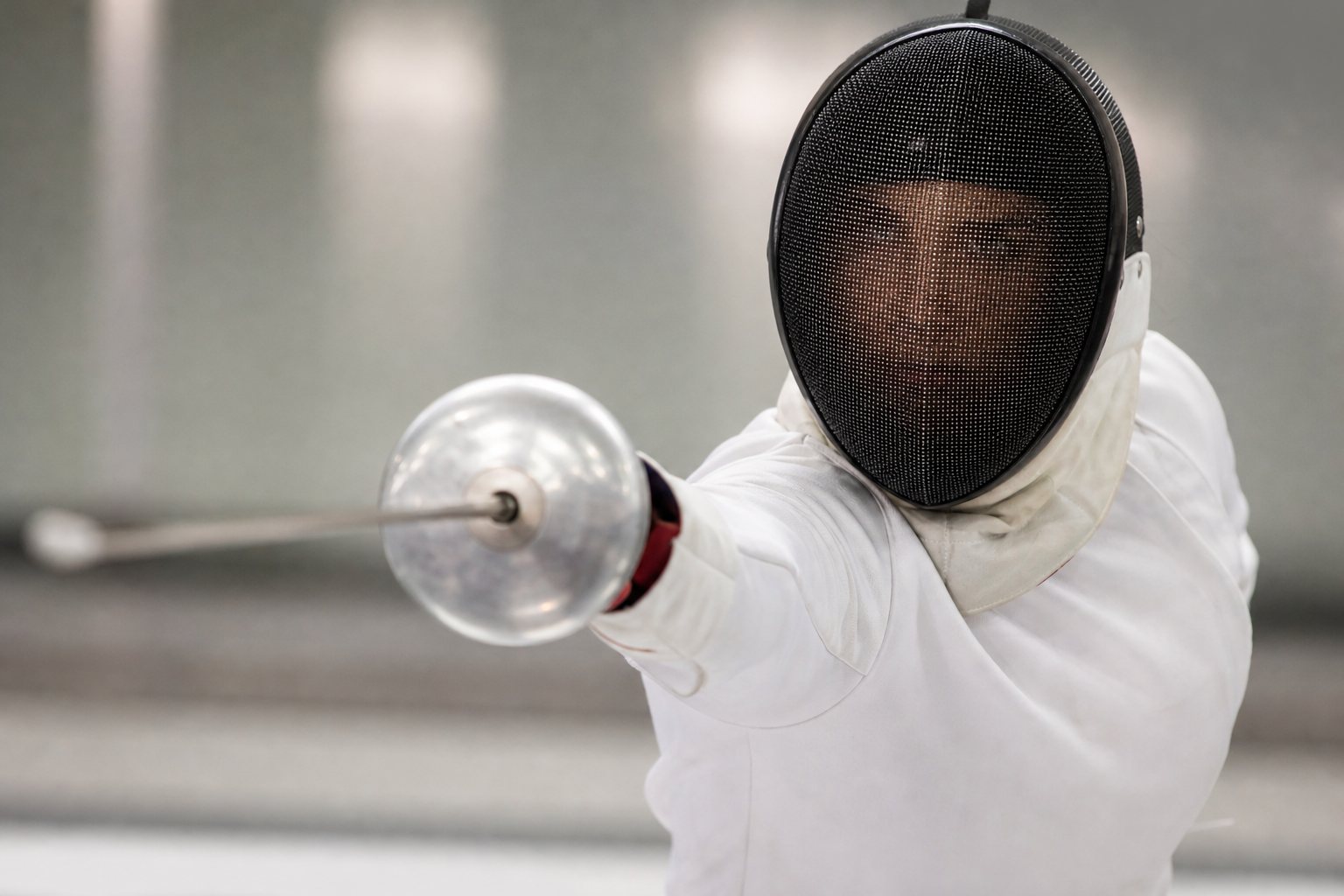
Monday starts in the pool at 6 a.m., lunch is a fencing lesson, and the evening is intervals on the track followed by a few sets of laser shooting with a high heart rate. Modern pentathlon training means building five skills at once: a swimmer’s efficiency, a runner’s engine, a fencer’s timing, an obstacle athlete’s grip and a shooter’s calm. This page covers what the sport demands, how a sensible week can be shaped, and what the research says. Very little of it is large or conclusive, and we say where. For the rules, see skills, rules and getting started.
Quick answer: A 2024 commentary says modern pentathlon needs aerobic and anaerobic endurance, strong legs and upper body, and explosive, precise movement, with the new Obstacle discipline adding emphasis on upper-limb and core power. Most weeks mix swimming, running, fencing, obstacle skills, shooting and strength work. Training evidence in the sport is small and mostly from national-team groups, so use it as ideas to discuss with a coach, not a prescription.
What the sport demands
Rappelt and Donath wrote in 2024 that modern pentathlon requires specific endurance capacities using both the aerobic and anaerobic systems while also raising lower- and upper-body strength, with explosive, precise repeated movements. They add that running and swimming must be fast but economical, and that swapping riding for Obstacle prioritizes explosive strength of the upper limbs and core while endurance and precision stay high in swimming, fencing and shooting. They also note that condensing the competition into a roughly 90-minute format means athletes need routines before, during and after the competition.
In plain words: you train several sports whose needs sometimes clash. Heavy upper-body work can interfere with swim feel; a hard run can leave your legs tired for fencing footwork. A weekly plan is mostly an exercise in sequencing.
A sensible weekly shape
There is no official weekly template, and the studies we found do not give one. The structure below is general coaching practice, offered as a way to think, not as a program. Ask a coach to adapt it to your age, experience and discipline strengths.
- Two to three focused sessions in your weakest event. Progress comes faster where you are furthest behind.
- One quality session for each other event, including fencing lessons and bout practice, a swim set, a run and obstacle skill practice.
- Two strength sessions (lower body, upper body and core) placed away from your hardest swim or run, if your schedule allows.
- Combined sessions: a laser run rehearsal, or swim-then-run, so the body learns to switch.
- At least one full rest day and an easier week at intervals planned by your coach.
Strength and power: what the studies show
Two small studies from a Chinese national-team group tested complex training, which alternates heavy resistance work with plyometric jumps in the same session. In a 2022 pilot, ten female national-team pentathletes did 8 weeks of resistance training and then 8 weeks of complex training (Qiao and colleagues). After the complex-training block, squat strength, isometric mid-thigh pull, jump height and a reactive-strength measure improved. A 2026 study in ten male national-team pentathletes (Liu and colleagues) found improved agility, strength and power during the complex-training block compared with the resistance block. Both used the same athletes in a fixed order, with no control group and no randomization, and the authors of the first call for larger, randomized trials. So treat the results as interesting, not settled.
Skill training: shooting and fencing
Shooting under fatigue is a skill you can train. In Dadswell and colleagues (2016), 17 pentathletes shot after each running phase; heart rate and blood lactate rose between series but aiming time, shot score and pistol movement did not change. A 2025 study of seven national-team athletes (Ünver and colleagues) found that heart rate was higher in the field than in the lab and higher on missed shots than on hits, while accuracy did not differ significantly between lab and field. Their recommendation was to practise running-and-shooting in varied weather and field settings rather than only at a range. A 2019 study of 25 young pentathletes (Sadowska and colleagues) found that the first running phase disturbed postural balance in the shooting position, and the disturbance stayed at that level in later series.
For fencing, the one-minute direct-elimination format means bout practice matters: practise winning quickly when tired. Our fencing hub covers fencing training in more depth.
Periodisation basics
Periodisation means organizing training into blocks so that hard weeks are followed by easier ones and the heavy work comes well before competition. The 2022 and 2026 studies above both used a fixed multi-week strength block in the pre-competition period, which fits that idea. We found no published pentathlon-specific guide to volumes or block lengths, so keep numbers for your coach. For swimming and running load, see swimming and running.
Training for the new obstacle discipline
UIPM describes the Obstacle course as 70 m with eight obstacles, raced head-to-head. The 2024 commentary points toward upper-limb and core power. Beginners can build general grip, pulling and trunk strength with a coach, and practise obstacle technique at a facility that supervises it. See obstacle course racing for more.
Training FAQs
How many hours a week do pentathletes train?
We found no official or published figure for the new format. It depends on age and level; a coach can set a schedule that you can recover from.
Should I lift weights as a pentathlete?
The sport needs lower- and upper-body strength (Rappelt and Donath, 2024), and small national-team studies used resistance and complex training. How much and when is for a coach to decide.
Can I train shooting without a laser pistol?
Dry practice of posture, breathing and routine is possible, but equipment rules and access vary. Ask your club what is available.
Is the research on pentathlon training strong?
No. The studies we found have small groups of national-team athletes, often without a control group.
Do I need to train all five skills every week?
Many athletes touch each discipline weekly, but that is a coaching decision; the research does not give a minimum.
Sources
- Rappelt and Donath 2024, Changing Horses in Midstream, Int J Sports Physiol Perform (PubMed 39168463)
- Qiao et al. 2022, Front Psychol, complex training in female pentathletes
- Liu et al. 2026, PeerJ, complex training in male pentathletes
- Dadswell et al. 2016, J Sports Sci (PubMed 26375196)
- Ünver et al. 2025, BMC Sports Sci Med Rehabil
- Sadowska et al. 2019, Int J Environ Res Public Health (PubMed 31726785)
- UIPM, 2026 format
General information for education only, not medical advice. It does not replace a sports medicine doctor, physical therapist, athletic trainer or registered dietitian who knows you. Read how we work in our editorial policy.