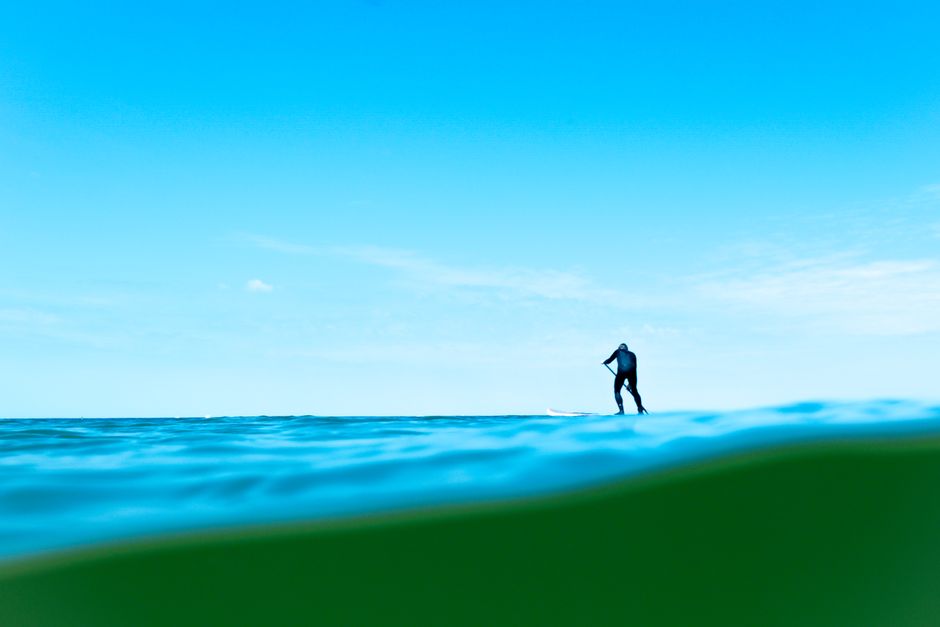
You are a hundred metres off the beach on a bright morning, the water is flat, and then a boat wake rolls in. Your knees stiffen, your eyes lock onto the nose of the board, and you are suddenly sure you are about to fall. Or you are on the start line of a distance race, heart pounding, with a beach full of boards and every paddler around you setting off faster than you planned. Paddleboard mental training means practicing the skills that help stand-up paddlers (SUP) stay steady, think clearly and pace themselves in moments like these. This page is for paddlers, parents and coaches, from first-time renters to racers.
Quick answer: Mental skills for paddlers are habits you can practice: build balance confidence by falling on purpose in warm, safe water with a life jacket on, look at the horizon or the next buoy instead of your feet, agree a plan and a turn-around point before you launch, and start races at a pace you have trained. Research on these skills in paddleboarders is thin, and nothing here promises a faster time or removes the real risks of open water. If worry, low mood or trouble with eating or sleep lasts more than a couple of weeks, see a doctor or a licensed mental health professional; in the US, call or text 988 in a crisis.
Balance confidence and the fear of falling in
Nearly every paddler falls in, and many feel nervous before they do. That worry is normal, and it can make you stiff, which makes falling more likely. Confidence usually comes from having done the thing you fear. Our paddleboard training guide describes on-water practice such as pivot turns, surf-stance paddling and paddling through boat wakes on purpose, always with a life jacket on. Many instructors add a first step: fall off deliberately, on a calm day in warm, shallow water, then practice climbing back on. We found no published study testing this approach in paddleboarders, so treat it as common instruction practice, not a proven treatment.
Where you look also matters. In a 2025 study (PeerJ), paddlers who could look where they liked were faster and used a higher stroke rate than when told to stare at the nose of the board. The study measured speed, not fear, so we use it only as a reason to practice lifting your eyes to the horizon. Cold water is a different matter: it is a safety issue, not a nerves issue, and the National Weather Service says to dress for the water temperature, not the air. Safety details are on our paddleboarding injuries and safety page.
Staying calm and deciding well on open water
Calm on the water starts on shore. Many experienced paddlers decide three things before they launch: what the weather and wind limit is for the day, where the turn-around point is, and who will call it if the group disagrees. The Coast Guard’s advice is to leave a float plan with a responsible person, and our paddle day and race day guide has the plan, the wind and lightning rules and what to carry, so we do not repeat them here.
When something goes wrong, a short routine beats a long debate. One pattern used by many instructors is: stop, breathe, look, decide. Stop paddling toward trouble, take one slow breath, look at the shore and the conditions, then choose one action, such as lying down on the board and paddling prone, or heading in. That is coaching practice, not a result from a SUP study. Good judgment also means saying no. If conditions are beyond your skill today, going home is a decision, not a failure.
Focus and routines
Long sessions test attention as much as shoulders. A 2026 survey of 172 paddleboard athletes (Wang and colleagues, PLoS One) found that people who scored higher on trait mindfulness also scored higher on psychological coping skills, and both were linked with mental toughness scores. It was a one-time questionnaire study, so it shows association, not that mindfulness training makes anyone paddle better. A practical use of the idea is simple: pick one cue for the stroke, such as hips driving the blade, and bring your attention back to it whenever it wanders. Wandering is normal; returning is the skill.
Visualization (imagery) means picturing a session or start before it happens. A 2023 systematic review and meta-analysis across sports (Reinebo and colleagues, Sports Medicine) looked at psychological interventions for athletic performance. We found no paddleboard-specific imagery study, so use it as one tool and check how it feels for you.
Race routines and pressure
Race mornings add pressure: a crowded beach, a horn, rivals. A 2026 position statement from Exercise and Sports Science Australia on performance under pressure (Schweickle and colleagues, Sports Medicine) lists pre-performance routines among its evidence-based strategies and says pressure can help as well as hurt. It also says practicing under some pressure, such as a time trial with friends watching, can prepare athletes. For a paddler, a routine can be the same warm-up order every race, one slow breath before the start and one cue word for the first strokes. Race logistics, fueling and course rules are on the race day page.
Buoy turns and beach starts are where races get messy. Rehearsing them in training, with other boards around you, makes them familiar; see the technical-race description on the training and race day pages. That is coaching practice, and we found no study on it.
Pacing a race
Pacing is partly a mental skill: holding back in the first minutes when everyone else sprints. We found no peer-reviewed pacing study of SUP races to quote. What the training research does show is that effort matters. In an analysis of a national-level SUP marathon, elite paddlers spent 89% of the race between 80% and 100% of their predicted maximum heart rate, and in a 2020 study of international male racers, 45 strokes a minute was more economical than 55 or 65 (see our training page). A 2025 analysis of sprint kayak racing (Estreich and colleagues, PLoS One) found a drop-off in velocity and a late kick to be the main pacing patterns. It studied kayakers, so apply it to SUP with caution. The practical message is that holding a pace is a learned skill: practice a steady rhythm you can hold for the whole distance, then add power.
Setbacks and bad days
Every paddler has a session that goes badly: a fall at the first buoy, a race ended by wind, a trip cut short. A common three-step reset is to take a slow breath, note one thing to learn and move on to the next job. We found no SUP study on recovering from a bad race, so this is coaching practice. After hard blocks, protect sleep and easy days; see paddleboarding recovery.
Young paddlers
We found no paddleboard-specific research on mental skills in children or teens to cite here. For youth programs and clubs, see youth paddleboarding and paddleboarding leagues and associations. Most young paddlers need patient, fun coaching and small steps in safe, shallow water. If a child shows lasting fear or distress, start with their pediatrician or a licensed mental health professional.
Mental performance is not the same as mental health
Everything above is about performance skills. Anxiety disorders, depression, disordered eating and burnout are health matters, not mindset problems, and a better routine will not fix them. The 2026 International Olympic Committee consensus statement on mental health in elite athletes (Reardon and colleagues, British Journal of Sports Medicine) treats them as matters for medical and psychological care. Signs worth taking seriously include worry or low mood that lasts, loss of interest in paddling, changes in eating or sleep, or feeling you cannot stop training.
Start with your doctor, a licensed psychologist or another qualified mental health professional. In the US, you can call or text 988 (Suicide & Crisis Lifeline) at any time. For eating and weight concerns, a clinician should lead; the basics are on our paddleboarding nutrition page.
Frequently asked questions
How do I stop being afraid of falling off my paddleboard?
Practice falling and climbing back on in small steps, in warm, shallow water, with a life jacket on and a friend nearby. Confidence comes from having done it, not from willing the fear away. We found no study testing this in paddleboarders, so treat it as common instruction practice.
Where should I look when I paddle?
A 2025 study found paddlers who could look where they liked were faster and had a higher stroke rate than when told to stare at the nose of the board. Try the horizon or the next buoy.
How do I stay calm if the wind picks up?
Decide your limits and turn-around point before you launch. If it happens anyway, use a short routine: stop, breathe, look, decide, then head in, lying prone on the board if needed. That routine is coaching practice, not a SUP study result.
How should I pace a SUP race?
We found no SUP pacing study to quote. Practice a steady stroke rhythm you can hold for the whole distance, and resist copying the fastest start around you. A 2020 study found 45 strokes a minute more economical than 55 or 65 in international male racers.
When is nervousness a health issue?
If worry, low mood or trouble with eating or sleep lasts more than a couple of weeks or interferes with daily life, talk to a doctor or licensed mental health professional. In the US you can call or text 988 in a crisis.
Sources
- Wang J et al. Trait mindfulness, psychological skills, and mental toughness in paddleboard athletes: a correlational study. PLoS One, 2026. PMID 42721209
- Kinematic and neuromuscular responses to different visual focus conditions in stand-up paddleboarding. PeerJ, 2025. PMID 40292107
- The effect of different cadence on paddling gross efficiency and economy in stand-up paddleboarding. IJERPH, 2020. PMID 32645890
- A performance analysis of a stand-up paddleboard marathon race. J Strength Cond Res, 2017. PMID 28538304
- Estreich H et al. Pacing profiles in sprint kayak racing. PLoS One, 2025. PMID 40601604
- Reinebo G et al. Effects of psychological interventions to enhance athletic performance: a systematic review and meta-analysis. Sports Medicine, 2023. PMID 37812334
- Schweickle MJ et al. Performance under pressure in sport: a position statement from Exercise and Sports Science Australia. Sports Medicine, 2026. PMID 42271117
- Reardon CL et al. Mental health in elite athletes: International Olympic Committee consensus statement (2026). British Journal of Sports Medicine. PMID 42580854
- National Weather Service, hazards of cold water activities
- US Coast Guard, float plan
- 988 Suicide & Crisis Lifeline
General information for education only, not medical advice. It does not replace a doctor, psychologist or other qualified professional, or a qualified SUP instructor. See how we work in our editorial policy. Back to the paddleboarding hub.