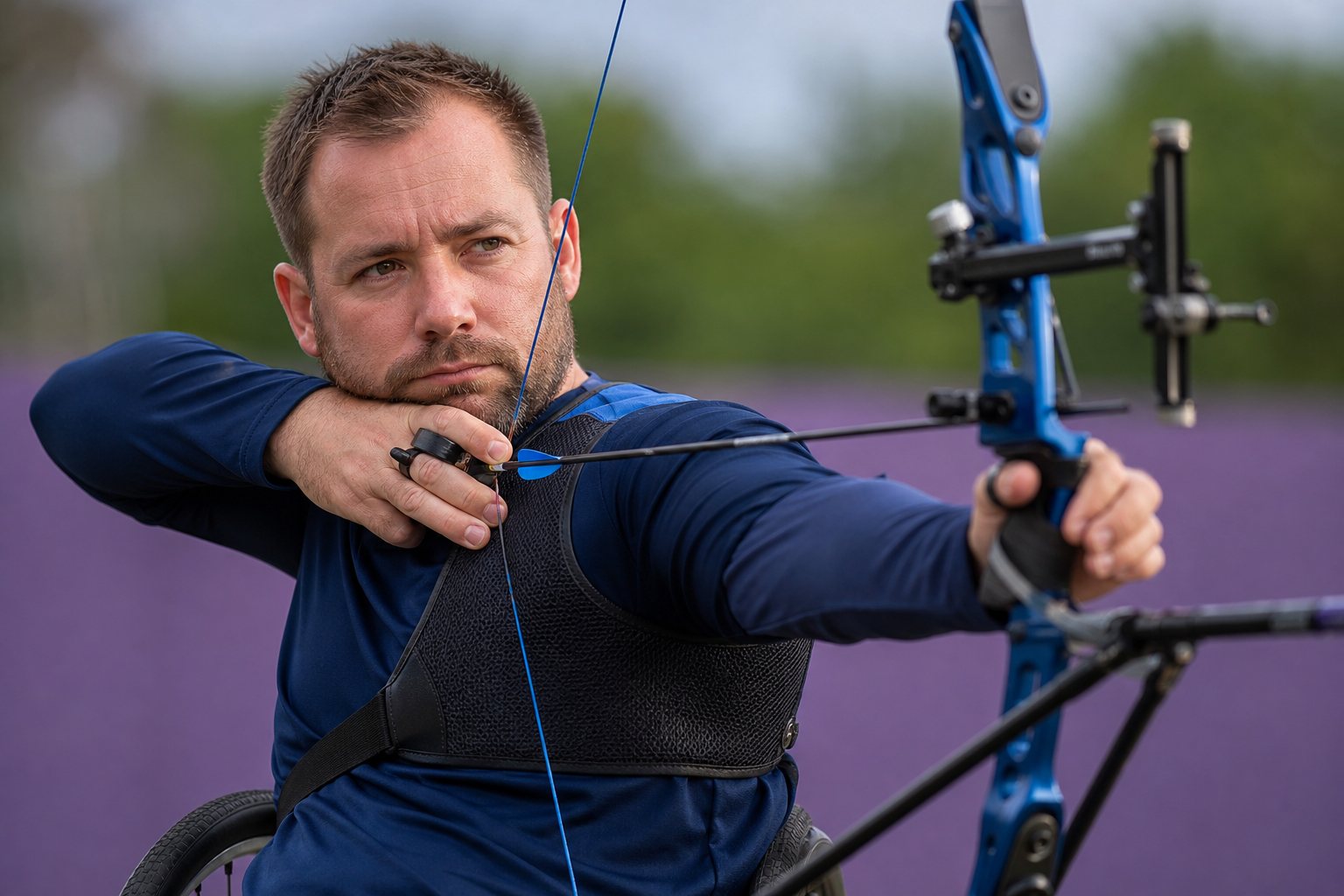
The line goes quiet, a whistle sounds twice, and the archers step up: one standing, one on a stool, one in a wheelchair, one wearing a blindfold. Para archery looks like Olympic target archery because it is built on the same rules, with extra rules for classification and assistive equipment. This page explains how it works, how a beginner can start, and where the official rulebooks live.
Quick answer: Para archery uses the same targets and scoring as able-bodied archery. Competition classes are Open, W1 and visual impairment (VI1, VI2/3), and the classification card lists the devices an archer may use. Beginners usually start at a club or adaptive sports program that lends gear; for national events in the US, you register with USA Archery and get classified. Rules and dates change, so check the current rulebook.
Back to the para archery hub. This is the adaptive side of archery.
The basics of scoring
Archers shoot at a target face with ten scoring zones. The innermost ring scores 10 and the outer ring scores 1, and an arrow that touches a line takes the higher score. World Archery describes a 122 cm face at 70 m for recurve and an 80 cm face at 50 m for compound, and the IPC lists the 80 cm face at 50 m for W1 archers. In the ranking round an archer shoots 72 arrows, and that total decides seeding for the head-to-head matches (IPC).
Match formats come from World Archery’s rulebooks. In recurve individual matches, archers shoot sets of three arrows and win a set for two points; the first to six set points wins. Compound matches are scored by total points over five ends of three arrows. Team and mixed team rounds use shorter shooting times. Para Open divisions follow nearly the same rules as able-bodied archery, according to World Archery.
Time limits and range signals
Shooting time is part of the rules. World Archery Book 3 gives 20 seconds per arrow in team rounds and alternate shooting, and 30 or 40 seconds per arrow for individual qualification and match play depending on the event. The IPC page for Para archery states 30 seconds per arrow. Because the number can differ by event, read the rules of the event you enter.
Range commands are the same everywhere and worth learning before your first visit: two whistles to step to the line, one to start shooting, three to walk and score, and five or more for an emergency stop (World Archery Book 3). Never touch an arrow before it has been scored, and never draw a bow unless you are on the shooting line facing the target.
Classes in plain language
Classification confirms that an archer has an eligible impairment and decides which assistive devices that archer may use. World Archery lists four competition classes:
- Open: wheelchair (W2) and standing (ST) archers compete together, with recurve or compound bows under almost the same rules as able-bodied events.
- W1: archers with the most severe impairments, usually affecting both sides of the body and the trunk. Recurve and compound are allowed, with limits.
- VI1: archers who are blind or nearly blind (B1), who shoot blindfolded.
- VI2/3: archers with low vision (B2 and B3), who shoot without blindfolds.
Athletes first provide medical evidence, then two classifiers test strength and range of movement or, for visual impairment, acuity and field tests plus observation while shooting. Pain is not scored, and the test can stop if it becomes too painful. Some athletes get a review date, for example when a condition is new or changing. A “not eligible” (NE) result means the archer cannot enter para events, though some NE archers are approved to use an assistive device in able-bodied events (World Archery).
How a beginner starts
- Find a range. Local archery clubs and adaptive sports organizations often lend bows, arm guards and tabs. Call first and ask about adaptive options, such as a stool, a stand, or a release aid.
- Take a coached session. A coach can set a draw weight that you can control and show you how to adapt your set-up to your body. Nothing on this page replaces that.
- Add a clinician if you have a medical condition. A sports medicine doctor, physical therapist or athletic trainer who knows your impairment can advise on training.
- Shoot for fun first. Classification only matters when you want to enter sanctioned competitions.
Getting classified in the United States
USA Archery asks for a medical intake form signed by a physician within the past 12 months, plus a photo, at least 30 days before the event. You also need a USA Archery membership. At the appointment you bring every assistive device you use, and classifiers test range of movement, strength and balance. Forms and schedules change, so confirm on the USA Archery site before registering.
Levels and pathways
After club level come national events (USA Archery runs para events within its tournament schedule, and Move United holds a national archery event), then World Para Archery events and the Paralympic Games. According to the IPC, archery has been on the Paralympic programme since Rome 1960, and it is confirmed among the 22 sports for LA28, with nine medal events. The Games run 15 to 27 August 2028; check the official programme for the current schedule.
Official rulebooks
World Archery publishes its rulebooks online: Book 2 covers events and formats and Book 3 covers target archery. Para-specific rules and classification documents are published on the World Archery site. Treat any page that summarizes rules, including this one, as a starting point and use the current rulebook for disputes or entries.
Para archery rules FAQs
Can I shoot from a wheelchair or stool?
Yes. Wheelchairs and stools are listed by World Archery as common assistive devices, and the classification card states what an archer may use in competition.
What does W1 mean?
W1 is the competition class for archers with the most severe impairments, usually on both sides of the body and the trunk. Recurve and compound archers compete together, with equipment limits (World Archery).
How do blind archers shoot?
VI1 archers shoot with blindfolds, and VI2/3 archers shoot without them. World Archery describes classification by acuity and field tests and observation while shooting.
Do I need to be classified to try archery?
No. Classification is for entering sanctioned competitions. Clubs and adaptive programs welcome beginners without it.
Is para archery scored differently from Olympic archery?
Scoring zones and the 72-arrow ranking round are the same. Distances and equipment can differ by class, and shooting time can be longer in some formats.
Sources
- World Archery: Para archery classification explained
- IPC: Para archery
- World Archery Rule Book 3 (2026-01-27)
- World Archery Rule Book 2 (2026-01-27)
- USA Archery: Para archery classification
- IPC: LA28 medal events and quotas
General information for education only, not medical advice. It does not replace a doctor, physical therapist, athletic trainer, classifier or qualified coach. See our editorial policy for how we research and write.