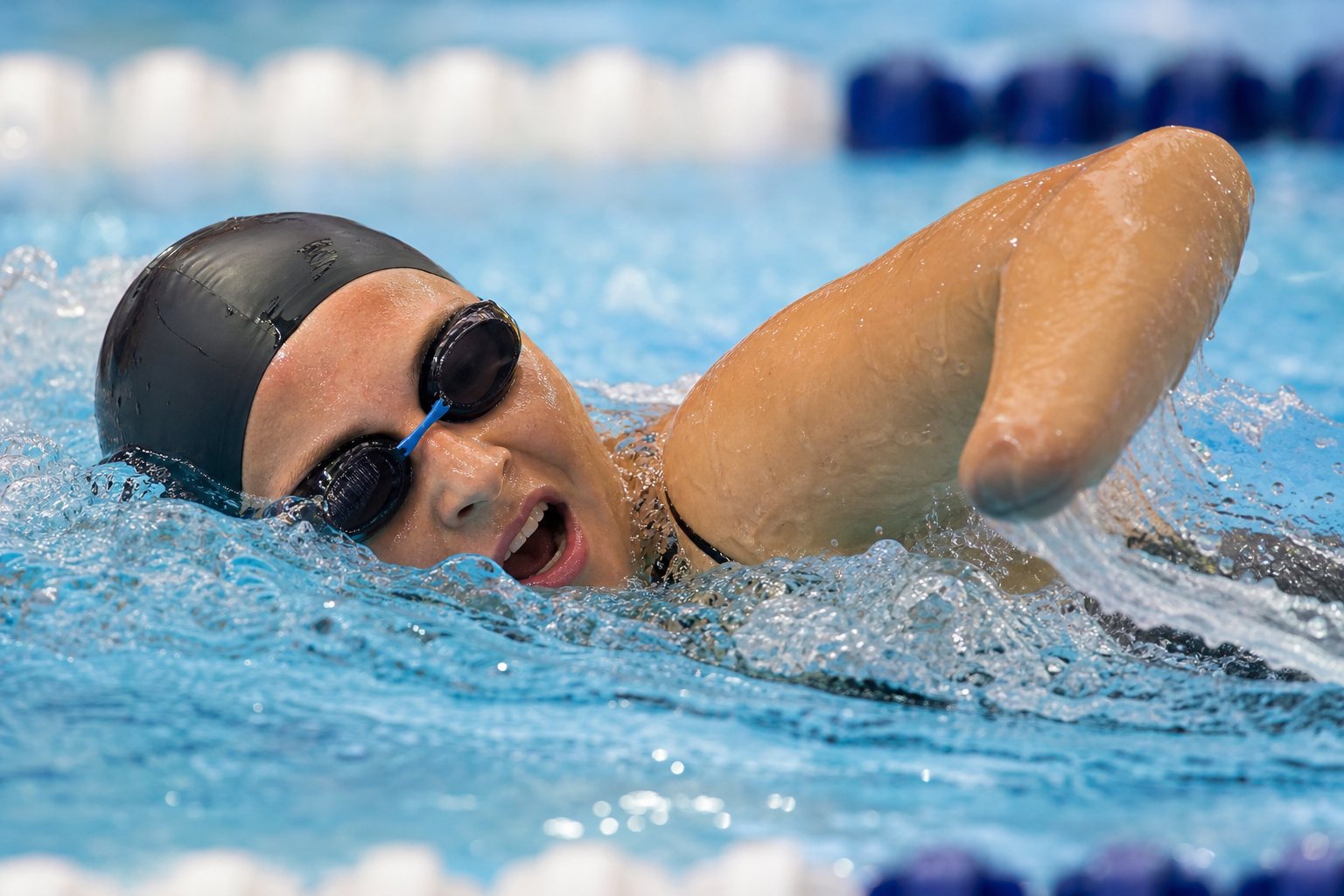
Behind the blocks, the swimmer in lane five breathes out slowly and runs through the same three cues she uses every race: long first stroke, count the turn, finish through the wall. In the next lane a swimmer with a vision impairment waits for the whistle with her tapper’s routine already rehearsed. Para swimming mental training is the set of mental skills, goal setting, focus, imagery, routines and ways of handling pressure and setbacks, that help a swimmer perform on the day. It is different from mental health, which is covered in its own section below, because mental performance skills do not treat anxiety, depression or burnout.
Quick answer: Mental skills such as goal setting, a pre-race routine, imagery and a plan for setbacks are common in Para swimming and other sports, but research on them in Para athletes is limited and no technique guarantees a result. Treat them as skills to practice, not shortcuts. If worry, low mood, sleep trouble, disordered eating or burnout are affecting your life, see a qualified mental health professional; in the US you can call or text 988.
General information, not medical advice. Logistics for race day are on our Para swimming rules page and the parent sport’s game day swimming guide.
What the research says about Para athletes
The 2026 IOC consensus statement on mental health in elite athletes (Reardon and colleagues, British Journal of Sports Medicine) says mental health symptoms are common among elite athletes, can affect performance, and that elite Para athletes are relatively understudied and may have distinct concerns. So most mental-skills advice for Para swimming is borrowed from other athletes and adapted. In a 2025 study of 83 Swedish elite Para athletes (Fagher and colleagues, British Journal of Sports Medicine), the most used coping behaviours were acceptance, active coping and planning, and athletes who used more active coping were less likely to report an injury in the next 52 weeks. It is an association in one country’s athletes. A 2026 survey of 111 Turkish Paralympic national team athletes in physical and vision impairment groups (Topuzoglu and colleagues, BMC Sports Science, Medicine and Rehabilitation) measured how they use imagery with the Sport Imagery Questionnaire and linked imagery use to sport experience; it describes use and does not prove imagery improves swimming.
Confidence and self-talk
Confidence grows from preparation you can point to: sets completed, starts practiced, a race plan rehearsed. A general approach is to write down two or three things you do well in the water and a short cue for each, such as “long” or “strong turn”, for use behind the block. Reinebo and colleagues’ 2023 meta-analysis in Sports Medicine of psychological interventions for athletes found effects that were not stable after sensitivity checks, so we promise nothing here.
Focus and attention
A pool race is short and loud. Many coaches teach one or two focus cues per length, such as stroke count, rhythm or the next wall. For swimmers with a vision impairment, the wall is signalled by a tapper (mandatory in classes S11, SB11 and SM11 per the 2024 World Para Swimming rulebook), so practice with your tapper until the tap is part of the rhythm. Limited visual feedback affects pacing in swimmers with a vision impairment, according to the Gatorade Sports Science Institute’s 2025 review, so practicing race pace with a coach’s feedback may help. (The review does not give a recommended method.)
Goal setting and motivation
Useful goals are specific and within the swimmer’s control: process goals (starts, turn counts, pull pattern), then performance goals (a time in a class), then outcome goals (a place). Check goals weekly with a coach, and keep one that is about enjoying the sport. This is general coaching practice, not a finding from a Para-specific trial.
Imagery
Many swimmers rehearse the race in their mind: the start, each length, the turn and the finish, using whatever senses they rely on, including sound, feel of the water and the rhythm of the tapper. That is the general method taught in sport psychology; the Turkish survey above shows Paralympic athletes use imagery, but we found no Para swimming trial that shows it speeds up a swimmer. Five minutes before sleep or at the start of a session is enough to try.
A pre-race routine
A routine you can repeat anywhere keeps you steady when a meet is delayed or the call room is crowded. A typical routine (general practice) has a warm-up, a breathing pattern, a set of cues and the same steps at the block. Build in time for transfers and equipment, and know the rules for your start and any assistance. Practice it in training, not only on race day.
Handling pressure and setbacks
Nerves are a normal part of racing. Breathing slowly, going through your routine and returning attention to the next stroke are common techniques. After a poor swim, many athletes find it useful to wait before reviewing, then pick one thing to fix. Classification can be stressful too: a class review or a change after a competition can feel like a verdict on you (a general observation). Talk it through with your coach and, if it is weighing on you, a mental health professional. The Swedish study above suggests acceptance and planning are common ways Para athletes cope with adversity.
Mental health is not the same as mental performance
The IOC consensus statement says mental health symptoms and disorders are common in elite athletes, can affect performance, and are treatable. In a 52-week study of 107 elite Swedish Para athletes (Fagher and colleagues, PM&R, 2023), 34.1% reported anxiety or depression in an average week, so these concerns are not rare. Anxiety that will not settle, low mood, loss of interest, disordered eating, severe burnout or thoughts of self-harm are health matters for a qualified professional, not something to fix with imagery. In the US, the 988 Suicide and Crisis Lifeline is available by call or text; elsewhere, contact local emergency services or your national helpline. We did not source NCAA or Paralympic helplines for this page.
Younger swimmers
We did not find Para-swimming-specific guidance for children on mental skills. Keep it simple and fun, let the child set goals, and speak to a doctor or counsellor if a young swimmer is withdrawn or distressed.
Para swimming mental training: FAQs
Does mental training improve Para swimming results?
Evidence in Para athletes is limited. Goal setting, routines and imagery are widely used, but no technique guarantees faster times.
How can a swimmer with a vision impairment build a race routine?
Rehearse the start, the tapper’s taps and the wall signals with your coach until they become automatic. Classes S11, SB11 and SM11 must use a tapper under the 2024 rulebook.
What if nerves ruin my races?
Practice breathing, a routine and one or two cues in training. If anxiety is persistent or affects sleep or daily life, see a mental health professional.
Is imagery useful for Para swimmers?
Paralympic athletes report using imagery, per a 2026 Turkish study, and sport psychology teaches it widely. We found no Para swimming trial showing it speeds up a swimmer.
Where can I get help right now?
In the US, call or text 988. If you are in danger, call emergency services. For other concerns, see a doctor or qualified mental health professional.
Sources
- Reardon et al. 2026, IOC consensus statement on mental health in elite athletes, BJSM
- Fagher et al. 2025, coping behaviour and injury in elite Para athletes, BJSM
- Fagher et al. 2023, mental health, sleep and pain in elite Para athletes, PM&R
- Topuzoglu et al. 2026, imagery in Paralympic athletes, BMC Sports Sci Med Rehabil
- Reinebo et al. 2023, psychological interventions in athletes, Sports Med
- Goosey-Tolfrey and Perret 2025, how impairments affect energy expenditure (GSSI SSE 261)
- World Para Swimming Rules and Regulations, April 2024
- 988 Suicide and Crisis Lifeline
General information for education only, not medical advice. It does not replace a visit with a sports medicine doctor, physical therapist or athletic trainer who knows you and your impairment. See how we write and check our pages in our editorial policy, and return to the Para swimming hub.