This article contains affiliate links: if you buy through them we may earn a commission, at no extra cost to you. Read our affiliate disclosure.
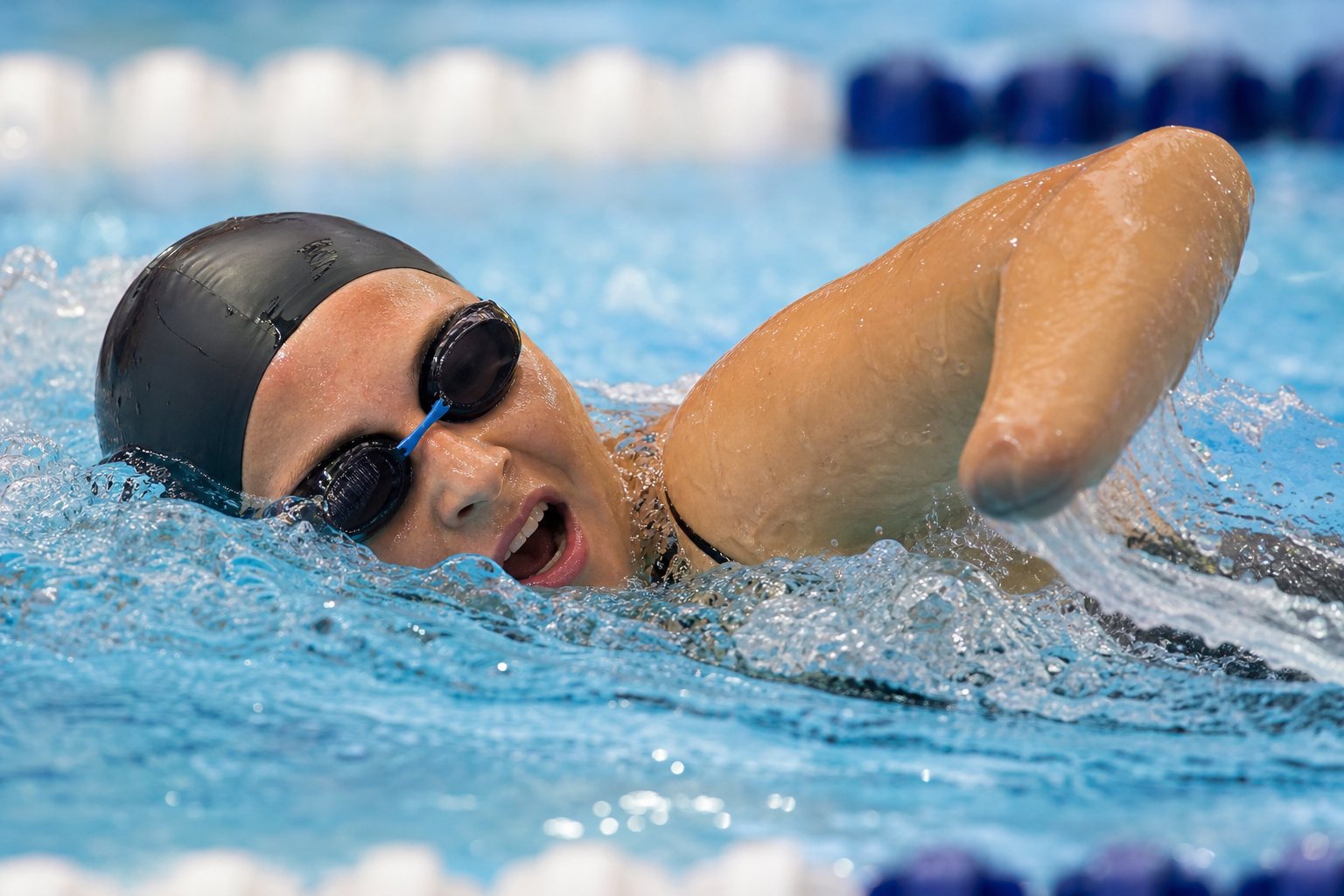
The pool is 50 metres long and a swimmer with a leg impairment is counting her strokes down the lane, trying to hold the same count on the fourth length as the first. Para swimming training is the planning behind a swimmer’s racing: how much water work, how much strength work, how it is arranged across a week and a season, and how each plan is bent around a particular body. Most published training research is about swimmers without impairments, so this page says clearly where the evidence is about Para swimmers and where it is general coaching practice.
Quick answer: Swimming asks a lot of the arms, shoulders and trunk, and Para swimmers are not one group: a swimmer with cerebral palsy, a spinal cord injury, a limb difference or a vision impairment trains differently. The small studies that exist link upper-body strength and power to 100 m freestyle speed. A sensible week mixes pool sessions, supervised strength work and rest, built up gradually with a coach who knows the swimmer’s impairment. Pain that lingers in a shoulder, or any new numbness or weakness, is a reason to see a sports medicine doctor, physical therapist or athletic trainer.
What the sport demands
Swimming is a whole-body sport, but how the body is used depends on the impairment. A 2025 motion-analysis study in Sports Medicine Open (Lee and colleagues) compared 27 swimmers with central motor and neuromuscular impairments (cerebral palsy, spinal cord injury and neuromuscular disorders, classes 2 to 9) with 13 swimmers without impairments swimming 100 to 200 m front crawl. The Para swimmers showed less shoulder roll and torso twist and more hip roll than the comparison group, which shows that technique targets differ by body. A 2025 cross-sectional study from Japan (Shimura and colleagues) of 7 swimmers with a unilateral forearm deficiency and 5 with a vision impairment found shoulder range of motion was lower in the forearm-deficiency group, which a coach may take into account when planning streamline work. Both studies are small, so treat them as examples, not rules.
Strength and power in the dry-land room
Cavaggioni and colleagues (Sports, 2024) tested 15 elite Paralympic swimmers (9 men, 6 women) on a lat pull-down and a bench press and compared the results with their best 100 m freestyle times from international competition. Several strength and velocity measures were related to race speed, and in the regression the lat pull-down and bench press velocity measures accounted for 40.6% to 65.8% of the variance in mean swimming speed. The authors call the results preliminary and the relationship moderate. A 2026 study in BMC Musculoskeletal Disorders (Mahmoudkhani and colleagues) tested the shoulder rotators of 53 elite male Para athletes, including Para swimmers, and found left-right strength differences stayed at or under 15% in all sports; the authors describe such differences as adaptations rather than automatic problems.
What this means for a plan is general: pulling and pushing strength, trunk work and shoulder-balance exercises are a common part of Para swimming programs, chosen and supervised by someone who knows the athlete. Our swimming training page covers dry-land basics for all swimmers, and the American Academy of Pediatrics’ youth strength-training guidance (supervised sessions, lifting without added weight first) is the starting point for younger swimmers.
A sensible week (general coaching practice)
No source we read prescribes a weekly shape for Para swimmers. The following is a general outline many coaches use, to be adjusted by the coach for the individual swimmer:
- Pool sessions with a mix of technique, aerobic swimming and short fast work, shaped to the swimmer’s strokes, class and fatigue pattern.
- Two or three short dry-land sessions (strength, trunk and shoulder care), kept away from the hardest pool days where possible.
- At least one easy day or rest day. The American Academy of Pediatrics suggests 1 to 2 days a week off from the main sport for young athletes (Brenner, Pediatrics 2016); adults benefit from rest too.
- Time for transfers, dressing and getting to the pool. For many swimmers these add effort that a distance count does not show. Plan around them.
Load, fatigue and season planning
The International Olympic Committee’s consensus on load in sport (Soligard and colleagues, 2016) says rapid jumps in training load are linked to more injuries and that gradual build-up protects. For Para athletes, a one-year Brazilian study of 102 athletes in swimming, athletics, powerlifting and taekwondo (Resende and colleagues, 2025) found that the odds of substantial gradual-onset injuries rose slightly as the season went on, and a related 2026 study of 61 athletes (Madaleno and colleagues) found high weekly stress was linked with higher odds of a gradual-onset injury the following week and high fatigue with substantial gradual-onset injury. So tracking stress, fatigue and soreness with simple weekly or daily scores is a reasonable habit, as the authors suggest. The studies show associations, not cause.
Training intensity distribution and tapering have been studied mostly in swimmers without impairments. A 2021 systematic review (International Journal of Sports Physiology and Performance) described sprinters as using polarized and threshold distributions and distance swimmers mostly pyramidal ones. A 2007 meta-analysis (Bosquet and colleagues) found taper plans worked best at about two weeks with volume cut 41% to 60% and intensity and frequency kept. Whether those numbers fit a given Para swimmer is a coach’s call.
Skills, starts and turns
Each swimmer’s allowed start and turn is set by classification (see Para swimming rules), so practice the start you will race. Sessions on starts, turns and finishes are worth separate time, because they decide close races and need a safe set-up: a spotter on the deck for swimmers who start sitting or in the water, and agreed signals for swimmers with a vision impairment and their tapper.
Training tools (check the fit first)
Pull buoys and bands are common tools. Not every tool suits every body or impairment, and none can be used in a race under World Para Swimming rules, so ask your coach whether a tool helps you before you buy it. The listings below are from the makers’ pages and do not carry a safety or effectiveness claim.

Speedo Swim Training Pull Buoy
- Soft EVA foam
- Raises hips and legs
- Check fit with your coach
$13.00 at Amazon, as of Nov 17, 2026 01:07 UTC
Check price on Amazon
THERABAND Beginner Resistance Band Kit
- Yellow, red, green flat bands
- Clinic-standard color system
- Ask a professional to show you the exercises
$11.99 at Amazon, as of Nov 17, 2026 01:07 UTC
Check price on AmazonWhen to get help
See a sports medicine doctor, physical therapist or athletic trainer for shoulder pain that lasts, pain at night or at rest, new numbness, weakness or changes in how your body responds, or any worry about skin or circulation in the training schedule. Related pages: injury prevention, recovery and the Para swimming hub.
Para swimming training: FAQs
How many days a week should a Para swimmer train?
We found no source giving a number. Coaches set it by the swimmer’s age, class, goals, fatigue and life schedule. Include at least one rest or easy day.
Does strength training make Para swimmers faster?
A small 2024 study of 15 elite Paralympic swimmers found upper-body strength and power measures related to 100 m freestyle speed. That is an association in a small group, not proof that a plan will work for you.
Should Para swimmers use the same plan as Olympic swimmers?
Not automatically. Most research is on swimmers without impairments; a plan should be adapted to class, strokes, strength, fatigue and any medical issues, by a coach who knows the swimmer.
Can I use paddles, fins or a pull buoy?
They are common in training but may not suit every impairment, and none are allowed in a race. Ask your coach first.
How do I know if I am overdoing it?
Watch for lasting pain, poor sleep, heavy fatigue or stress. A 2026 study of Para athletes linked high stress and fatigue to later gradual-onset injury. Talk to your coach or a clinician.
Sources
- Cavaggioni et al. 2024, dry-land strength and Paralympic swimming, Sports
- Lee et al. 2025, body roll in Para swimmers, Sports Med Open
- Shimura et al. 2025, female Para swimmers, J Phys Ther Sci
- Mahmoudkhani et al. 2026, shoulder isokinetic strength in Para athletes, BMC Musculoskelet Disord
- Resende et al. 2025, one-year injuries in Para athletes, BMJ Open Sport Exerc Med
- Madaleno et al. 2026, stress, sleep, fatigue and injury in Para athletes
- Soligard et al. 2016, IOC consensus on load in sport and injury risk
- AAP, Brenner 2016, sports specialization and intensive training
- Training intensity distribution in elite swimmers, systematic review 2021
- Bosquet et al. 2007, tapering meta-analysis
- AAP HealthyChildren.org, strength training
- Speedo pull buoy (Amazon listing)
- THERABAND Beginner Kit (Amazon listing)
General information for education only, not medical advice. It does not replace a visit with a sports medicine doctor, physical therapist or athletic trainer who knows you and your impairment. See how we write and check our pages in our editorial policy, and return to the Para swimming hub.