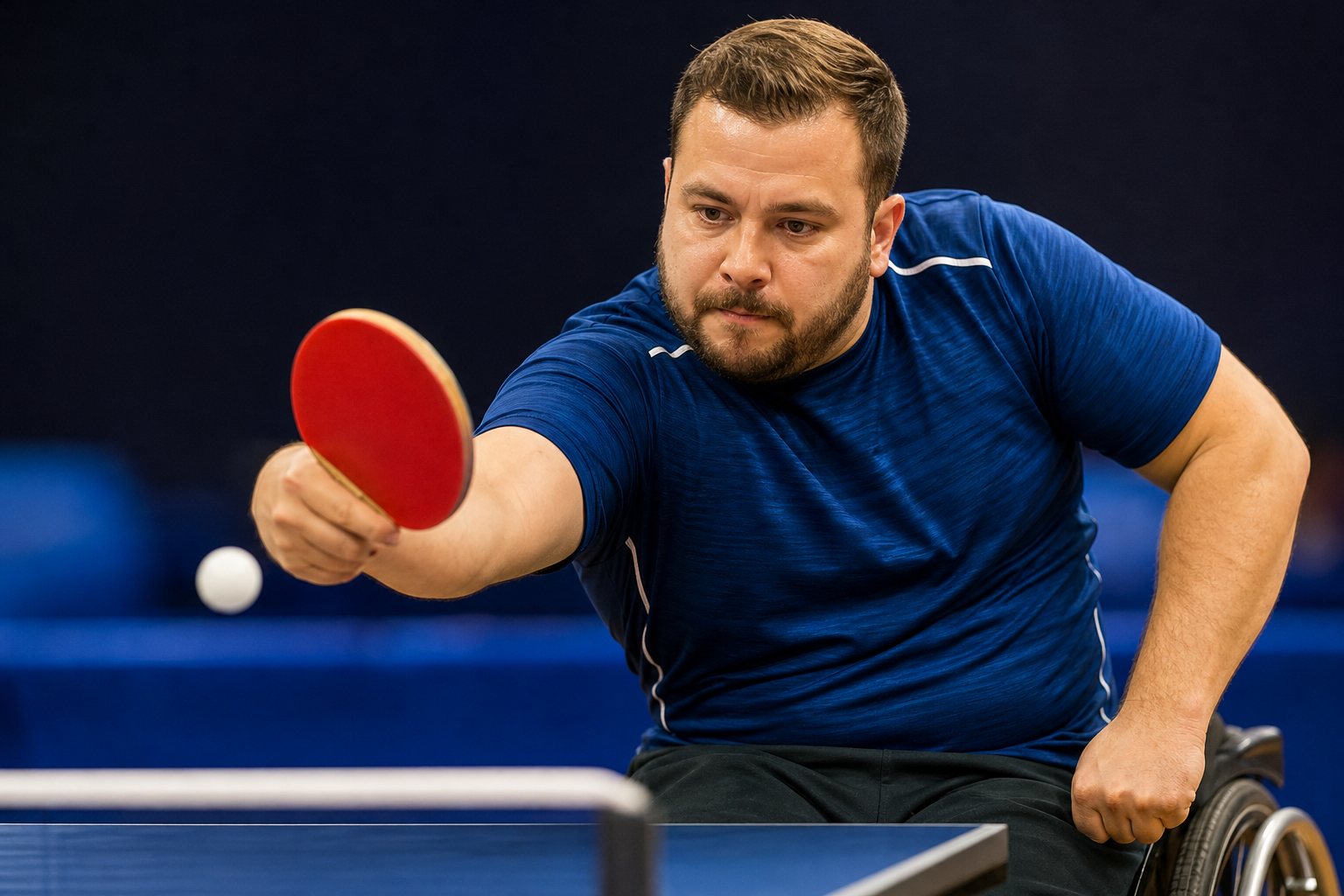
It starts as a nagging ache at the top of the shoulder after a long tournament weekend, and by Monday it hurts to reach for a ball. Para table tennis injuries are the strains, overuse problems and occasional falls that come with a fast racket sport played from a chair or on one’s feet with an impairment. The honest picture is that good numbers are thin. This page sets out what we found, general rehabilitation principles and when to see a professional. To lower your risk see injury prevention.
Quick answer: Para-specific table tennis injury data are scarce. What exists points to the shoulder and upper limb as the main trouble spot, and Paralympic surveillance has not flagged table tennis as high-risk. Rehab is guided by a clinician who knows your impairment. See a sports medicine doctor, physical therapist or athletic trainer for pain that lasts, and get emergency care after a head injury with danger signs.
What the numbers say
At the Tokyo 2020 Paralympic Games, injury surveillance (Derman and colleagues, British Journal of Sports Medicine, 2023) covered 4,403 athletes from 162 countries and recorded 386 injuries, an incidence of 5.8 per 1,000 athlete days. Football 5-a-side (17.2), taekwondo (16.0), judo (11.6) and badminton (9.6) had the highest rates, and table tennis was not among them. The shoulder (0.7) and the hand and fingers (0.6) were the most common sites, in injuries per 1,000 athlete days. At Paris 2024 (Br J Sports Med, 2026), 535 injuries were recorded among 4,450 athletes, 8.6 per 1,000 athlete days, and again table tennis was not named as a high-rate sport. We could not find a table-tennis-specific figure in either, so we do not quote one.
Smaller studies fill part of the gap. A questionnaire study of 61 para table tennis players, which we know only from a database listing, reported that 60.7 percent of injuries involved the upper limb and named incorrect technique as the most common cause. For standing table tennis in general, a 2022 scoping review of 42 investigations (Medicina) listed tenosynovitis, benign muscle injuries, strains and sprains as the most common types, most often in the lower limb, shoulder and spine. In 139 national-level juniors (Bonhomme and colleagues, 2026), 82.6 percent of injuries were overuse. Those are standing players, so they show the sport, not para players.
Shoulder and upper limb
The shoulder does the swinging, and for wheelchair users it also pushes the chair. A 2017 systematic review in PLOS ONE reported shoulder complaints in 16 to 76 percent of wheelchair athletes across the studies it covered, with low study quality. Pain at the top or front of the shoulder, pain when lifting the arm, night pain, weakness, or a catching feeling are all reasons to be assessed. Do not self-diagnose: several different problems feel similar. Wrist and elbow overload also occur in racket sports, and the American Academy of Orthopaedic Surgeons describes tennis elbow as pain on the outer elbow linked to repeated gripping, which can affect any racket sport player.
Back, hips, knees and feet
Trunk and back strain are plausible in any player who twists repeatedly, and a 2018 study found that wheelchair table tennis players had less trunk rotation than able-bodied athletes, which may change how loads are shared, though that study did not measure injury. For standing classes, the knee and the lower limb are common sites in the table tennis literature. If a joint swells, locks, gives way or cannot take weight, see a clinician promptly.
Skin, pressure areas and chair-related problems
Long sessions in a chair can cause pressure injuries. A 2021 study of wheelchair basketball athletes (Maeda and colleagues) linked repeated high pressure loading and complex movements to pressure injuries, and a guideline from the Australian Institute of Sport and Paralympics Australia addresses prevention and management in para sport. Check your skin after play using the routine your clinician gave you. Red areas that do not fade, broken skin or new swelling need professional advice, and a sore should not be played on.
Heat, spinal cord injury and autonomic dysreflexia
Athletes with a spinal cord injury may sweat less below the injury and may not feel heat in affected areas, according to a Sports Science Exchange review on para sport. Injuries at or above the T6 level also carry a risk of autonomic dysreflexia, a sudden rise in blood pressure that Paralympics Australia describes as potentially life-threatening. If you have such an injury, follow your own clinician’s plan and call emergency services if you cannot settle symptoms. Deliberately causing it to boost performance (called boosting) is banned by the IPC.
Head injuries
A fall from a chair can cause a concussion. The CDC’s HEADS UP guidance says to recognize the signs, remove the person from play, and have a healthcare provider decide when they return. Call emergency services for loss of consciousness, repeated vomiting, worsening headache, seizure or confusion.
General rehabilitation principles
Rehabilitation is individual and should be led by a clinician who knows your impairment. These principles are widely used general practice, not a protocol for any injury:
- Get the problem assessed first; the name of the injury decides the plan.
- Reduce the movements that hurt, but keep moving what you safely can.
- Rebuild strength and control gradually, shoulder blade and trunk as well as the painful spot.
- Look at causes too: technique, chair set-up, table height, workload and sleep.
- Return to full play in steps, as a clinician advises. We cannot give a return date, and recovery times vary a lot.
When to see a professional
See a sports medicine doctor, physical therapist or athletic trainer for pain that lasts more than a few days, wakes you at night, comes with numbness, weakness or swelling, or follows a fall. Urgent care is needed for head injury danger signs, a deformed limb or any symptom of autonomic dysreflexia. This page cannot diagnose anything or clear you to play.
Para table tennis Injuries and Rehabilitation FAQs
What is the most common injury in para table tennis?
We found no reliable para-specific ranking. A small questionnaire study reported mostly upper-limb injuries, and shoulder problems are common in wheelchair athletes in general.
Is para table tennis dangerous?
Paralympic surveillance at Tokyo 2020 and Paris 2024 did not flag table tennis as a high-rate sport, but those numbers cover all sports and do not break out table tennis for us.
Can I keep playing with shoulder pain?
Get it assessed first. A clinician can say what is safe, and often adjusts technique, volume or chair set-up.
How long does an injury take to heal?
It depends on the injury and the person, and we do not give timeframes. A clinician can give an estimate after an assessment.
What should I do after a fall from my chair?
Stop playing, check for head injury signs and injuries, and seek care if you have danger signs, a headache that worsens, or pain you cannot explain. A provider decides when to return.
Sources
- Derman et al., BJSM 2023: injury at the Tokyo 2020 Paralympic Games (summary page)
- Injury and illness at the Paris 2024 Paralympic Games (PMID 42103446)
- Epidemiology of sports injuries in para table tennis (Magiran listing)
- Scoping review of table tennis injuries, Medicina 2022 (PMID 35629989)
- Bonhomme et al., Ann Med Surg 2026 (PMID 42583567)
- Shoulder complaints in wheelchair athletes: a systematic review, PLOS ONE 2017 (PMID 29161335)
- Zemkova et al., Int J Sports Med 2018 (PMID 30452067)
- AAOS OrthoInfo: tennis elbow
- AIS and Paralympics Australia: pressure injuries in para sport
- Gatorade Sports Science Institute: thermoregulatory challenges in para sport
- Paralympics Australia: position statement on boosting (2024)
- IPC: the IPC tightens rules to clamp down on boosting
- CDC HEADS UP: signs and symptoms
General information for education only, not medical advice. See our editorial policy. More: the para table tennis hub, injury prevention, recovery, the table tennis hub and the sports hub.