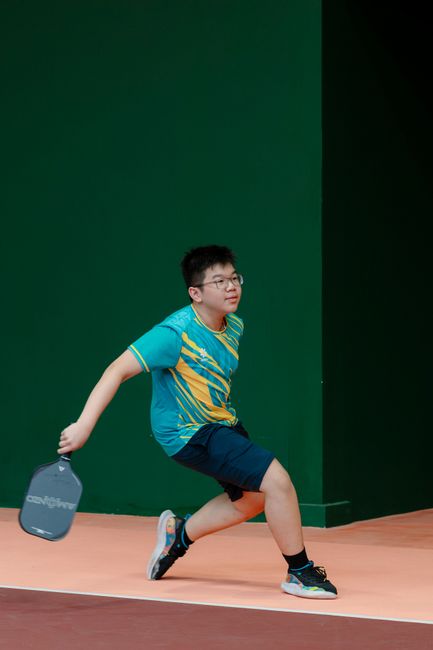
It’s 9-9 in the third game of the semifinal, your partner is serving, and the last point ended with both of you leaving a ball that landed in. Nobody says anything for a second. Then the score gets called and you have ten seconds to be ready. That moment is what pickleball mental training is about: the skills that help you reset after a point, talk with your partner, and keep your head when it matters, whether you’re in Saturday open play, a club ladder or a national event.
Quick answer: Pick a short between-point routine and use it every point, in practice too. Agree with your partner before the match on who takes what and how you’ll talk after errors. For nerves, the main published advice is to practice under mild pressure, not to avoid it. Research on pickleball mental skills specifically is thin, so much of this page borrows from sport psychology in general, and no technique promises a win. If worry, low mood, changes in sleep or eating, or loss of enjoyment last more than a couple of weeks, see a doctor or licensed mental health professional.
What the research does and doesn’t say
Pickleball has plenty of studies on who plays and how it affects health, but very few that test mental-skills training in pickleball players. We found none on between-point routines or partner communication in pickleball itself. So this page relies on a general position statement on performance under pressure, a few pickleball-specific studies where they exist, and plain coaching practice, which we label as such.
Between-point resets
Pickleball moves fast, and the time between rallies is short. Under the rules we summarize on our pickleball rules page, the full score is called before you serve and you then have 10 seconds to serve. If you need a moment, you can signal that you’re not ready (raise your paddle or free hand overhead or turn your back to the net) before the score call starts. A standard time-out is up to one minute. A reset has to fit inside those small windows.
The Exercise and Sports Science Australia (ESSA) position statement on performance under pressure (Sports Medicine, 2026) lists four strategies with an evidence base: pre-performance routines, implicit attentional strategies, psychological skills training and mindfulness-based approaches. It is not specific to pickleball, so the steps below are a common coaching template, not a tested pickleball formula:
- Release: the point is over. Tap paddles, walk to the baseline, or fix your grip, whatever marks “that one’s gone.”
- Breathe: one slow breath out while you get back in position. Shoulders down.
- One intention: choose a single plan for the next point, such as “return deep” or “soft third shot to the middle.”
- Ready: your usual serve or return setup, then play.
Practice the routine in drills and warm-up games so it’s automatic when you need it. See our pickleball training page for what else belongs in a practice week.
Communicating with your doubles partner
Most pickleball is doubles, so much of the mental game is shared. We found no pickleball study on partner communication. The closest we found is a 2025 scoping review (Cureus) of 14 studies of elite sports doubles teams, mostly tennis. It reported five collaborative practices: performance evaluation, frequent and structured practice, ongoing coach feedback, a shared team culture and mindset, and choosing partners with prior experience or familiarity. It was written to draw lessons for healthcare teams, and elite tennis is not rec pickleball, so treat it as food for thought.
Ideas to agree on before you walk on court (our suggestions, from common coaching practice):
- Who takes the middle: and what you’ll call out (“mine,” “yours,” “bounce it”) so balls don’t get left or double-hit.
- Line calls: in rec and most tournament play, each side calls the lines on its own side. Decide how you’ll check with each other, and remember that a ball you’re not sure about is in (see our rules page).
- A reset phrase after errors: something short and kind, like “next one,” in place of a sigh or a stare.
- One tactic at a time: use time-outs and changes of ends to share a single adjustment, not a list of everything that went wrong.
- During the match: shrink the goal to this point, then the next. Use the one-minute time-out for a breath, a drink and one adjustment.
- Right after: eat, drink and cool down before you review anything. See our pickleball recovery page.
- Next day: write down two things that worked and one thing to practice, then go play.
- Schweickle MJ et al., ESSA position statement, Performance Under Pressure in Sport, Sports Medicine, 2026.
- Worthington GR et al., Flow experiences in recreational doubles pickleball among adults 60 and older, Journal of Aging and Physical Activity, 2026.
- Martin EA et al., Perceived, but not neuromuscular, fatigue after doubles pickleball competitions, Research Quarterly for Exercise and Sport, 2026.
- Cui P, Jiang K, Yoon I, Passion and attitudes toward playing through pain among collegiate pickleball athletes, Frontiers in Psychology, 2026.
- Walker K et al., Collaborative practices of elite sports doubles players: a scoping review, Cureus, 2025.
- Cerezuela JL et al., Pickleball and mental health in adults: a systematic review, Frontiers in Psychology, 2023.
- Reardon CL et al., IOC consensus statement on mental health in elite athletes, British Journal of Sports Medicine, 2026.
- 988 Suicide & Crisis Lifeline.
- USA Pickleball Official Rulebook and 2026 Rulebook Change Document, as summarized on our rules page.
Focus, confidence and goals
Confidence is your belief that you can do a specific thing, such as keep dinks low or reset a fast volley. It grows from honest evidence: well-run practice, games against players at the right level, and the habit of noting what worked afterward. Goals help when you control them. A common split is outcome (win the bracket), performance (keep 80% of my serves in during drills) and process (use my reset routine on every point). Process goals are the ones nobody can take away on a bad day. This split is standard coaching practice, not the finding of a pickleball study.
One thing the research does say about focus: a 2026 survey of 213 adults aged 60 and over who play recreational doubles (Journal of Aging and Physical Activity) found high self-reported “flow,” a state of full immersion, including concentration, a sense of control and a balance between challenge and skill. Players who played more days per week reported more flow. It is a self-report survey, so it describes how players feel, not what makes them win.
Handling pressure and tournament nerves
The ESSA statement says pressure can have both helpful and harmful effects on performance, and that training environments with implicit learning and well-used pressure training can prepare athletes for it. In pickleball terms, that might mean ending practice with games that start at 8-8, playing a drill set where the loser does a small chore, or playing a few points with a spectator watching. These are our ideas for applying the statement, not drills it names.
On the day, use your routine most when the game matters most. Pick a target and commit to the plan, not the result. One more finding worth knowing: after an 11-game doubles competition, 32 recreational players (16 men and 16 women) reported more perceived fatigue, yet their countermovement-jump tests showed no sign of neuromuscular fatigue (Research Quarterly for Exercise and Sport, 2026). The authors do not say mental strategies change this, and the study did not test any. Still, it suggests that “my legs are gone” late in a tournament may sometimes be more feeling than fact. Food, drink and heat are real, and our pickleball tournament day page covers them.
After a loss or a bad stretch
These are common coaching suggestions, not results of a pickleball trial. A related caution: a 2026 survey of 500 Chinese collegiate pickleball players found that obsessive passion for the sport was associated with greater acceptance of playing through pain and injury, while harmonious passion was associated with less. It is one cross-sectional survey and cannot show cause. Still, wanting a win badly is never a reason to play on with a sudden injury, and pain is a question for a clinician. Start with our pickleball injuries page.
Getting ready for a tournament
Mental preparation starts before the first game. Write two or three process goals on a card for your bag, agree on plans with your partner, and know the format and the schedule. For fuel, hydration and heat, use the game day page; for formats and where events happen, see leagues and associations. We did not find a pickleball-specific source on mental skills for young players, so we don’t make claims about it here. For ages, stages and formats, see our youth pickleball page.
Mental performance is not the same as mental health
Routines, self-talk and imagery are performance skills. Anxiety disorders, depression, disordered eating, burnout and thoughts of self-harm are health matters, and a routine won’t treat them. The International Olympic Committee’s 2026 consensus statement on mental health in elite athletes (British Journal of Sports Medicine) describes mental health conditions as common in athletes, able to affect performance, and treatable, with many athletes continuing to compete. A 2023 systematic review of 13 studies (Frontiers in Psychology) found that pickleball was linked to better wellbeing, life satisfaction and lower depression and stress, but about 91% of the people studied were over 50, and the review is about play as exercise, not a treatment for any condition.
Talk to a doctor or a licensed mental health professional if you notice persistent low mood or worry, dread before matches, changes in sleep or eating, losing interest in a game you loved, or exhaustion that rest doesn’t fix. In the United States, you can call or text 988 (or chat at 988lifeline.org) for the free, confidential 988 Suicide & Crisis Lifeline, 24 hours a day. If you are in immediate danger, call your local emergency number. Outside the US, use your country’s crisis line.
FAQs
How do I stop getting nervous in pickleball tournaments?
Nerves can’t be removed completely, and the ESSA statement says pressure can help or hurt. Its suggestions are pre-performance routines, pressure training, attention strategies and mindfulness. Use a routine on every point, practice mild pressure situations, and give yourself a simple task for the next point.
How do I reset after losing a point in pickleball?
You have 10 seconds to serve once the score is called, so keep the reset short: release the point, one breath, one intention, then serve or return. Signal “not ready” before the score call if you truly need a moment.
How should doubles partners talk during a match?
We found no pickleball study on this. Elite doubles teams in a 2025 scoping review emphasized shared practice, feedback and a common mindset. In practice, agree beforehand on middle balls, line calls and a short reset phrase.
Does visualization help pickleball players?
We did not find a pickleball study that tested imagery, so we can’t say. Many athletes and coaches use short imagery sessions in other sports, and it costs nothing to try alongside real practice.
Why do I feel so tired late in a tournament?
In one 11-game study, recreational players felt more tired afterward even though jump tests showed no sign of muscle fatigue. Real fatigue still comes from heat, poor fueling and little sleep, so also see our tournament day page. Stop for chest pain, dizziness or confusion.
When is nervousness a health problem?
When worry, low mood or dread lasts for weeks, disrupts sleep or eating, or takes the fun out of playing, talk to a doctor or licensed mental health professional. In the US, call or text 988 if you are in crisis.
Sources
General information for education only, not medical advice. It does not replace care from a doctor or licensed mental health professional. See our editorial policy for how we choose and check sources. Back to the pickleball hub.