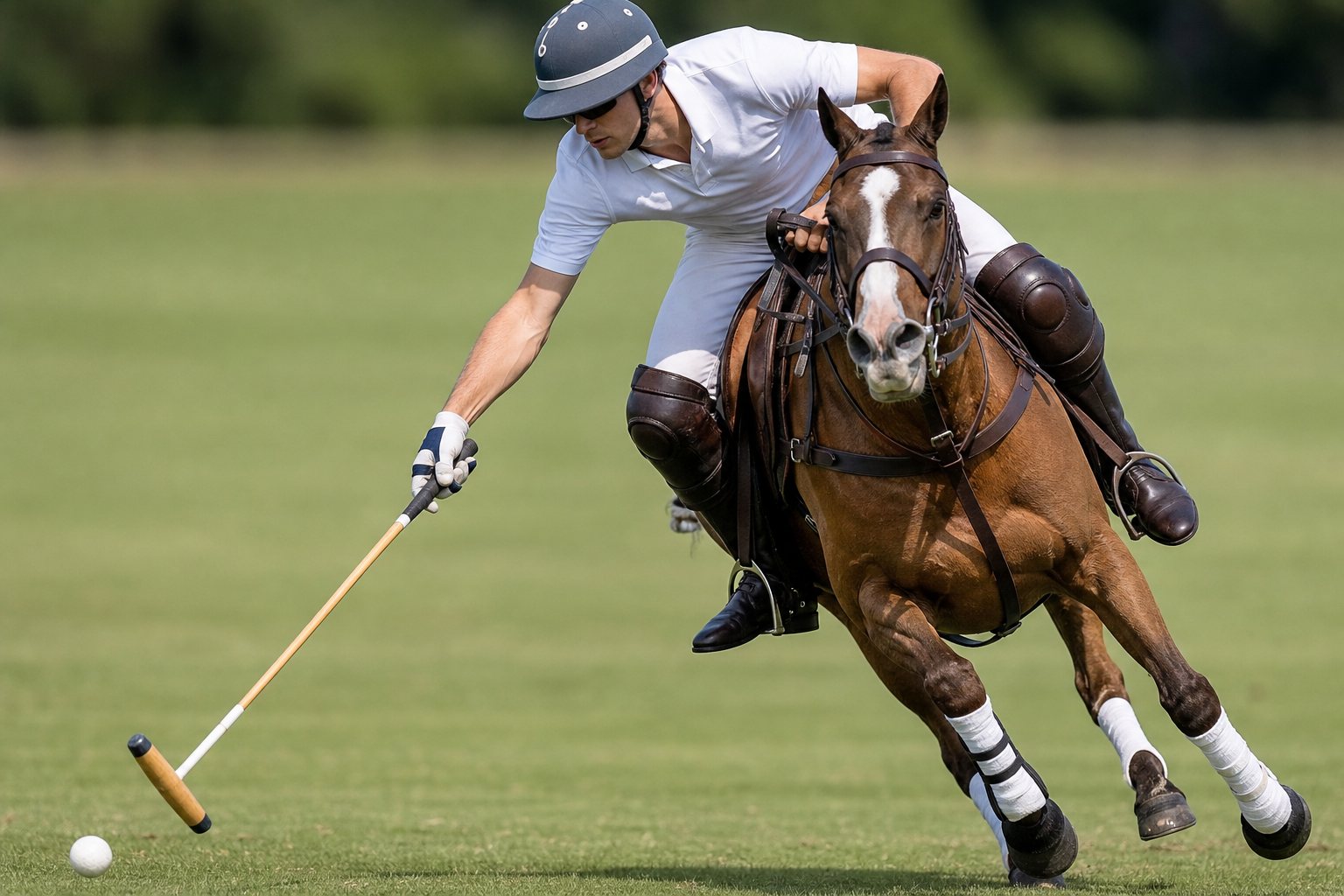
The horse stumbles on a soft patch near the boards, the rider goes over its shoulder, and the umpire’s whistle brings the match to a halt while teammates run to help. Falls like this are the most common story in polo injuries: damage to arms, shoulders, wrists, head and face from falls, the ball, the mallet and collisions. This page puts published numbers on those patterns, explains the general principles of rehabilitation, and says when to see a professional. It does not diagnose, and it does not say when anyone is ready to play again.
Quick answer: In a 2026 study of accident reports from 26 English clubs (236 injured players), limb injuries were most common (47.9 percent), then face or head (38.6 percent), and eye injuries were the most common reason for hospital treatment. A 1999 Argentine study found fractures in 39 percent of injuries, mostly from falls. Suspected concussion means stopping play and seeing a healthcare provider; call 911 for danger signs. See a sports medicine doctor, physical therapist or athletic trainer for any injury that does not settle.
General information, not medical advice. To lower risk, see polo injury prevention. Back to the polo hub.
What the numbers say
Polo has few injury studies, and they are small and not directly comparable, so read them as a pattern rather than a rate you can apply to yourself.
- England, 2026 (Ken-Dror and colleagues, Postgraduate Medical Journal). Accident reports from 26 clubs, 2018 to 2024, covering 236 injured players. The most common site was the limb (arm, hand, leg, wrist, shoulder) at 47.9 percent, then face or head at 38.6 percent, of which 12.1 percent affected the eyes. The most common reason to need hospital treatment was an eye injury. For injuries caused by the ball or stick that needed hospital care, the head or face (38.1 percent) and eyes (37.5 percent) led. The authors advise requiring eye protection as well as helmets.
- UK players’ survey, 2015 (Sports Medicine Open). Of 112 players, 58 percent reported falling and 17.3 percent had an injury needing a hospital visit, most commonly to a shoulder or wrist.
- Argentine high-goal season, 1999 (British Journal of Sports Medicine). Thirty-four riders reported 64 injuries; 39 percent occurred in the arms, 31 percent in the legs and 19 percent in the head, and a fracture occurred in 39 percent, mostly from a fall. The overall rate was 7.8 injuries per 1,000 player-game hours, with most injuries classed as major. The authors recommended a helmet with a face protector and a trauma-experienced doctor at matches.
- German retrospective study, 2019 (Sports Orthopedics). A search summary reports 103 players and a rate of about 5.3 to 6.1 injuries per 1,000 player-game hours; we did not read the full paper.
For wider context, a CDC-authored estimate for 2001 to 2003 (Thomas and colleagues, British Journal of Sports Medicine) counted about 102,900 emergency-department-treated horse-related injuries a year in the United States. Two thirds were to people mounted on the horse, commonly from a fall, and head and neck were the most often injured region (23.2 percent). A 2015 review of equestrian orthopaedic injuries (Orthopaedic Journal of Sports Medicine) found falling from the horse was the leading cause of injury in US studies. Riders and polo players share that hazard.
Concussion
A fall, a ball or a mallet strike can cause a concussion. The CDC’s HEADS UP programme says to recognise the signs (headache, dizziness, confusion, balance problems, nausea), remove the person from play, and have a healthcare provider decide when return is safe. It lists danger signs that need emergency care, such as repeated vomiting, a seizure, a headache that worsens, or increasing confusion. Nobody on the sidelines, and no article, can clear a player.
Eye and face injuries
The English study makes eye injuries the headline. The cause may be the ball, the stick or a fall, and the study says the helmet protects the head but not the eyes. Any blow to the eye, vision change or pain needs prompt medical attention.
Crush and severe trauma
Severe injuries occur. A 2026 case report in Current Sports Medicine Reports describes a traumatic crush injury in a polo player and its acute management and recovery. We have not read the full report and cite it only to show that serious trauma is documented. Matches should have an emergency plan and an ambulance; the 2015 UK survey found players ranked paramedics and ambulances above a doctor’s presence.
Horse-related injuries to the player
Being kicked or crushed on the ground is also a risk with horses, which the CDC-authored study found common among unmounted people. Learn to handle horses safely and be taught by someone experienced.
General rehabilitation principles
Published polo rehabilitation guidance is scarce. These points are general sports-medicine principles, not polo findings, and your clinician’s plan comes first:
- Get a proper assessment before you decide how to treat pain or swelling.
- Rehabilitation usually moves from protecting the injury, to restoring movement, to rebuilding strength, and then to sport-specific work such as riding at a walk before cantering and hitting.
- Progress is guided by symptoms and function, not just the calendar. Recovery times vary, and we give none.
- Returning to play is a decision for a qualified clinician, and after a head injury a healthcare provider.
- Horses matter too: a rider returning from injury may need a quieter horse.
When to see a professional
See a sports medicine doctor, physical therapist or athletic trainer if you have a possible fracture or dislocation (deformity, severe pain, can’t use the limb), numbness, a head injury, any eye injury or vision change, or pain that does not improve. Call emergency services for danger signs.
Polo injuries FAQs
What is the most common injury in polo?
In the English 2026 study of 236 injured players, limb injuries (47.9 percent) led; head and face followed. Other studies also found arms prominent.
Are polo injuries serious?
They can be. The 1999 Argentine study classed most injuries as major, and fractures occurred in 39 percent. Rates vary between studies.
Do helmets stop concussions?
No. Helmets lower risk but cannot prevent every concussion. Follow HEADS UP: remove, assess, and let a provider decide.
Do I need eye protection?
The English authors advise it. Ask your club and an eye doctor.
How long does recovery take?
There is no universal time; it depends on the injury and the person. Ask your clinician.
Sources
- Ken-Dror G et al. (Postgrad Med J 2026, PMID 41263769)
- Falls and injuries to polo players (Sports Med Open 2015, PMID 27747839)
- Injuries to polo riders: a prospective evaluation (Br J Sports Med 1999, PMID 10522635)
- Thomas KE et al. Non-fatal horse related injuries (Br J Sports Med 2006, PMID 16611723)
- Orthopaedic injuries in equestrian sports (Orthop J Sports Med 2015, PMID 26535400)
- Traumatic crush injury in polo, case report (Curr Sports Med Rep 2026, PMID 42084399)
- CDC HEADS UP: signs and symptoms
- CDC HEADS UP: response
General information for education only, not medical advice. It does not diagnose, treat or clear anyone to play. For your own situation, see a sports medicine doctor, physical therapist or athletic trainer. How we write and check our pages is in our editorial policy.