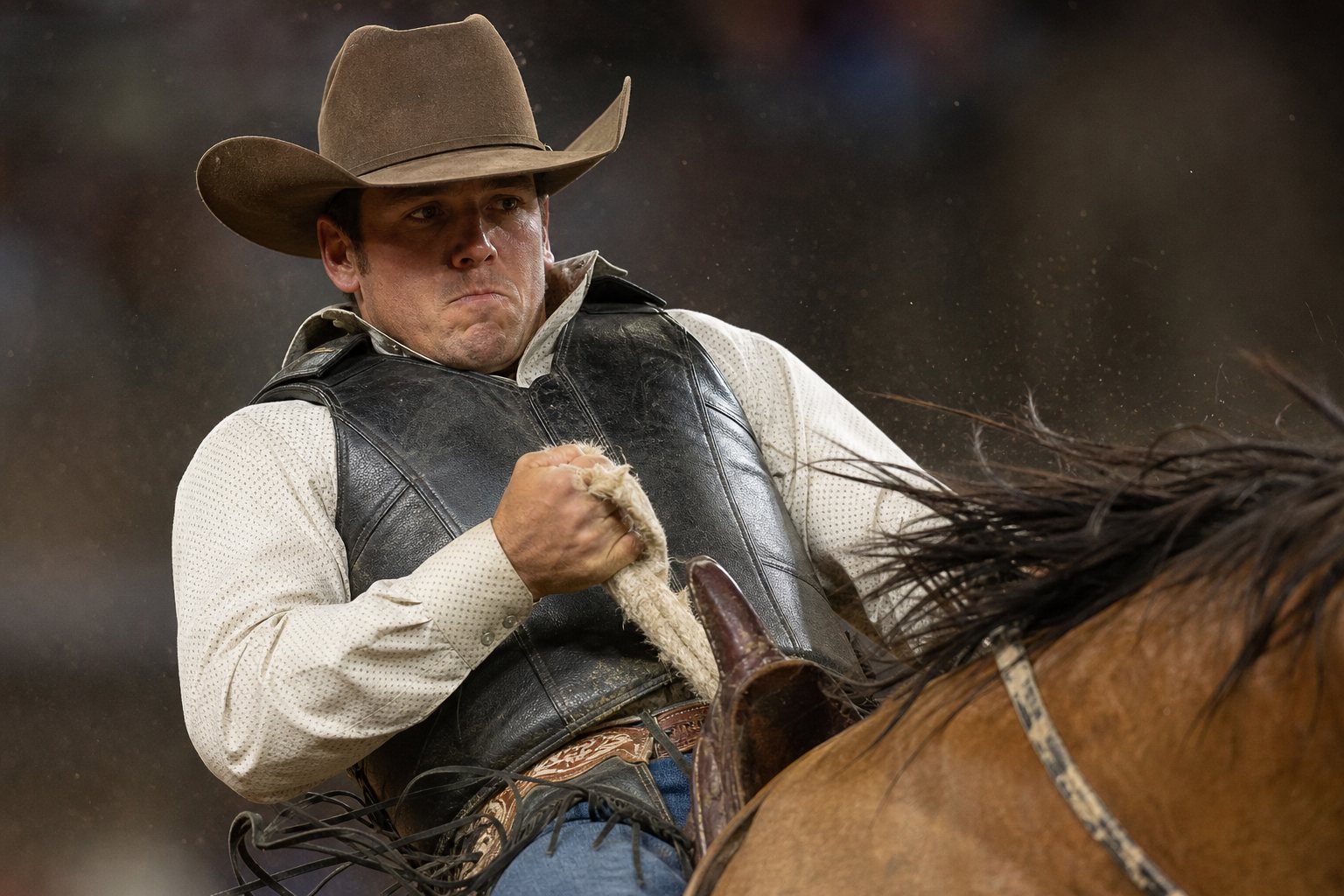
A bull rider finishes a long weekend on the road, gets home at two in the morning and has to be at the practice pen by noon. There is no off-season locker room, no team strength coach, and the “workout” is often chores and a run. Rodeo training means the physical and skill preparation behind eight-second rides and tenth-of-a-second runs: event practice with animals, strength and power work, and enough conditioning to stay on and to land. It is a young research area, so this page is honest about how little has been measured.
Quick answer: What the research does show: rodeo is intermittent and mostly anaerobic, and in one study of 43 male rodeo athletes the riders who competed at higher levels had more hip adduction and abduction strength, neck flexion strength and rotational power. The authors suggest riders focus on hips, neck and rotation. We found no published rodeo-specific weekly program with set numbers, so the weekly outline below is general coaching practice and not a prescription. Talk to a coach and a sports medicine professional before changing your training.
What rodeo asks of the body
A review in Sports Medicine (Meyers and Laurent, 2010) describes rodeo as intermittent, with short periods of highly intense activity, and notes that actual practice with livestock closely imitates a sport-specific form of interval training. The same review says rodeo competitors’ body size and performance measures were comparable to athletes in more traditional sports, and that the optimal fitness level for a basically anaerobic sport “remains to be determined.” In plain words: short, violent efforts, then waiting.
Different events pull on different parts of the body. A 2025 study of 162 college rodeo athletes (Wolfe and colleagues, International Journal of Sports Physical Therapy) found event-specific movement patterns that showed up on the Functional Movement Screen, and suggested event-specific preventive exercise. We read it as a sign that a calf roper and a bareback rider should not train identically, not as a ready-made routine.
What strength and power work can focus on
The best numbers we have come from Oranchuk and colleagues (Journal of Strength and Conditioning Research, 2023), who tested 43 male amateur, professional and internationally ranked rodeo athletes (bareback, bull riding, saddle bronc and bullfighters):
- Among riders, competitive level correlated with age and rodeo experience, hip abduction and adduction strength, neck flexion force and rotational power.
- Bullfighters were taller and heavier than bull riders, and bull riders were leaner than bullfighters.
- The authors concluded riders should focus preparation on hip and neck strength and rotational power, and bullfighters on stiffness and anaerobic power.
- It is a small study of men, in correlation form: it shows what top riders have, not that building it makes you a better rider.
For timed-event athletes (ropers, barrel racers, goat tyers) we found no equivalent test data in this research pass, so the advice below for them is general practice: leg and trunk strength for dismounts and balance, grip and shoulder endurance for roping, and horsemanship hours, since the horse is half the team. See horseback riding training for rider fitness basics.
A sensible week (general coaching practice)
This is not from a rodeo study. It is the usual way strength coaches organize a mixed skill-and-power sport, so adapt it with a qualified coach.
| Day type | What it usually includes | Why |
|---|---|---|
| Event practice (2 to 4 days) | Warm-up, then skill reps at moderate intensity: spurring on a barrel, roping the dummy, patterning your horse | Skill is learned in many calm repetitions, not just at full speed |
| Strength and power (2 days) | Squat or hinge variations, single-leg work, rows and pulls, neck and trunk work, medicine-ball rotations, jumps if cleared | Matches the hip, neck and rotation findings above |
| Easy conditioning (1 to 2 days) | Walking, easy cycling or swimming, mobility | Supports recovery between hard days |
| Full rest (1 day or more) | No event practice | Overuse and overtraining are named risks in rodeo (Meyers and Laurent 2010) |
How hard to train around competitions is a choice for you and your coach. As a rule of thumb for any athlete, many coaches lighten the week before a big rodeo (a taper), but we found no rodeo-specific taper study.
Periodisation on the road
A rodeo season is not a clean block of training followed by a peak. College athletes, in a survey of 71 NIRA members (Miller and colleagues, South Dakota Medicine, 2023), spent most training time on event-related activities but also did a considerable amount of exercise not related to their event each week. Pros may enter many rodeos in a few days. General approach: put the heaviest strength work early in the week and away from long drives, keep sessions short during heavy travel, and plan one lighter week every few weeks. Treat these as habits to discuss with a coach, not as research results.
A 2018 article on concussion in the Journal of Athletic Training (Wicklund and colleagues) points out that rodeo athletes often train outside a traditional gym and may lack consistent access to health care. A simple off-season plan that fits your barn, truck and schedule beats a perfect plan you cannot follow.
Skill work with animals
Rodeo experience comes from repeated contact with livestock. The Sports Medicine review notes that several studies link trauma to poor technique, inexperience and poor judgement. So the practical order is: learn technique on equipment and gentler stock, add speed and difficulty slowly, and ask an experienced rider or coach to watch. Our injury prevention page covers what to do before and after a hard ride.
Rodeo training FAQs
How do I get stronger for bull riding?
The only published performance data we found (43 male rodeo athletes) points to hip abduction and adduction strength, neck flexion strength and rotational power. A qualified strength coach can turn that into a safe program; do not copy a template off a video.
How many days a week should a rodeo athlete train?
No published rodeo guideline gives a number. A common general pattern is two to four event days, two strength days, one or two easy days and at least one full rest day, adjusted for travel and age.
Do barrel racers and ropers need gym work?
Probably yes in a general sense, since all athletes benefit from strength and fitness, but we did not find rodeo-specific studies for timed-event athletes. Ask a coach who works with riders.
Is cardio useful for rodeo?
Rodeo is mostly short bursts, but overall fitness helps recovery between runs and long weekends. The Sports Medicine review says the optimal fitness profile for rodeo has not been determined.
Can kids do strength training for rodeo?
General coaching practice (not rodeo-specific research) is to start young athletes with body weight and technique under supervision. Ask a qualified youth strength coach.
Sources
- Meyers MC, Laurent CM. The rodeo athlete: sport science: part I. Sports Med 2010
- Meyers MC, Laurent CM. The rodeo athlete: injuries: part II. Sports Med 2010
- Oranchuk DJ et al. Anthropometric and physical performance characteristics in rodeo athletes. J Strength Cond Res 2023
- Wolfe A et al. Functional Movement Screening Profile of College Rodeo Athletes. Int J Sports Phys Ther 2025
- Miller JJ et al. Injury and exercise in collegiate rodeo athletes. S D Med 2023
- Wicklund A et al. Return to play in rodeo athletes after concussion. J Athl Train 2018
General information for education only, not medical advice. It cannot replace a sports medicine doctor, physical therapist or athletic trainer who knows you. Read how we work in our editorial policy.