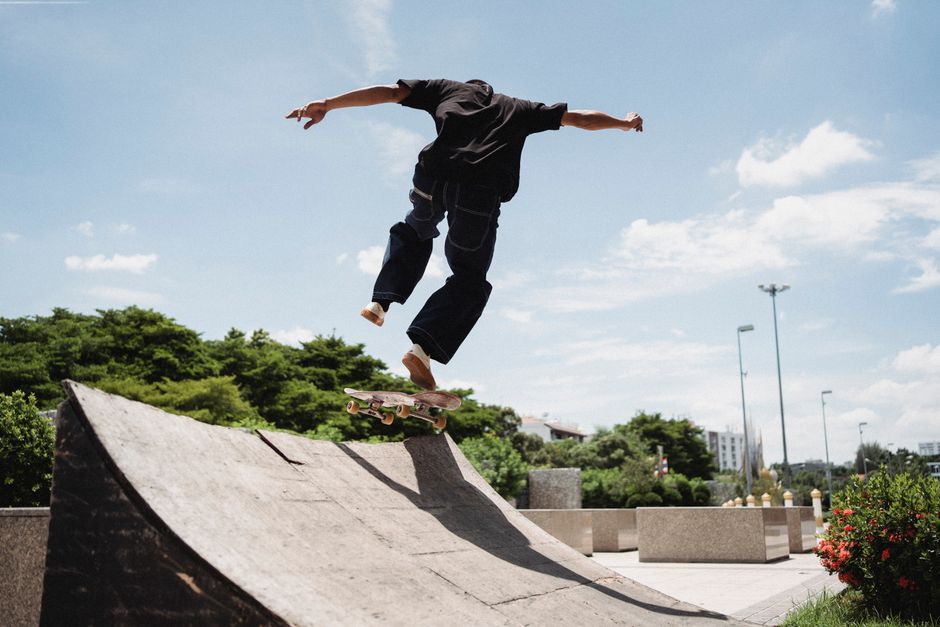
You have been rolling up to the same drop-in for twenty minutes. Your friends have gone twice. Your board is fine, your legs are fine, and your feet still will not leave the coping. Every skater knows that moment, and it has nothing to do with how strong you are. Mental training for skateboarding is the deliberate practice of handling fear, falls, frustration and pressure so you can skate your own session, or your own contest run, more calmly. It supports good skating; it cannot promise a landed trick or a score.
Quick answer: Break a scary trick into smaller steps, learn to fall before you need to, keep goals about what you control (rolling in, committing, your routine) rather than only landing it, and take injuries seriously before you take your confidence seriously. None of this guarantees a result. See a doctor or a licensed mental health professional, not only a coach, if worry, low mood, disordered eating or exhaustion are affecting your daily life, and see a clinician after any hard fall with a headache, dizziness or fogginess.
General information for skaters. Back to the skateboarding hub. Balance, strength, warm-up and the order to learn tricks are on our skateboarding training page, and food, heat, contest formats and the checklist for the day itself are on session and contest day. This page goes deeper on the thinking side and tries not to repeat those.
Why skating is a different mental game
Most skaters learn with no coach and no scoreboard. A 2026 narrative review in Frontiers in Sports and Active Living describes skateboarding as a self-organized activity, one where participants decide what they do and when, and argues that this supports autonomy, with mastery, identity and belonging supported more variably depending on the setting and the people in it. Nobody paces your progression for you, so you need to learn to do it yourself.
Research on what separates better skaters mentally is thin. A 2024 scoping review in Sports Medicine found only 19 studies on the demands of the sport, and none that linked them to contest success. The habits below come from general sport psychology and safety guidance; common practice is labelled as such.
Fear of a trick, and progression
Fear on a board is not a flaw. Sometimes it means the step really is too big. The American Academy of Orthopaedic Surgeons (AAOS) and POSNA position statement on skateboarding safety says to learn to stop, slow down and turn first, to practice tricks and jumps in a controlled place such as a supervised skatepark, and not to go faster than your experience permits. That is a mental-skills rule as much as a safety rule: it keeps the fear matched to the task.
Ways many skaters and coaches break a frightening trick into pieces (general practice, not a tested protocol):
- Shrink the obstacle. Roll in on a smaller bank, ollie the low curb before the stair set, or ride the transition at half speed. The movement stays the same while the stakes drop.
- Separate the parts. Practice the pop, the shape in the air and the landing on their own, then join two of them.
- Use a commitment cue. One short word or breath before you go, so the decision is made at the top and not halfway down. A 2011 meta-analysis of 32 studies by Hatzigeorgiadis and colleagues (Perspectives on Psychological Science) found self-talk tended to help more on fine or new tasks, which fits learning a trick.
- Have a “no” that stays a “no.” Walking away from a line you are not ready for is a skill. So is skating with people who do not push you into it.
Bailing and falling, mentally
A big part of fear is simply not knowing what happens when it goes wrong. AAOS tells skaters to learn how to fall, and we put practicing falls in the progression on our training page. In a 2020 review in the British Journal of Sports Medicine, McIntosh and colleagues watched videos of Vans Park Series, Street League Skateboarding and Dew Tour events and found high rates of falls and crashes, but also that the athletes showed a capacity to control falls and limit head impacts. The same paper notes that helmets made for skateboarding are available that protect against skull fractures and intracranial injuries. For the details on protection and injuries, see skateboarding injuries; helmets and pads are also on our gear page.
What you can practice in your head, not only on your body:
- Decide your bail before you go. “If it goes wrong, I step off and slide on my pads.” A plan makes the bail a choice and not a panic. This is common coaching advice, not a studied method.
- Keep the bail and the reset separate. Fall, check yourself, stand up, then decide. Do not stack the next try on top of a fall that shook you.
Confidence after an injury
After a bad slam, confidence often comes back more slowly than the body. We did not find research on this in skateboarders specifically, so the evidence below comes from other sports and is offered as context, not as a skateboarding finding.
- In a study of 187 recreational and competitive athletes after ACL reconstruction, only 31 percent had returned to their pre-injury level of sport at 12 months. Psychological readiness to return, fear of reinjury and recovery expectations all contributed to who got back (Ardern and colleagues, American Journal of Sports Medicine 2013). The authors concluded that psychological recovery deserves attention alongside physical recovery.
- A 2016 consensus statement from the First World Congress in Sports Physical Therapy (Ardern and colleagues, British Journal of Sports Medicine) says return to sport is a decision made together by clinician, athlete and coach, is a continuum alongside rehabilitation, and is best viewed through a biopsychosocial lens.
What that means in practice, without replacing your clinician: ask your doctor or physical therapist when you are cleared, not only your own feeling. Afterwards, expect to come back through the early steps of the progression, and treat that as the plan, not as failure. If a fall left you with headache, dizziness or fogginess, that is a medical question, not a confidence question: stop and see a clinician. World Skate competition rules, as of April 2025, require a suspected concussion to be removed from competition, with no return for 14 days and medical clearance. More on healing is on our recovery page.
Motivation and goals you control
A goal of “land a 360 flip today” depends on luck, your board and your legs. A goal of “try it ten times with a clean setup” is yours. Many coaches use three kinds of goal: a process goal you control, a performance goal such as a clean first run, and an outcome goal such as a placing. A 2026 expert statement on goal setting for Exercise and Sports Science Australia (Swann and colleagues, Sports Medicine) is a good place to read about setting goals well, and a 2025 paper in the British Journal of Sports Medicine (Goddard and colleagues) asks whether goal setting in youth sport can unintentionally contribute to dropout, so keep kids’ goals about fun and skill, not only results.
Imagery and a pre-run routine
Imagery means rehearsing the run or the trick in your head: the roll-up, the pop, the landing and how it feels under your feet. A 2026 scoping review in Frontiers in Psychology (Zhao, Wang and Anuar) mapped how athletes use mental imagery to manage stress, which shows researchers take it seriously. We have not found a skateboarding-specific study to cite for how much it helps, so use it as one tool among several and never as a substitute for safe progression.
A simple pre-run routine many skaters build, with each step yours to change:
- Check the board and your pads and helmet. AAOS advises inspecting equipment before every use.
- One slow breath. A review of slow breathing (Zaccaro and colleagues, Frontiers in Human Neuroscience 2018) linked breathing at fewer than about ten breaths a minute with higher heart rate variability and feeling calmer and more alert. It does not prove better tricks.
- See the first trick and the line in your mind.
- One cue word, then go.
Contest nerves
A contest is a different animal from a session: a clock, judges, a crowd and a single chance at a run. The formats differ, and we keep the details on the contest day page and the rules page. The mental points that follow from the format, as described in the World Skate competition rules (April 2025):
- Practice is part of the contest. The rules set a minimum of 120 minutes of practice before competition and at least 45 minutes in a single session. Use it to find your lines, not to try new tricks you have never landed.
- Runs and tricks reward a plan. Formats count your best run, and in some formats your best two tricks, so one fall does not have to end your day. Deciding in advance what you will do after a fall, such as “same line, one trick safer,” is easier than deciding on the spot.
- A short start window. The rules limit you to five seconds to start after the signal, so have the first step of your routine ready.
Many contest skaters are teenagers; see our youth page and leagues and associations. Nerves before a run are normal. Treat them as energy to use rather than a signal to quit: breathe, run the routine, and pick the trick you can land. Afterwards, review one thing that went well and one thing to work on.
Mental performance is not mental health
Everything above is about performance skills. Anxiety that will not settle, depression, disordered eating and burnout are health matters, not weaknesses of technique, and a better routine will not fix them. The International Olympic Committee consensus statement on mental health in elite athletes (Reardon and colleagues, British Journal of Sports Medicine 2019) treats them as health concerns that need proper assessment and care.
Signs to take seriously include worry or low mood lasting weeks, dreading skating you used to love, withdrawing from friends, big changes in eating or sleep, or feeling hopeless after a setback. Start with your doctor or a licensed mental health professional. In the US, you can call or text 988 (Suicide & Crisis Lifeline) at any time; outside the US, use your local emergency number or crisis line. The Association for Applied Sport Psychology lists performance-skills resources, but a consultant is no substitute for a doctor or therapist.
Skateboarding mental training: FAQs
How do I stop being scared of a trick?
Make the step smaller: a lower obstacle, a slower speed, one piece of the trick at a time. AAOS advises learning to stop and turn first, practicing in controlled places and not going faster than your experience allows. Some fear is a good signal that the step is too big. If it stays overwhelming, talk to a coach or a licensed professional.
How do I get my confidence back after a bad fall?
First, get checked if you hit your head or are hurt, and follow your clinician on when to return. Research in athletes after ACL surgery links fear of reinjury and psychological readiness with whether people return to their previous level, though that work was not done in skateboarders. Many skaters rebuild with easy tricks they can land before going back to the one that hurt them.
Does visualization help skateboarding?
Many skaters use it, and researchers study imagery in athletes broadly. We have not found a skateboarding study we can cite for how much it helps, so treat it as a way to rehearse and settle, not as a guarantee.
How do I handle nerves in a contest?
Use a short routine, a practiced breath and a plan for what happens after a fall. Remember that formats count your best run, and in some formats your best tricks, so one fall does not have to end your day. See the contest day page for formats and logistics.
Sources
- AAOS and POSNA. Position Statement 1127, In-Line Skating and Skateboarding Safety (PDF)
- McIntosh AS, Patton DA, McIntosh AGD. Managing head injury risks in competitive skateboarding: what do we know? Br J Sports Med 2020 (PMID 33032991)
- Ardern CL et al. Psychological responses matter in returning to preinjury level of sport after ACL reconstruction surgery. Am J Sports Med 2013 (PMID 23733635)
- Ardern CL et al. 2016 Consensus statement on return to sport from the First World Congress in Sports Physical Therapy, Bern. Br J Sports Med 2016 (PMID 27226389)
- Diewald SN et al. Skating into the Unknown: scoping review of skateboarding research. Sports Med 2024 (PMID 38743173)
- The intrinsic value of self-organized sport and physical activity: a narrative review. Front Sports Act Living 2026 (PMID 42840996)
- Hatzigeorgiadis A et al. Self-talk and sports performance: a meta-analysis. Perspect Psychol Sci 2011 (PMID 26167788)
- Zaccaro A et al. How breath-control can change your life: slow breathing review. Front Hum Neurosci 2018 (PMID 30245619)
- Swann C et al. Goal setting in exercise and physical activity: an expert statement for Exercise and Sports Science Australia. Sports Med 2026 (doi)
- Goddard SG et al. Goal setting in youth sport: are we unintentionally contributing to dropout? Br J Sports Med 2025 (doi)
- Zhao L, Wang Y, Anuar N. Mapping the use of mental imagery for stress management in athletes: a scoping review. Front Psychol 2026 (doi)
- Reardon CL et al. Mental health in elite athletes: IOC consensus statement (2019). Br J Sports Med 2019 (doi, PMID 31097450)
- World Skate. Skateboarding Street and Park Competition Rules, April 2025 (rules)
- 988 Suicide and Crisis Lifeline (988lifeline.org)
- Association for Applied Sport Psychology resources (appliedsportpsych.org)
General information for education only, not medical advice. It does not replace a doctor, licensed mental health professional or qualified coach. See our editorial policy for how we research and write.