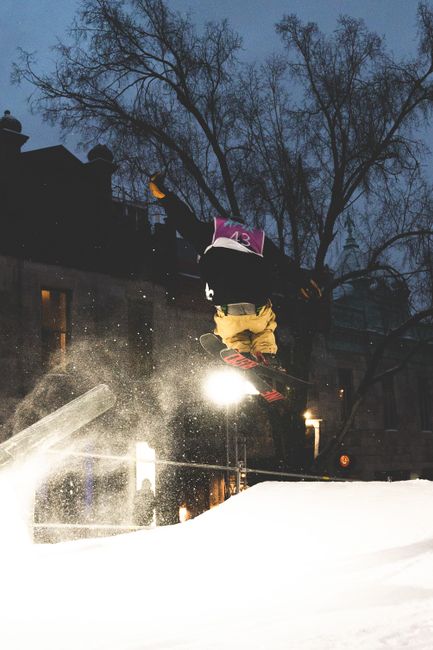
You are standing at the lip of a run you have ridden a dozen times, and today your legs will not commit. Maybe it was last week’s fall on the same pitch, or maybe the park crew just built a bigger jump. Every rider knows the feeling, from a first-day beginner on the bunny hill to a halfpipe athlete in a final. Snowboarding mental training means practicing the skills between your ears (handling fear, progressing at a sensible pace, rebuilding confidence after a fall, rehearsing a run in your head) the way you practice your turns. This page is about mental performance, which is different from mental health; there is a clear section on that difference below.
Quick answer: Fear on a board is often useful information, and mental skills such as a short pre-run routine, imagery of how a run should feel, and small step-by-step progressions help you act on it calmly. Research specific to snowboarders is thin, so most tips here are common coaching practice, and no technique guarantees a better or safer run. If a fall left you in pain or with a swollen joint, or if worry or low mood is taking over, see a doctor, sports medicine clinician or other qualified professional; in a crisis in the US, call or text 988.
Fear and progression: listen first, then step up
Park and freeride riders choose risk on purpose. A 2020 interview study of 24 adolescent and 24 adult freeriders (Journal of Sports Science and Medicine) found that both groups named challenge, freedom or pleasure, friends and balance among their motives. Most of the adults (79%) had already had a major accident or close call, compared with 29% of the adolescents, and some adults said they only grasped the risks after a bad experience. It was a small qualitative study of freeriders, not park riders in general, but it fits what many riders say: fear is part of why the sport is exciting, and it is also how you learn your limits.
The AAOS OrthoInfo page on skiing injury prevention, which also applies to riders, advises taking lessons, learning how to fall correctly and avoiding difficult runs when you are tired; see our snowboarding training guide for the fitness side. Beyond that, the following ladder is common instructor and coaching practice, not a result from a snowboarding trial:
- Break the new trick into pieces. Ride the approach and the takeoff speed on a smaller feature first, then add one new thing at a time.
- Use a go or no-go check. Before you drop in, ask: do I know my speed, my landing and my exit? If one answer is no, ride a smaller version or walk it.
- Name the fear. Is it speed, height, a landing you cannot see or a crowded run? A specific fear has a specific fix, such as scouting the landing or riding it with a friend.
- Retreat without shame. Choosing a smaller feature today is a decision, not a failure, and tired late-day legs are a good reason to do it.
- Ride with people who push you kindly, not people who dare you.
Confidence after a fall
A bad slam can leave you tense, riding stiff or avoiding the run that caught you. A 2023 paper in BMJ Open Sport and Exercise Medicine on returning to sport after snow sports injuries says that getting back to pre-injury performance requires a high level of confidence and a resumption of risk-taking in demanding situations such as high-amplitude jumps. It calls for a biopsychosocial and interdisciplinary approach, so that recovery is understood as psychological as well as physical. A 2026 study of 34 skiers and snowboarders after ACL reconstruction (The Knee) found that returning to sport was multifactorial: younger age and a shorter time off work were linked with returning, and a measure of fear of movement (kinesiophobia) was not significantly different between those who returned and those who did not. It was a small single-centre study, so it shows that confidence is only one piece of a bigger picture.
What this means in practice:
- Get hurt parts checked first. If a fall caused pain, swelling, a head knock or a joint that feels unstable, see a doctor or physical therapist before working on your head. Our snowboarding injuries guide covers the warning signs.
- Rebuild in small steps on terrain you know: easy runs, then medium, then the feature that scared you. Many riders also repeat a smaller version several times before moving up.
- Rehearse the fall itself. Practicing how you were taught to fall (see our training page) can make the next slam feel less unknown. This is coaching practice, not a tested result.
- Let the body finish healing. Our snowboarding recovery guide covers sleep and rest days.
Visualization: see the run, feel the run
Imagery is mental rehearsal of a run: the takeoff, the air, the landing, the line down the pitch. A 2026 study in Frontiers in Psychology compared 10 national-team halfpipe riders with 15 college students on mental rotation tasks. The riders showed lower activation in a part of the prefrontal cortex while performing as accurately, which the authors say is compatible with, but does not by itself prove, greater neural efficiency. That does not show that visualizing makes you ride better; it hints that experienced halfpipe athletes handle spatial thinking differently.
A 2023 meta-analysis across sports (Reinebo and colleagues, Sports Medicine) found moderate effects for psychological skills training, including imagery, but reported that the effects were not stable once non-randomized trials and subjective outcomes were removed. Treat imagery as a free addition to real riding, not a replacement. A simple routine: in the lift line or at the top, close your eyes, picture the run from your own eyes in real time, feel your board, your speed and the landing, and finish with a calm breath. Rehearse at home too, then check what works for you.
Routines, focus and goals
A 2026 position statement from Exercise and Sports Science Australia on performance under pressure (Schweickle and colleagues, Sports Medicine) lists pre-performance routines among evidence-based strategies, along with psychological skills training and mindfulness-based approaches. It also says pressure can have helpful and harmful effects. A rider-sized routine takes about 20 seconds: a slow breath, one cue word (knees, eyes up, ride it out), and a look at your line.
- Pick one cue per run and come back to it when your mind drifts.
- Set goals you control, such as clean takeoff speed or riding the whole run with your chin up, along with outcome goals like landing a first 360.
- Ride for fun on purpose. A rider who only chases the next trick can lose why they started; some days should just be laps with friends.
Competition nerves
We found no study of competition anxiety in park, halfpipe or race riders specifically, so we do not make claims about it. The ESSA statement above says that training with some pressure can help prepare athletes. Practice your routine in low-stakes settings, such as a jam session with friends watching or a mock run with a start gate, so that the real run is not the first time. In freeride competitions, a 2025 perspective (Frontiers in Physiology) notes that athletes descend based solely on visual inspection of the terrain, without practice runs, and that psychological resilience in the discipline remains underexplored. For competition logistics such as food, hydration and staying warm between runs, see our snow day guide instead of repeating it here.
Youth riders
The freerider interview study above found that adolescents learned about risk mostly through families and ski clubs, and its authors wondered whether more instruction on reducing risk would mean fewer accidents or close calls. That is a question, not a finding. Parents and coaches can help by praising effort over big tricks and by never pushing a young rider onto terrain they have said no to. See our youth snowboarding page for more.
Mental performance is not the same as mental health
Everything above is about performance skills. Anxiety disorders, depression, disordered eating, burnout and the fear that stays after a serious injury are health matters, not mindset problems, and a better routine does not fix them. The 2026 International Olympic Committee consensus statement on mental health in elite athletes (Reardon and colleagues, British Journal of Sports Medicine) treats them as medical and psychological care issues. Signs worth taking seriously include worry or low mood lasting weeks, panic when you think about riding, big changes in sleep or eating, or dread of a sport you used to love.
Start with your doctor, a licensed psychologist or another qualified mental health professional. In the US, you can call or text 988 (Suicide & Crisis Lifeline) at any time.
Snowboarding mental training: FAQs
Is it normal to be scared of a jump or a run?
Yes. Fear is part of why many riders enjoy the sport, and interviews with freeriders show that most adults have had a close call. Break the feature into smaller steps and ride it at a smaller size first. If the fear is intense or constant, talk to a qualified professional.
How do I get my confidence back after a bad fall?
First make sure any injury has been checked. A 2023 paper on snow sports return to sport describes confidence and willingness to take risk as part of recovery. Rebuild on terrain you know, in small steps; no method is guaranteed.
Does visualization work for snowboarding?
Research across sports finds moderate but unstable effects of psychological skills training, including imagery (Reinebo 2023). We found no snowboard trial of it, so try a short routine and see whether it helps you.
How do I stop overthinking before I drop in?
A short routine with a breath and one cue word is a standard strategy, and the ESSA statement lists pre-performance routines among evidence-based approaches. Practice it on easy runs first.
When is it more than nerves?
If worry, low mood or avoiding riding lasts for weeks, affects your sleep or eating, or follows a head injury, see a doctor or qualified mental health professional. These are health matters, not weaknesses.
Sources
- Does Age Matter? A Qualitative Comparison of Motives and Aspects of Risk in Adolescent and Adult Freeriders. Journal of Sports Science and Medicine, 2020. PMID 32132834
- Call for the application of a biopsychosocial and interdisciplinary approach to the return-to-sport framework of snow sports athletes. BMJ Open Sport and Exercise Medicine, 2023. PMID 37608842
- Key determinants of return to sport after anterior cruciate ligament reconstruction in snowboarders and skiers. The Knee, 2026. PMID 42190336
- Reduced left dorsolateral prefrontal activation during spatial imagery in elite snowboard halfpipe athletes. Frontiers in Psychology, 2026. PMID 42111553
- A perspective on competitive freeride skiing and snowboarding. Frontiers in Physiology, 2025. PMID 41036321
- Reinebo G et al. Effects of Psychological Interventions to Enhance Athletic Performance: A Systematic Review and Meta-Analysis. Sports Medicine, 2023. PMID 37812334
- Schweickle MJ et al. Performance Under Pressure in Sport: A Position Statement from Exercise and Sports Science Australia. Sports Medicine, 2026. PMID 42271117
- Reardon CL et al. Mental health in elite athletes: International Olympic Committee consensus statement (2026). British Journal of Sports Medicine. PMID 42580854
- AAOS OrthoInfo, Skiing Injury Prevention
- 988 Suicide & Crisis Lifeline
General information for education only, not medical advice. It does not replace a doctor, psychologist or other qualified professional. See how we work in our editorial policy. Back to the snowboarding hub.