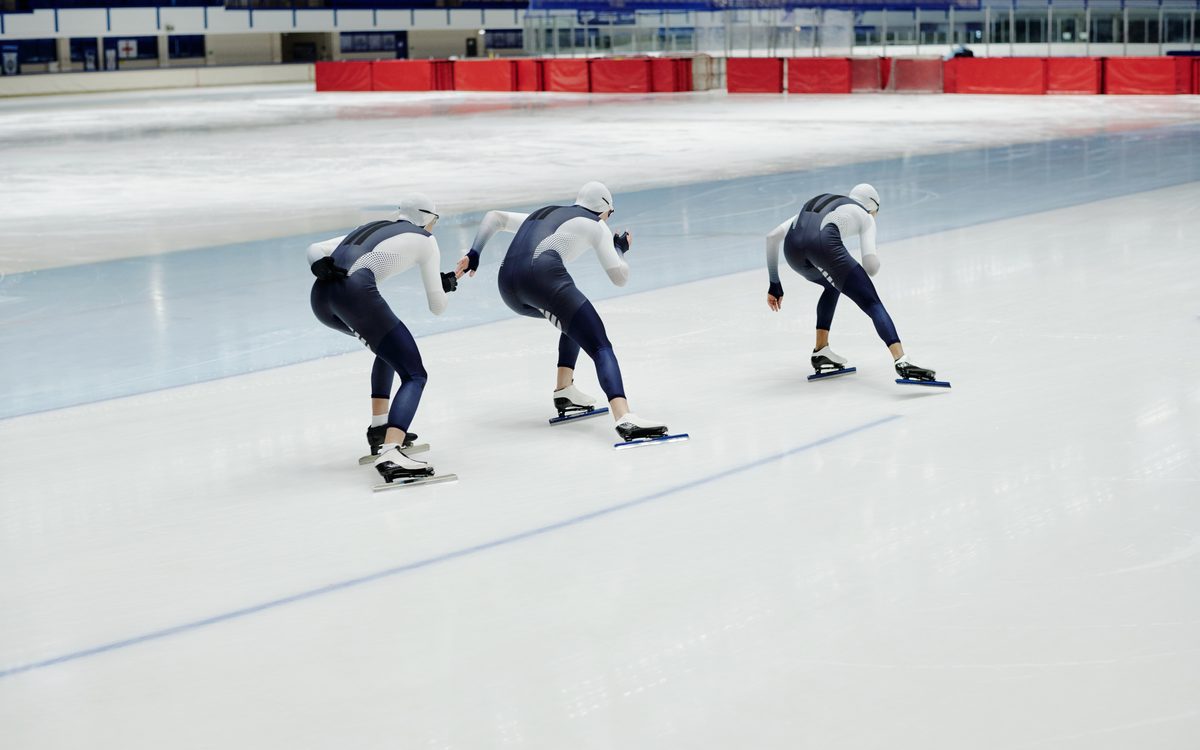
Two skaters come off the last corner side by side, one blade clips the other, and in half a second the whole pack is sliding toward the padded boards. A 2025 video study of every short track fall at 16 international competitions counted 1,505 falls in 18,631 race entries. Short track injury prevention is the set of habits around a skater, from a warm-up and a gradual training load to strength work, race awareness and the right protective gear, that aim to lower the chance and the severity of injury. They lower the odds; they cannot promise anything.
Quick answer: Falls and blade contact are part of short track, so protection matters as much as fitness. The best-supported steps are the equipment the rules require (helmet, cut-resistant clothing, gloves, neck protection, shin and knee pads, eye protection), rest days, building load gradually, and strength and balance work. A 2024 scoping review found no study that tested whether any prevention measure actually lowers injuries in competitive speed skaters, so treat these as sensible habits, not guarantees. See a sports medicine doctor, physical therapist or athletic trainer if pain persists, and call 911 after a head injury with danger signs or heavy bleeding.
General information, not medical advice. This page is about lowering risk. What the injuries look like is on our short track injuries page, so we do not repeat it. For the rest of the sport see the short track speed skating hub and our speed skating hub.
Warm-up
We did not find a published injury-prevention warm-up program that has been tested in short track skaters, so there is no named routine to point to. The following is general coaching practice. A typical off-ice warm-up is 10 to 15 minutes of easy movement to raise body temperature, dynamic mobility for hips, ankles and trunk, light activation of the glutes and thighs, and a few short, quick efforts. On the ice, easy stroking and low-position skating come before starts and hard intervals. A cold rink is a reason to start earlier, not to hurry.
Skills and race awareness
In the 2025 fall study (Clement and colleagues, Scandinavian Journal of Medicine and Science in Sports), about 61%% of falls were group falls and the authors named interactions between skaters as the main cause. Individual falls were about 35%% of the total. That points toward racecraft as injury prevention: holding a clear line, leaving space, knowing who is on your inside, and following the passing rule that makes the overtaking skater responsible until the two are side by side (ISU Rule 295). Coaches also practice falling and sliding feet first toward the mats (general practice; we found no study).
Training load and rest
A 2015 study of young elite athletes in field hockey, football and speed skating (van Hilst and colleagues) found that 60% of speed skaters had low back pain in the previous 12 months, and that in skaters more training hours were associated with a higher chance of back pain. It was a questionnaire study, so it cannot prove cause. For young athletes, the American Academy of Pediatrics (Brenner, 2016) recommends one to two days off a week from the main sport and about three months a year away from it in one-month blocks. A 2024 AAP clinical report (Brenner and Watson) says imbalances of training load and recovery lead to overuse injuries and overtraining. We did not find a speed skating-specific safe weekly increase, so a coach should raise load gradually. See training.
Strength, balance and conditioning
A 2016 study of young short track skaters (Felser and colleagues) found force fell about 25% when leg strength was tested on skates compared with standing, and concluded that the knee and ankle need to be stabilized to transfer strength to the ice. A randomized study of 28 young speed skaters (Winter and colleagues, 2015) found a 15-minute balance circuit done five times a week for 12 weeks improved dynamic balance. Neither study measured injuries. Groin is among the most commonly injured sites in elite short track skaters (Quinn and colleagues, 2003), and a Copenhagen adductor exercise program cut groin problems in male football players (Haroy and colleagues, 2019), but it has not been tested in skaters.
The rink, the cold and the pads
ISU Rule 280 requires protective mats around the ice, and some padding systems use free-standing, connected mats that can move enough to slow a falling skater. The rink itself is cold. A 2018 study of 36 competitive speed skaters (Kurowski and colleagues) found 79.4% reported exercise-related respiratory symptoms, and more positive airway tests in winter. That does not prove the rink is to blame, but breathing symptoms are worth mentioning to a doctor. Dress in layers off the ice and keep warm between races.
Protective equipment and fit
The ISU says short track races involve risks of cuts, concussions and puncture wounds, particularly from skates in a collision or fall (Communication 2636, May 2024). Its risk areas include the neck, groin, hands, front of the knees and ankles. The 2026 rules require, among other things, an ASTM-compliant or ISU-approved helmet, cut-resistant gloves, shin protection, padded knee protection, long sleeves and legs, cut-resistant neck protection that fully covers the neck, eye protection, and blades with closed tubes and rounded ends of at least 10 mm radius (Rule 288). Cut resistance is based on the EN 388 standard, and the ISU requires level 3 suits at the Olympics and ISU events and level 2 for senior and junior A/B international competitions, with level 3 highly recommended (Communication 2636). US Speedskating sets its own levels by event type, so check your club and meet rules before buying.
Two caveats. First, standards are not guarantees: the ISU itself says no equipment can assure full protection under all conditions. Second, helmets reduce but do not eliminate head injury. A 2014 laboratory study (Karton and colleagues) found speed skating helmets nearly eliminated catastrophic head injuries such as skull fractures, but rotational acceleration values were close to the high end of concussion probability, and a 2024 scoping review noted two studies in which short track helmets performed poorly compared with helmets from other sports. Maker claims are only claims; look for the standard and level named in the rules, and check that helmet, neck and ankle protection fit without gaps. Product examples are on our gear page.
What prevention cannot do
Short track involves fast pack racing in close quarters, so falls and some injuries will still happen. The 2024 scoping review (Hendricks and colleagues) found competition injury rates of 2% to 18% of participants and seasonal complaints as high as 84% for back pain, but found few high-quality studies and none testing the effectiveness of prevention measures. That is why we describe habits as sensible, not proven.
When to see a professional
- Pain that stays in one spot, wakes you at night or changes how you skate.
- Swelling, a joint that gives way, or a limb you cannot put weight on.
- Numbness, tingling or weakness.
- Any head injury with symptoms (CDC HEADS UP lists danger signs including repeated vomiting, increasing confusion, seizures and a worsening headache). Remove the skater from the ice and call 911 for danger signs.
- A cut that bleeds heavily: apply direct pressure and call 911 (general first aid).
Short track injury prevention FAQs
What is the single most important protection in short track?
Rules require several items together, so no single one is “most important.” The ISU stresses cut protection for risk areas including the neck, ankles and hands, plus helmets, and says no equipment gives full protection.
Do helmets prevent concussion in short track?
Not completely. A 2014 test study found speed skating helmets nearly eliminated skull fractures but rotational acceleration values were near the high end of the concussion range. The CDC advises recognizing signs, removing the athlete from play and having a healthcare provider decide on return.
Is there a proven warm-up for short track skaters?
We did not find a published program tested in short track skaters. Many coaches use a general dynamic warm-up, which is common practice.
How often should a young skater rest?
The American Academy of Pediatrics recommends one to two days a week off the main sport and about three months a year away from it, in one-month blocks. A coach and doctor can adapt that to the skater.
Are hockey cut-resistant products enough for short track?
Not necessarily. Required levels follow the EN 388-based levels in the ISU and US Speedskating rules for your type of event, and a hockey product may be rated under a different standard. Check the label against your event’s requirements.
Sources
- ISU Communication No. 2636, Protection equipment in Speed Skating and Short Track Speed Skating (May 2024)
- ISU Short Track Sport Rules 2026: Rules 280, 288, 295
- US Speedskating Short Track Rules and Regulations 2026-27, section J
- US Speedskating, Injury Prevention
- Clement et al., falls in short track 2021-2023, Scand J Med Sci Sports 2025
- Hendricks et al., injuries in ice speed skating: scoping review, 2024
- Karton et al., speed skating helmet performance, Br J Sports Med 2014
- Quinn et al., injuries in short track speed skating, Am J Sports Med 2003
- van Hilst et al., low back pain in young elite athletes, 2015
- Felser et al., strength and short track performance, 2016
- Winter et al., proprioceptive training in young speed skaters, 2015
- Haroy et al., Adductor Strengthening Programme in football, Br J Sports Med 2019
- Kurowski et al., winter training conditions and airway reactivity in speed skaters, 2018
- AAP, Brenner, sports specialization and intensive training, 2016
- AAP, Brenner and Watson, overuse injuries, overtraining and burnout in young athletes, 2024
- CDC HEADS UP, signs and symptoms
General information for education only, not medical advice. It does not replace a visit with a sports medicine doctor, physical therapist or athletic trainer. See how we write and check our pages in our editorial policy.