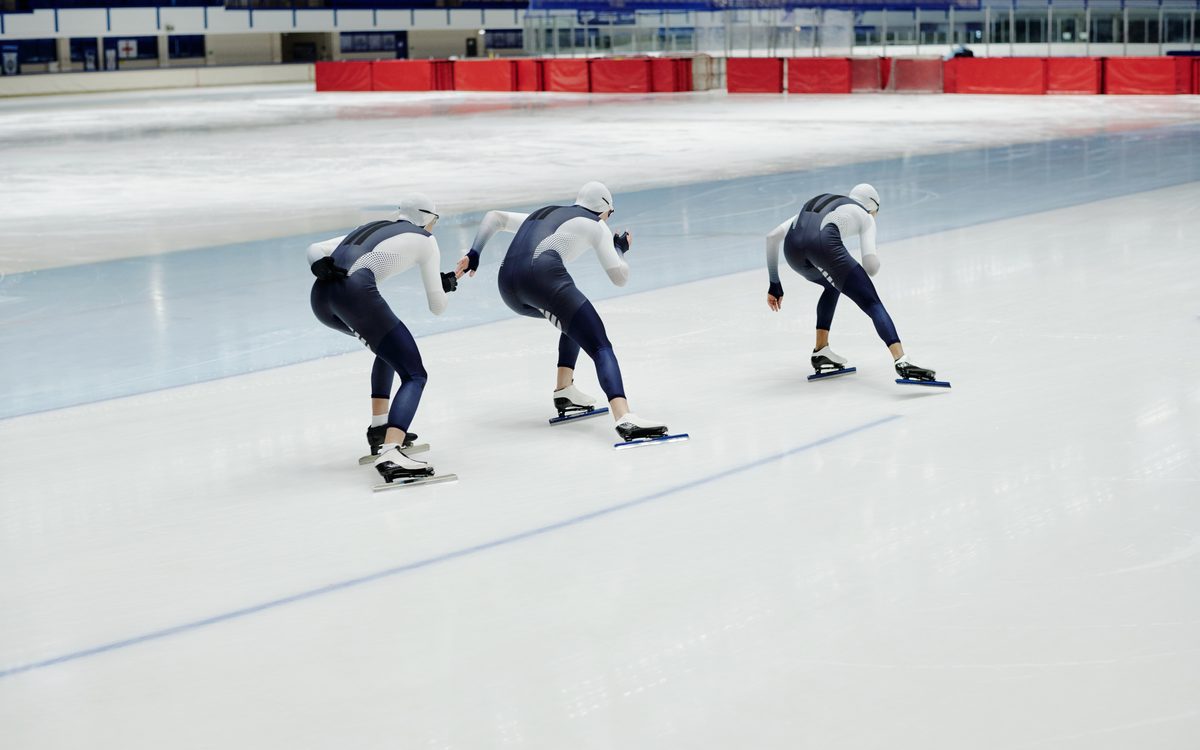
A 6 a.m. ice slot, a cold rink and a skater who ate half a banana in the car. By the third hard interval the legs are empty and the afternoon strength session is already in doubt. Short track nutrition is the food, fluid and (for some) supplement plan that supports the training described on our training page and the repeated rounds of a race day, while keeping the skater healthy. Most of it is ordinary food eaten on time.
Quick answer: Skaters need enough total energy, carbohydrate to fuel hard sessions, protein spread through the day, and fluids, with amounts that depend on training load. Eating too little for the training load, called low energy availability, can harm health and performance (IOC REDs consensus 2023). Supplements add little for most skaters and carry risks, including banned-substance contamination, so look for third-party testing (NSF Certified for Sport or Informed Sport) and talk to a doctor or registered sports dietitian first. In a study of nine international-level short track skaters, high-dose nitrate juice did not improve time trials.
General information, not medical advice or a diet plan. For recovery see recovery. The sport overview is on the short track speed skating hub and the parent sport is on the speed skating hub.
How big is the fuel need?
The energy used in a single race is modest compared with the training behind it. In a 2026 study of nine elite male short track skaters (Kiyici and colleagues), total energy use was about 124 kJ in a 500 m, 163 kJ in a 1000 m and 202 kJ in a 1500 m. Training is what drives daily needs: a 2026 review (Sperlich and colleagues) puts elite speed skating volumes at about 900 to 1,100 hours a year. The same study found the aerobic share rose from 22.2% at 500 m to 44.3% at 1500 m, with the glycolytic and phosphagen systems supplying the rest. Fuel planning matters most across training weeks and multi-round days.
Carbohydrate and protein
The joint position of the Academy of Nutrition and Dietetics, Dietitians of Canada and the American College of Sports Medicine (2016) gives carbohydrate ranges by training load: 3 to 5 g per kg of body weight a day for light training, 5 to 7 g for moderate (about an hour a day), 6 to 10 g for high (one to three hours a day) and 8 to 12 g for very high loads. It recommends 1.2 to 2.0 g of protein per kg a day, and about 15 to 25 g of protein in a meal after exercise. For a 60 kg skater, that works out to roughly 72 to 120 g of protein a day (our arithmetic). The statement also says athletes should be referred to a registered dietitian for a personalized plan, which is especially sensible for growing teenagers.
Meal ideas are general practice, not research results: rice, pasta, potatoes, oats, fruit and bread for carbohydrate; eggs, dairy, poultry, fish, beans or tofu for protein. A morning skater who cannot face breakfast might try something small and familiar, such as toast and banana, and eat properly after practice.
Race day and multi-round days
The ISU rulebook guarantees a minimum of 15 minutes between races (Rule 291), and some days include several rounds and relays. Common practice, not a rulebook item, is to eat a familiar meal a few hours before the first race, keep snacks and drinks easy to carry, and take small amounts of carbohydrate and fluid between rounds. Competitions in heated rinks still need fluids even though the ice is cold, and sweat losses differ from person to person, so a dietitian can help with a personal plan. Our recovery page covers what else skaters do between races.
Low energy availability and RED-S
The IOC consensus statement on Relative Energy Deficiency in Sport (REDs, 2023, Mountjoy and colleagues) describes a syndrome of harm to health and performance in female and male athletes who do not take in enough energy relative to their exercise. It covers effects on bone, reproductive, metabolic and immune health, mental health and performance, and notes growing evidence in males. Short track has no weight classes, but timing to the hundredth of a second can tempt skaters to chase a lighter body, which is our observation, not a finding. A 2019 study of 12 elite speed skaters (Varley and colleagues) found whole-body bone mineral content was about 1% higher before the season and at season end than mid-season, which the authors linked to changes in training load.
Warning signs worth discussing with a doctor include lost or irregular periods, repeated stress injuries, constant fatigue, frequent illness and preoccupation with food or weight. Skipping meals or cutting weight to “get faster” is a health matter, not a training tip. Eating disorders are medical conditions: seek a doctor and a registered dietitian. If someone is in crisis, the 988 Suicide & Crisis Lifeline (US) is available by call or text.
Iron, vitamin D and calcium
The 2016 joint position notes that female athletes have higher iron needs. A 2021 UEFA expert statement on soccer players warns that routine iron supplementation can do more harm than good, so iron is best checked with a blood test and treated by a doctor. Vitamin D and calcium needs also depend on age, diet and sun exposure. Ask your doctor or dietitian about testing rather than guessing.
Supplements, with care
The International Olympic Committee consensus on dietary supplements (Maughan and colleagues, 2018) says that few supplements have good evidence for performance: it lists caffeine, creatine, nitrate and sodium bicarbonate as having support, with beta-alanine possibly useful. It also notes that sports foods and fortified products can be useful when a skater cannot eat enough. Here is what to keep in mind:
- Evidence in skaters is thin. In a 2018 double-blind crossover trial of nine international-level short track skaters (Richard and colleagues), five days of high-dose nitrate juice (up to about 6.5 mmol a day) raised nitrate and nitrite in saliva but did not improve one or two 1000 m time trials.
- Banned-substance risk. Skaters at national and international level can be tested. Under anti-doping rules, athletes are responsible for what is in their body, even if a supplement was contaminated. USADA’s Supplement Connect says no supplement is 100% risk-free and recommends third-party certification.
- Look for third-party testing such as NSF Certified for Sport or Informed Sport, and read labels. “Not third-party certified” means no outside check for banned substances.
- Young athletes: the AAP has advised against energy drinks and against creatine for children and adolescents (see its policy statements).
- Caffeine is not for everyone. Sensitivity, heart conditions and pregnancy are reasons to ask a doctor first, and nothing here is dosing advice. Follow the product label and your clinician.
We do not recommend specific supplements on this page. Check with a doctor or registered sports dietitian before starting any.
Short track nutrition FAQs
How much should a short track skater eat?
It depends on age, size and training load. The 2016 ACSM, Dietitians of Canada and Academy of Nutrition and Dietetics position gives carbohydrate ranges of 3 to 12 g per kg a day by training load and 1.2 to 2.0 g per kg of protein, and recommends a registered dietitian for personal plans.
What should I eat before an early morning skate?
Something small and familiar that you have tried in training, then a proper meal afterward. This is general practice. A sports dietitian can tailor it, especially for young athletes.
Is RED-S a problem for short track skaters?
It can be for any athlete who eats too little for their training. The IOC 2023 consensus covers female and male athletes. Talk to a doctor about warning signs such as lost periods, repeated stress injuries and constant fatigue.
Do nitrate supplements help skaters?
In one study of nine international-level short track skaters, five days of high-dose nitrate did not improve 1000 m time trials. Evidence is limited, and any supplement carries contamination risk.
How do I choose a safe supplement?
Ask a doctor or dietitian first, then look for third-party testing such as NSF Certified for Sport or Informed Sport, and remember no supplement is risk-free. Skaters who may be drug tested are responsible for what they take.
Sources
- Kiyici et al., energy systems in short track, J Strength Cond Res 2026
- Sperlich et al., Olympic ice sports review, 2026
- Thomas, Erdman and Burke, joint position statement: nutrition and athletic performance (ACSM, AND, DC), 2016
- Mountjoy et al., IOC consensus statement on REDs, 2023
- Varley et al., seasonal bone and body composition in elite speed skaters, 2019
- Maughan et al., IOC consensus statement: dietary supplements and the high-performance athlete, 2018
- Richard et al., nitrate and time trials in world-class short track skaters, IJSPP 2018
- USADA, Supplement Connect
- UEFA expert group statement on nutrition in elite football, 2021 (iron)
- ISU Short Track Sport Rules 2026, Rule 291
- 988 Suicide & Crisis Lifeline
General information for education only, not medical advice. It does not replace a visit with a sports medicine doctor, physical therapist or athletic trainer. See how we write and check our pages in our editorial policy.