This article contains affiliate links: if you buy through them we may earn a commission, at no extra cost to you. Read our affiliate disclosure.
Thursday night ladder match, the third game. You are tired, the court is warm, and your opponent plays a drop shot you have to chase from the back corner. A lunge, a stab with the racket, and you are on the front wall in one piece. Or you are not: a heel that goes pop, an ankle that rolls, a ball that finds a face. Squash injury prevention is the set of habits around a player, a warm-up, sensible weekly load, leg and trunk strength, a plan for heat, eye protection and a check-up when you are older, that aim to lower the chance of getting hurt. They lower the odds. They never take them to zero.
Quick answer: The clearest step in squash is eye protection: polycarbonate goggles that meet the current ASTM standard, worn every time you step on court. After that, warm up before the first hard rally, build match and court hours up gradually, train your legs and calves, plan for a hot court, and get a medical check before going hard if you are older or have heart risk factors. See a sports medicine doctor, physical therapist or athletic trainer if pain keeps coming back, and call 911 for chest pain, collapse or a head or eye injury with vision change.
General information, not medical advice. This page is about lowering risk. What each injury looks like, and when it needs a doctor, is on our squash injuries guide, so we do not repeat it here. For the sport as a whole, start at the squash hub..
Where squash players get hurt, and why that shapes prevention
A 2026 systematic review of squash injury research (12 studies) found that most injuries are lower-limb soft-tissue injuries around the ankle and knee, that the low back and shoulder are often reported, and that eye and face injuries are rarer but more severe. It also points to heat strain and poor uptake of protective equipment. So prevention comes down to four things: protect the eyes, look after the legs, manage heat, and know your heart.
Eye protection: the one step with the clearest evidence
The ball is small enough to fit into the eye socket. A 2024 systematic review of eye injuries in racket sports found that, in the larger studies, a median of 93% of eye injuries happened to players wearing no eyewear, and that only eyewear meeting current ASTM or similar standards was linked to no eye injuries. The American Academy of Ophthalmology (AAO) recommends polycarbonate sports eyewear meeting ASTM standards for racquet sports, and warns that everyday glasses can shatter. Open, lensless eye guards do not work in squash: the ball can still push through the opening.
US Squash requires all players and coaches to wear protective eyewear on court at events it accredits, meeting ASTM F3164, with the older ASTM F803 still accepted. World Squash recommends eyewear at all times, including the warm-up, and makes it mandatory for doubles and junior events it sanctions. The two goggles below are listed by their sellers as meeting ASTM F803; that is a seller claim, not a certification we have checked, so check the label against your event’s list.

Dunlop Sports Vision Protective Squash Eyewear
- Clear polycarbonate lenses
- Listing: ASTM F803, WSF approved
- Adjustable strap, pouch included
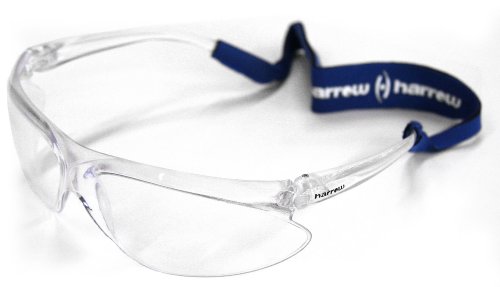
Harrow Shield Pro Eyewear
- Polycarbonate eye guard
- Anti-fog inner lens
- Listing: ASTM F803
Fit and standards: squash gear.
Warm up before the first hard rally
The American Academy of Orthopaedic Surgeons (AAOS), in its tennis guidance, recommends 3 to 5 minutes of light cardio followed by stretching, and notes that cold muscles are more prone to injury. World Squash’s 2025 rules allow a maximum 4-minute on-court warm-up, which is short for a cold body, so many players do 10 to 15 minutes off court first. That routine is common practice, not a tested program: we found no squash warm-up trial. See match day and training.
Technique: lunges, stops and the back corner
Most squash damage comes from the legs doing what the game asks: lunges to the front corners, hard stops, quick pushes out of the back. AAOS says the Achilles usually tears when the calf is stretched quickly, as when you push off or land. We found no squash trial showing that a lunge style prevents Achilles or knee injury, so we claim none. General good practice: land the lunge with the knee tracking over the foot, recover to the T, and stop a ghosting set when your movement turns sloppy (more on training).
Fatigue is part of technique: in one study, knee extensor strength dropped 16% after one hour of match play, which is why lunges and stops get worse late in a long match.
Build load up gradually
Squash is high intensity: in elite players’ simulated matches, mean heart rate was 92% of maximum, with about 69% of the match above 90% (Girard, 2007). Jumping from two social games a week to nightly matches, or from a layoff to a tournament weekend, is a big step for tendons as well as lungs. The IOC consensus statement on load and injury (Soligard and colleagues, 2016) makes the general case for managing load carefully, and the American Academy of Pediatrics (AAP) recommends one to two days off from sport each week. We found no published squash weekly-hours rule, so we give none. Change one thing at a time (more matches, longer sessions, harder sessions) and notice how heels, knees and back feel the next morning.
Conditioning and strength for ankles, knees and Achilles
For ankles, the National Athletic Trainers’ Association (NATA) says the strongest risk factor for a sprain is a previous sprain. It recommends a balance and neuromuscular training program of at least three months, and taping or bracing during practice and matches for athletes who have sprained before. A lace-up brace such as the one below fits inside most court shoes; it does not replace the training or a diagnosis.

ASO EVO Ankle Stabilizer
- Lace-up with figure-8 straps
- Fits left or right foot
- Low profile, fits in court shoes
For knees, calves and the Achilles we found no squash prevention trial. In a US study of 406 Achilles ruptures, most happened during sport, most patients were men in their 40s, and the lead author reported that racquetball and squash together caused 9% of the sports ruptures. Many physical therapists recommend gradual calf strengthening and extra care after a layoff; treat that as sensible practice, not a guarantee. Trunk and hip strength help the low back, which the 2026 review lists as a common problem site (see training). Heel pain that is stiff in the morning and returns every session should be seen by a physical therapist before it becomes a tear.
Court collisions, rackets and the ball
Two players share one small box, so a racket, the ball or a body can hit a face or head. A survey of 653 squash players and coaches in Switzerland, Germany and France found that 20% had seen a dental injury on court and 4.5% had had one; only one person wore a mouthguard. We found no squash research showing mouthguards prevent these injuries. Practical court manners: watch your swing and give your opponent room to see and reach the ball. For concussion, the CDC HEADS UP rule is: if you suspect one, stop, and do not return that day until a health care provider has checked you. Only Canada had squash-specific concussion guidance among the leading squash nations (2025 review), so your club may have none.
Heat, hydration and the closed court
Squash courts are hotter than they feel. A 2025 study (Int J Sports Physiol Perform) measured core temperatures of 39.0 to 40.1 degrees Celsius in squash players at a wet-bulb globe temperature of 19.4 degrees. It noted that cramps are common at tournaments and an early warning sign of more severe heat illness, and that an indoor court limits sweat cooling. Elite players in another study sweated about 1.1 litres per hour, and those who trained again the same day did not replace the fluid and sodium they lost.
From NATA’s fluid replacement statement: know your sweat rate and drink to avoid large body-weight loss. Between two matches in a day, rehydrate with a carbohydrate and protein drink and a salty snack (Bergeron, 2014). If someone is dizzy, confused or hot and stops sweating, treat it as an emergency: NATA’s position on exertional heat illness is to cool first, with cold-water immersion where possible, and transport second. Detail: game day.
Older players and the heart
Squash is one of the most intense things a middle-aged recreational player can do. In older male players, heart rate rose by 150% and stress hormones rose sharply, normal in a healthy heart but a possible trigger for dangerous rhythms in someone with coronary artery disease. A 1986 study of 60 sudden deaths linked to squash (mean age 46) found coronary artery disease in most, and 45 had warning symptoms beforehand, most often chest pain. The 2026 review calls the overall cardiac rate low. The message for older and returning players is to get checked first.
- Screening before you go hard. The American College of Sports Medicine’s preparticipation screening considers how active you already are, any symptoms, known heart, metabolic or kidney disease, and how hard you plan to exercise. If you are inactive or have risk factors, see your doctor before taking up competitive squash.
- Never play through chest symptoms. Chest pain or pressure, unusual breathlessness, fainting or pain spreading to the jaw, neck, back or arm: stop and call 911 (CDC).
- Know where the AED is. The American Heart Association says immediate CPR can double or triple the chance of surviving cardiac arrest. Know where your club’s defibrillator is before you need it.
Younger players
The AAO and AAP list squash among the sports with a high eye-injury risk for young athletes and recommend polycarbonate eyewear; World Squash requires it at junior events it sanctions. The AAP’s report on resistance training for children and adolescents supports supervised, well-taught programs, and the AAP recommends regular days off. See our squash youth page.
What prevention cannot do
Goggles, a warm-up and strong calves lower the odds; they do not remove them. Much squash research is observational, so it shows patterns, not proof. If you are hurt, get checked; return-to-play decisions belong to the person treating you (basics on our recovery page).
When to see a professional
- Right away: chest pain, fainting or collapse; a hit to the eye with any change in vision, flashes of light, new floaters or blood in the eye (see an eye doctor); concussion danger signs; a knocked-out tooth.
- Within a day or two: a pop at the heel or knee, an ankle you cannot stand on, a suspected concussion.
- Soon: heel, knee, back or shoulder pain that keeps coming back, or swelling that lasts more than a few days.
Squash injury prevention: FAQs
Which goggles standard should I look for?
US Squash requires ASTM F3164 eyewear at its accredited events and still accepts the older ASTM F803. Look for the standard on the product and check your event’s list.
Can I wear my normal glasses or contacts on court?
The AAO warns that everyday glasses are not protective and can shatter, and the 2024 review found contact lenses and some other eyewear made certain injuries worse. Ask an optician about prescription sports frames.
How can I protect my ankles and Achilles?
For ankles, NATA recommends at least three months of balance and neuromuscular training, and bracing or taping after a previous sprain. For the Achilles we found no squash trial; gradual calf strengthening is sensible, and a pop or sudden heel pain needs a doctor.
I am over 50. What should I do before playing squash?
Talk to your doctor, especially with heart risk factors, symptoms or a long layoff; ACSM’s screening is the framework. Build up gradually and stop at once for chest pain, faintness or unusual breathlessness.
Sources
- McCartney et al., Squash Under Strain, injury review, Sports (Basel) 2026
- Horsley et al., injuries in England Squash funded players, Phys Ther Sport 2020
- Mazarelo et al., eye injuries in racket sports, Phys Sportsmed 2024
- American Academy of Ophthalmology, sports eye safety
- AAO and AAP, protective eyewear for young athletes
- US Squash participation policies, protective eyewear
- World Squash, Rules of Singles Squash 2025 V1.2
- AAOS OrthoInfo, tennis injury prevention
- AAOS OrthoInfo, Achilles tendon rupture
- Raikin et al., Achilles tendon ruptures, Foot Ankle Int 2013
- NATA position statement on ankle sprains, Kaminski 2013
- Girard et al., knee extensor strength after a squash match, J Sci Med Sport 2010
- Girard et al., physiological demands of squash, J Strength Cond Res 2007
- Soligard et al., IOC consensus on load and injury, Br J Sports Med 2016
- AAP, Brenner, sports specialization and intensive training, Pediatrics 2016
- AAP clinical report, resistance training for children and adolescents, Pediatrics 2020
- Persic et al., dental injuries in squash, Dent Traumatol 2006
- Mangan and Heron, squash concussion guidance, Sports (Basel) 2025
- CDC HEADS UP, concussion signs and symptoms
- Ihsan et al., heat strain in squash, Int J Sports Physiol Perform 2025
- Turner et al., sweat and sodium losses in elite squash players, Nutrients 2023
- NATA position statement, fluid replacement, McDermott 2017
- NATA position statement, exertional heat illnesses, Casa 2015
- Bergeron, rehydration between sessions, Br J Sports Med 2014
- Brady et al., cardiovascular response to squash in older men, Eur Heart J 1989
- Northcote et al., sudden death in squash players, Br Heart J 1986
- ACSM preparticipation screening, Riebe et al., Med Sci Sports Exerc 2015
- CDC, heart attack signs and symptoms
- American Heart Association, cardiac arrest and CPR
General information for education only, not medical advice. It does not replace a visit with a doctor, physical therapist or athletic trainer. See how we write and check our pages in our editorial policy..