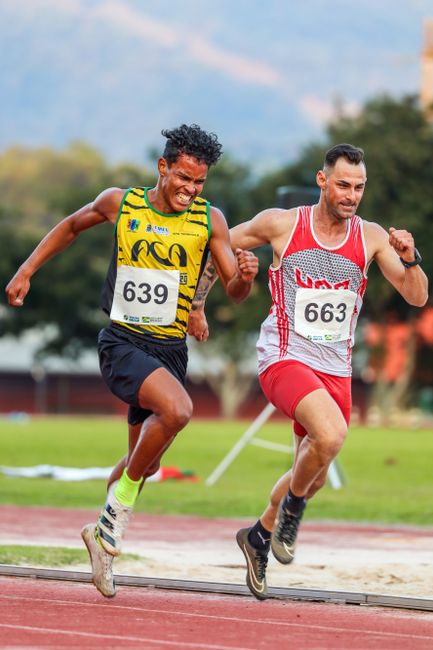
You have warmed up, and now you are sitting in the call room with the other athletes in your heat, in your race kit, waiting. The meet is loud outside and the 100 m you have run a hundred times in practice suddenly feels very big. Track and field mental training means practicing the skills between your ears (focus, confidence, routines, handling nerves, bouncing back) the way you practice your starts and your approach runs. This page is about mental performance, which is different from mental health; there is a clear section on that difference below.
Quick answer: Mental skills are trainable habits: a short routine you repeat before every race or attempt, one or two cues to focus on, goals you control, and a plan for what you do after a bad race. Research on these tools is promising but not settled, and none of them guarantees a faster time or a longer throw. If worry, low mood, or trouble eating or sleeping lasts more than a couple of weeks or gets in the way of daily life, see a doctor, licensed psychologist or other qualified professional, and in a crisis call or text 988 (US).
Confidence: built from evidence, not slogans
Sport psychologists often call confidence self-efficacy: your belief that you can do a specific thing, such as hold form over the last 100 m or clear the next height. It grows mostly from things you can point to, like completed workouts and personal bests. In a 2026 study of 658 young athletes in German elite sports schools (Schröder and colleagues, Behavioral Sciences), confidence, goal setting and self-discipline differed between performance groups in track and field trials, with small effect sizes. A 2026 survey of 772 Chinese track and field athletes (Fan and colleagues, Frontiers in Psychology) linked self-management with performance, partly through resilience. Both are observational, so they show links, not causes.
A practical habit: after every workout or meet, write down two things that went well, even after a poor result.
Focus: one cue, then come back to it
In track and field the part that counts is often very short: a sprint lasts seconds, and a jump or throw takes a few seconds between long waits. Focus mostly means choosing what to attend to in that window. Many coaches suggest one cue per event, such as “tall and relaxed” in the first 30 m or “drive the knee” over a hurdle. Drifting is normal; coming back is the skill. We found no track and field trial testing specific cue words, so treat these as coaching practice.
Motivation and goal setting
Athletes stay motivated through long seasons when goals feel like their own. A common approach splits goals into outcome (make the final), performance (run a certain split) and process (hold posture through the curve). Process goals are fully in your control, so they hold up when the clock disappoints. Sleep and load matter too; see our training guide and recovery guide.
Visualization and imagery
Imagery means rehearsing a race or attempt in your mind, using as many senses as you can: the feel of the blocks, the sound of the gun, the rhythm of your approach, the landing. A 2023 systematic review and meta-analysis of psychological interventions across sports (Reinebo and colleagues, Sports Medicine) found moderate effects for imagery, multimodal psychological skills training and mindfulness-based approaches compared with controls, but the effects were not stable: when non-randomized trials and subjective outcomes were removed, they were no longer significant. In a 2026 survey of 156 Tunisian junior distance runners (Goumni and colleagues, Frontiers in Psychology), imagery was the coping strategy they reported using most, which tells us what they do, not that it works. Imagery is a low-cost add-on to real practice, not a replacement for it.
- Try 3 to 5 minutes before bed or in the stands: see and feel yourself running, jumping or throwing, from the first step to the finish or landing.
- Rehearse the hard moments too: a fast athlete in the next lane, a tight no-jump, a headwind, and then your calm response.
Pre-race routines and the call room
A pre-performance routine is a short, fixed sequence that gets you ready and shuts out noise. A 2026 position statement from Exercise and Sports Science Australia on performance under pressure (Schweickle and colleagues, Sports Medicine) lists pre-performance routines among the evidence-based strategies, along with psychological skills training and mindfulness-based approaches.
The call room is its own mental test. A 2026 review of sprint preparation at major championships (Aggett and colleagues, Sports Medicine) notes that the interval between warm-up and race start includes time in a designated Call Room and can exceed 50 minutes, and that recent World Athletics rules prohibit heated garments there. The review is mainly about keeping muscles ready, and its authors say the recommendations rest partly on applied practice and that athletes should find their own response in training. The mental side is the same idea: a long wait is easier with a plan. Many athletes use it for a repeated sequence, such as checking spikes and bib, a few slow breaths, one cue word, then imagery of the first 10 m. That sequence is common practice, not a finding of the review. Meets differ, so check the call times for yours.
- At the start line: two or three steps you can repeat in the time the starter allows, for example breathe out, settle into the blocks, one cue word. Use it at every practice start, not just at meets.
- Field events: a short routine before each attempt gives you something steady between long waits.
- Meet-day routine: the same order for warm-up, food and quiet time. For fuel, fluids, heat and warm-ups between events, see our track and field meet day guide.
False-start nerves
Sprinters know the fear: you go too early and you are out, or you hold back to be safe and lose the start. A 2021 critical review of sprint start regulation (Milloz and colleagues, Sports Medicine) explains that World Athletics-certified start information systems record athletes’ response times to make sure no one gains an unfair advantage by responding in under 100 ms after the signal, and that the scientific basis for that 100 ms threshold has been criticized. A 2016 analysis of World and European Championship data (Brosnan and colleagues, Journal of Sports Sciences) suggested different revised thresholds. These are debates about the rule, not advice for your start. For the current rule as it applies to your meet, see our track and field rules guide.
What can you do with the nerves? Practice starts to the real sequence (on your marks, set, signal) so it becomes automatic, and rehearse the calm version in imagery. We found no study testing a specific mental technique for avoiding false starts, so these are general habits, not proven methods. Starting systems also matter for fairness: a 2025 study (Steele and colleagues, Psychology of Sport and Exercise) found D/deaf athletes can be at a reaction time disadvantage with some systems, and a visual-haptic combination was the fastest and most equitable tested. Deaf or hard-of-hearing athletes can ask organizers about the system ahead of time.
Handling pressure and nerves
Nerves before a race are normal. The ESSA statement says pressure can have both helpful and harmful effects on performance, and that training with some added pressure can help prepare athletes. On the track that might mean a time trial with teammates watching or a mock final with seeded lanes. Keep it safe and fair.
In the Tunisian runner survey above, athletes reported moderate cognitive anxiety (worried thoughts) and somatic anxiety (racing heart, tight muscles), and higher self-confidence went with more task-focused coping. It was cross-sectional, so it cannot show that confidence reduces anxiety.
Multi-event focus: many races, one day
Many athletes run several events in a day at school or club meets, and decathletes and heptathletes compete across many events over two days. The mental challenge is moving on: a bad long jump should not follow you to the hurdles. We found no study of mental strategies for multi-event athletes, so this is general coaching practice. A simple approach is a short reset after each event (one slow breath, one thing to learn, then your next job) and a written plan for the day. Warm-up, fuel and heat details are in our meet day guide.
After a bad race, a no-height or a miss
Every athlete has a race that goes wrong. Many coaches teach three steps: acknowledge it (a slow breath), learn one thing (“my approach was short”), and move to the next job. Talk to yourself the way you would to a teammate, and review marks and video for lessons, not punishment.
Repeated setbacks can also wear on motivation. In a 2026 study of 235 track and field athletes at the Turkish University Athletics Championships (Çifçi and colleagues, Frontiers in Psychology), more pessimism went with more athlete burnout, and higher levels of confidence and concentration weakened that link. It was a correlational study. If a run of poor results is leaving you flat or dreading training, tell your coach or a trusted adult, and read the section on mental health below.
Preparing for competition
In the week before a meet: one or two imagery sessions, practice of your routine, one or two process goals, and enough sleep. Physical preparation is in our training guide; meals, fluids, heat and warm-up timing are in the meet day guide. If an injury is part of why you feel anxious about racing, see our injuries guide and a sports medicine doctor, physical therapist or athletic trainer.
Young athletes
Keep it light for kids: fun routines, effort goals and praise for trying. Most children need supportive coaching, not a specialist. See our youth track and field guide for age-based guidance.
Mental performance is not the same as mental health
Everything above is about performance skills. Anxiety disorders, depression, disordered eating and burnout are health matters, not mindset problems, and they are not fixed by a better routine. The 2026 International Olympic Committee consensus statement on mental health in elite athletes (Reardon and colleagues, British Journal of Sports Medicine) treats them as medical and psychological care issues. Signs to take seriously include worry or low mood lasting weeks, panic before practice, withdrawing from friends, big changes in eating or sleep, or dreading training you used to enjoy.
Start with your doctor, a licensed psychologist or other qualified mental health professional. In the US, you can call or text 988 (Suicide & Crisis Lifeline) at any time. For disordered eating, nutrition basics are in our nutrition and supplements guide, but a clinician should lead care.
Frequently asked questions
How do I stay calm in the call room?
Use the wait for a short routine you have practiced: a few slow breaths, one cue word, and imagery of the first part of your race. Call room time can be long at major championships, per a 2026 Sports Medicine review, so having a plan helps. Rules differ by meet.
How do I stop worrying about a false start?
Practice starts to the full sequence so it feels automatic, and rehearse a calm start in your mind. No study we found tests a specific method for avoiding false starts, so ask your coach to help you build a routine you trust.
How do I stay focused through several events in one day?
Many coaches suggest a short reset after each event and a written plan for the day. No research we found tests this in multi-event athletes, so treat it as common practice. Meal and warm-up timing are in our meet day guide.
Sources
- Reinebo G et al. Effects of Psychological Interventions to Enhance Athletic Performance: A Systematic Review and Meta-Analysis. Sports Medicine, 2023. PMID 37812334
- Aggett J et al. Optimising Pre-race Physical Preparation for Sprint Events at Major Championships Under New Rule Changes and Competition Formats. Sports Medicine, 2026. PMID 42867623
- Milloz M et al. Sprint Start Regulation in Athletics: A Critical Review. Sports Medicine, 2021. PMID 33125639
- Brosnan KC et al. Effects of false-start disqualification rules on response-times of elite-standard sprinters. Journal of Sports Sciences, 2016. PMID 27351870
- Steele ER et al. Multisensory reaction time differences between D/deaf and hearing populations in athletics starting systems. Psychology of Sport and Exercise, 2025. PMID 41285211
- Schröder S et al. Mental Skills Training: An Often-Overlooked Aspect of Preparation for Future High-Performing Athletes in Sports Schools. Behavioral Sciences, 2026. PMID 42510229
- Fan Z et al. Exploring the influence of track and field athletes’ self-management on athletic performance. Frontiers in Psychology, 2026. PMID 42991299
- Goumni C et al. Anxiety, self-confidence, and self-esteem in relation to competitive coping profiles. Frontiers in Psychology, 2026. PMID 42656329
- Çifçi F et al. The moderating role of athletic mental energy in the relationship between pessimism and burnout among athletes competing in university sports competitions. Frontiers in Psychology, 2026. PMID 42920459
- Schweickle MJ et al. Performance Under Pressure in Sport: A Position Statement from Exercise and Sports Science Australia. Sports Medicine, 2026. PMID 42271117
- Reardon CL et al. Mental health in elite athletes: International Olympic Committee consensus statement (2026). British Journal of Sports Medicine. PMID 42580854
- 988 Suicide & Crisis Lifeline
General information for education only, not medical advice. It does not replace a doctor, psychologist or other qualified professional. See how we work in our editorial policy. Back to the track and field hub.