This article contains affiliate links: if you buy through them we may earn a commission, at no extra cost to you. Learn more.
Six-thirty on a Sunday morning at a lake in July. Bikes racked in long rows, towels laid out with shoes, helmet and race belt, a line of colored swim caps waiting for the horn. Three hours later, a first-timer is crying happy tears at the finish of her first sprint. On the other side of the world, a 60-year-old runs down Ali’i Drive in Kona after 140.6 miles. Triathlon is swimming, cycling and running, one after the other, with the clock running the whole time, including while you change shoes. USA Triathlon (USAT) says it sanctions more than 3,500 events and races a year and supports more than 300,000 active members.
Triathlon, page by page
- Rules: how the game works at every level
- Leagues & associations: pro, college, high school and youth
- Youth & high school: ages, safety and recruiting, for players and parents
- Injuries & sports health: prevention, concussion, when to see a pro
- Training & conditioning: before: off-season to in-season
- Game day: during: fueling, hydration, heat
- Recovery: after: games, tournaments, sleep
- Nutrition & supplements: what to eat, tested supplements
- Best wearables: trackers and watches for the sport
- Gear: the complete equipment list
Buying guide · Our Triathlon buying guide compares the gear we'd pick, with prices and sizing:
This page covers the sport from a kids’ splash-and-dash to the IRONMAN World Championship, plus its cousins duathlon (run, bike, run) and aquathlon (swim and run). Sports health is the heart of it: the swim start is the riskiest moment of the day, running causes the most injuries, and the long training is where most problems begin. We already have full sections on swimming, cycling and running; here we focus on what’s different when you put the three together, including triathlon training that fits a normal life.
Triathlon at a glance
| The format | Swim, then bike, then run, with two transitions (T1 and T2) in between. Your time includes the transitions. |
|---|---|
| Main distances | Super sprint (250–500 m swim, 6.5–13 km bike, 1.7–3.5 km run); sprint (750 m, 20 km, 5 km); standard or “Olympic” (1.5 km, 40 km, 10 km); middle distance such as IRONMAN 70.3 (1.2-mile swim, 56-mile bike, 13.1-mile run); long distance such as a full IRONMAN (2.4 miles, 112 miles, 26.2 miles: 140.6 miles in all). |
| Related sports | Duathlon (run, bike, run), aquathlon (swim, run), aquabike (swim, bike), cross triathlon (mountain bike and trail run) and paratriathlon. |
| Governing bodies | World Triathlon worldwide (founded in 1989, more than 170 national federations); USA Triathlon in the US (founded in 1982); IRONMAN runs its own branded races and rules. |
| Biggest events | The Olympic and Paralympic Games, the World Triathlon Championship Series, the IRONMAN World Championship in Kona, the IRONMAN 70.3 World Championship and the pro T100 Triathlon World Tour. |
| Most common injuries | Overuse injuries from running (knee, Achilles, calf, foot), lower back and neck pain from the bike position, swimmer’s shoulder, and crash injuries on the bike. |
How triathlon works
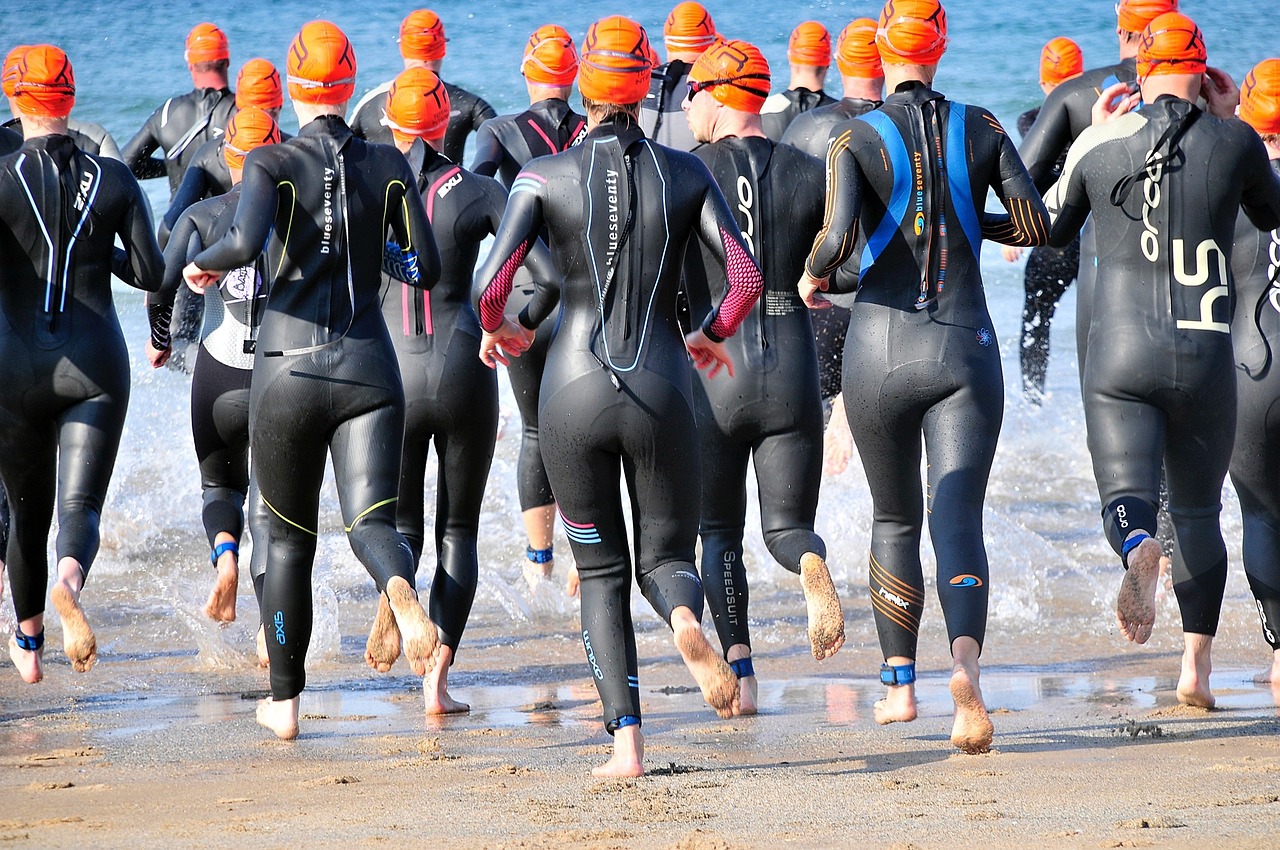
The swim is in a pool, a lake, a river or the sea. Open water races start in waves by age group, all at once (a mass start) or a few at a time (a rolling start). Wetsuits depend on water temperature: in most USA Triathlon age-group races they’re allowed up to 78°F, allowed above that only if you give up awards, and banned at 84°F and up. Pool races usually seed swimmers by expected time and send them off a few seconds apart.
Transition is the “fourth discipline.” Every athlete has a spot on a bike rack. In T1 you peel off the wetsuit, put on your helmet (buckled before you touch the bike) and push the bike out to the mount line. In T2 you rack the bike, swap to running shoes and go. No riding inside transition, and no help from friends.
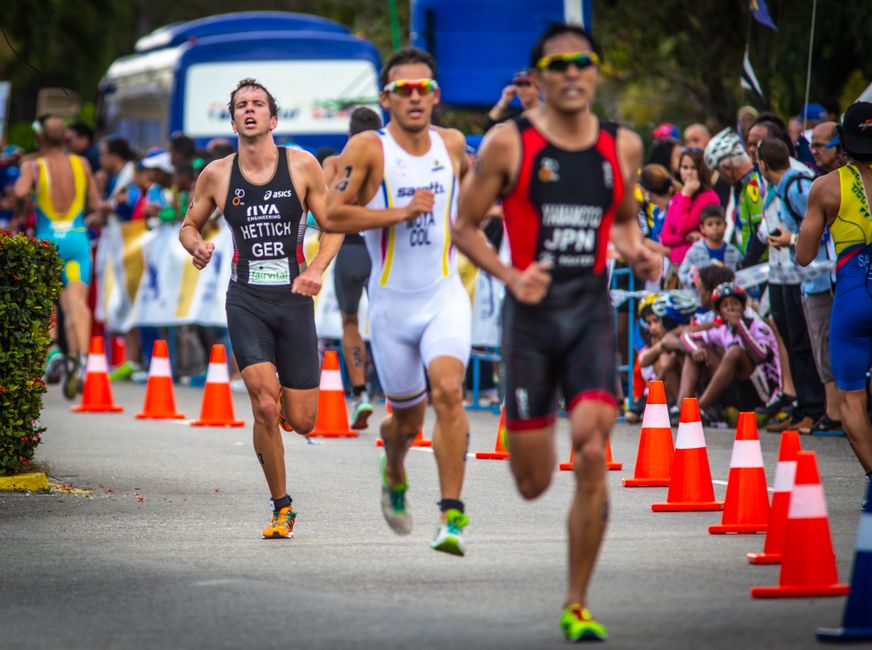
The bike in nearly every age-group race is “draft-illegal”: you can’t sit in someone’s slipstream. Under the 2026 USA Triathlon rules the draft zone is 12 meters (about six bike lengths), and you get 25 seconds to complete a pass through it. Elite and junior races, and the NCAA, are usually “draft-legal,” with packs like a bike race. The run is simple: run or walk, number on the front, no headphones, no pacers. Our triathlon rules page explains every rule and penalty in plain words.
Duathlon and aquathlon. A duathlon is run, bike, run: the standard sprint is 5 km, 20 km and 2.5 km, a good choice for people who don’t swim or for winter and spring racing. An aquathlon is swim and run; when wetsuits aren’t needed it often starts with a short run, then the swim, then a final run. Aquathlon is a gentle first race for kids and for swimmers who don’t ride.
Triathlon at every level
Kids and youth
USA Triathlon youth races run from age 6 to 15, with distances that grow with the child: for 7–10-year-olds, roughly a 50–100 meter swim, a 2–5 km ride and a 1 km run; for 13–15, up to about 375 meters, 10 km and 2.5 km. USAT recommends pool swims and closed roads for the youngest. Splash & Dash events (swim and run, no bike needed) run at more than 25 locations a year, and IRONKIDS fun runs are held at many IRONMAN races. Parents, see our youth triathlon page for distances by age, what gear a kid actually needs and safety questions.
High school and junior
Most US high schools don’t have triathlon teams, so teens race with clubs. USAT’s Junior National Series offers draft-legal racing for ages 13–15 and 16–19, leading to Youth and Junior Nationals (in 2026, July 31 to August 2 in West Chester, Ohio). Juniors aged 16–19 race the sprint distance (750 m, 20 km, 5 km), the same distance raced at the NCAA championships. Some regions also run a high school series with team scoring.
College
Women’s triathlon became an NCAA Emerging Sport for Women in 2014. In 2025–26, 42 colleges sponsored it, 14 of them in Division II, and Conference Carolinas becomes the first NCAA conference to sponsor the sport in fall 2026. NCAA races are draft-legal sprints, and the 2026 national championship is November 8 in Tempe, Arizona. Collegiate club triathlon is open to men and women: the 2026 USA Triathlon Collegiate Club Nationals in Gulfport, Mississippi drew more than 1,000 athletes from more than 100 clubs.
Pro, Olympic and Paralympic
Triathlon joined the Olympics at Sydney 2000 over the standard distance, and the mixed relay was added at Tokyo 2020. Para triathlon debuted at the Rio 2016 Paralympics with six medal events; at LA28 it will have 12, one for every class, men and women. LA28’s triathlons will be at Venice Beach, where the women’s race on July 15, 2028 will award the first medals of the Games. Away from the Olympics, pros race the World Triathlon Championship Series, the IRONMAN Pro Series and the PTO’s T100 Triathlon World Tour (2 km swim, 80 km bike, 18 km run). Our triathlon organizations page explains who runs what.
Adult age-groupers
Most triathletes are “age-groupers,” racing in five-year age groups by their age on December 31 of the race year. Many start with a local sprint, move to an Olympic distance, then a 70.3. IRONMAN, which began with 15 people on Oahu on February 18, 1978, now lists more than 170 triathlons worldwide; you must be 18 for its full and 70.3 races. In 2026 the IRONMAN World Championship returns to a single race day in Kona for men and women together, on October 10. Clubs, masters swim groups and group rides make the training social.
Sports health for triathletes
Triathlon is kind to the body in one way: you spread the load over three sports. But you also train more hours than most athletes, and the injuries pile up where training goes too far. This section is general information, not medical advice. If you’re hurt, see a professional.
The swim: open water and heart safety
Deaths in triathlon are rare, but they cluster in the water. A study of US triathlons from 1985 to 2016 found 135 sudden deaths, cardiac arrests and trauma deaths. Most of the sudden deaths and cardiac arrests (90) happened during the swim. In USAT-sanctioned races the rate was 1.74 per 100,000 participants, much higher in men aged 60 and older (18.6 per 100,000), and 44% of those examined after death had heart disease that mattered. The lessons: see a doctor before you train if you’re older, have heart disease, chest pain, fainting or a family history of sudden death; practice open water swimming with a buddy and safety cover before race day; seed yourself honestly in the start; and raise an arm and call for help if you get into trouble. Under USA Triathlon rules you may rest by holding a buoy or a stationary boat; accepting more help than that ends your race.
Overuse injuries, mostly from running
Running is where triathletes get hurt most. In an early survey of race finishers, 70% of training injuries came partly or entirely from running, and the knee, shoulder and ankle were hurt most. In a study of 131 triathletes, half were injured in the six months before the season, and overuse caused 68% of those injuries and 78% of injuries during the season. A 2025 survey of 758 triathletes found more than half had been injured in the past year, most often in the knee, and those who got prevention advice from a physician, physical therapist or coach were less likely to be hurt. Our triathlon injuries page covers the common ones, and the running injuries page goes deeper on the run.
Swimming is the gentlest of the three, but the shoulder takes thousands of overhead strokes a week, and shoulder pain is the most common swimming complaint. On the bike, a fit that doesn’t suit you can mean knee, neck and lower back pain. Our swimming injuries and cycling injuries pages explain them.
Heat, fluids and fueling enough
Summer racing means heat. The National Athletic Trainers’ Association (NATA) recommends getting used to the heat over 7–14 days and, for exertional heat stroke, fast cold-water immersion by trained staff. Call 911 for confusion or collapse. The sports-nutrition position statement from the American College of Sports Medicine and two dietitians’ groups suggests about 0.4–0.8 liters of fluid an hour during exercise, adjusted to your sweat rate, and not drinking so much that you gain weight. Long training also needs enough food: the International Olympic Committee warns that under-fueling (REDs) affects both female and male athletes. See our triathlon nutrition page.
Crashes and head knocks
Helmets are compulsory every time you ride in a race, and the chin strap must be buckled whenever you have the bike. After any crash or fall, if an athlete seems dazed or confused, or has a headache, dizziness or balance problems, follow the CDC’s HEADS UP advice: stop for the day and get checked by a healthcare provider before training again. Call 911 for a worsening headache, repeated vomiting, seizures or growing drowsiness.
When to see a professional
See someone for pain that changes how you swim, ride or run, pain that gets worse each session, bone pain you can point to with one finger, swelling, numbness, or anything that hasn’t settled in a week or two of easier training. A sports medicine physician manages most of these without surgery, a physical therapist guides rehab and the return to training, and an athletic trainer is the first stop for college and junior athletes. For the bike, a professional bike fit is worth it if your knees or back keep complaining.
Triathlon training
Most plans mix swims, rides and runs through the week, with one longer session of each, a few harder workouts and plenty of easy ones. Two things make it triathlon training rather than three separate sports. First, brick workouts: a ride followed straight away by a run, so your legs learn the wobbly first mile. Second, practice the race day: open water swims with sighting (lifting your eyes to spot the buoy), wetsuit practice, and quick transition drills at home. Build slowly, add strength work twice a week, and take an easy week every few weeks.
Start with a sprint. Many athletes then step up to an Olympic distance and later a 70.3, and the jumps are easier with a season or two of racing behind you. Our triathlon training page lays out the plan; swimming, cycling and running training pages go deeper on each sport, and VO2 max training covers intervals. For race morning, see triathlon race day.
Recovery for triathletes
With three sports there’s always something to train, which is exactly why rest days matter. Sleep first: the CDC recommends 7 or more hours for adults, 8–10 for teens. Then eat after long sessions, and keep easy days easy. Many triathletes use compression boots after a long ride, a massage gun or foam roller for calves and quads, and recovery shoes around the house. These are comfort tools, not treatment. Heart rate variability can help you spot a rough week: see HRV for athletes. The triathlon recovery page has the full routine.
Gear for triathlon
You can do your first sprint with goggles, any safe bike, a helmet and running shoes. After that, the gear that makes the biggest difference is a wetsuit that fits for cold water, a tri suit you can wear all race, elastic laces and a race belt for fast transitions, and a watch with a multisport mode. On the bike, aerobars are allowed in most age-group races; no headphones in any segment.
Our picks: the Synergy Endorphin full-sleeve wetsuit (women’s version about $399; men’s version also sold), the Zoot Core Tri Tank Racesuit (about $115), Lock Laces elastic laces (about $10), the Garmin Forerunner 570 running and triathlon watch (about $550), and the Hyperice Normatec Go for tired calves (about $379). Prices change often; these are what we saw at the maker or a major retailer in October 2026. The full list, with how to choose, is on our triathlon gear page, and watches are on the best triathlon wearables.
Synergy Endorphin Full Sleeve Wetsuit (Women's)
- Yamamoto #39 neoprene
- 5 mm core panel, 2 mm arms
- About $399
Zoot Core Tri Tank Racesuit (Men's)
- Sleeveless, chamois pad
- Pockets, UPF 50+
- About $115
Lock Laces Elastic No-Tie Laces
- 48 in, stretch to 72 in
- One size, kids and adults
- About $10
Garmin Forerunner 570
- GPS, AMOLED, 42 or 47 mm
- Garmin Coach triathlon plans
- About $550
Hyperice Normatec Go
- Calf compression sleeves
- 7 levels, 40-200 mmHg
- About $379
For more, browse Recovery & Regeneration and Training & Performance.
Triathlon FAQs
What are the triathlon distances?
The sprint is a 750 m swim, 20 km bike and 5 km run. The standard or Olympic distance doubles it: 1.5 km, 40 km and 10 km. A half or IRONMAN 70.3 is 1.2 miles, 56 miles and 13.1 miles, and a full IRONMAN is 2.4, 112 and 26.2 miles. Super sprints and youth races are shorter.
Can a beginner do a triathlon?
Yes. Pick a sprint, ideally with a pool swim or a calm lake, and make sure you can swim the distance without stopping before race day. You can do a breaststroke swim, ride any safe bike and walk part of the run. If you have heart disease or symptoms, see a doctor first.
Do I need a wetsuit for a triathlon?
Not always. In most USA Triathlon age-group races a wetsuit is allowed up to 78°F water, optional without awards above that, banned at 84°F and up, and mandatory at 60.6°F and below. Many athletes like one in cold water for warmth and buoyancy. You can rent one for your first race.
What is drafting in triathlon?
Riding close behind another cyclist to save energy. It’s against the rules in most age-group races: stay 12 meters back, and if you go into that zone to pass, finish the pass within 25 seconds. Getting caught means a time penalty served in a penalty box.
What’s the difference between a duathlon and an aquathlon?
A duathlon is run, bike, run, with no swim; the standard sprint is 5 km, 20 km and 2.5 km. An aquathlon is swimming and running only, either swim then run or run, swim, run, which makes it a good first multisport race for kids and swimmers.
How old do you have to be to do an IRONMAN?
Eighteen for IRONMAN and IRONMAN 70.3 races, unless the race says otherwise. Kids can do IRONKIDS fun runs at many IRONMAN events, and USA Triathlon youth races from age 6.
Triathlon rewards patience: build slowly, respect the open water, sleep, eat enough and listen to pain. Then enjoy the finish line, whatever the distance. Keep exploring: swimming, cycling and running on their own, energy gels and electrolytes for long days, and every other sport on our sports hub.