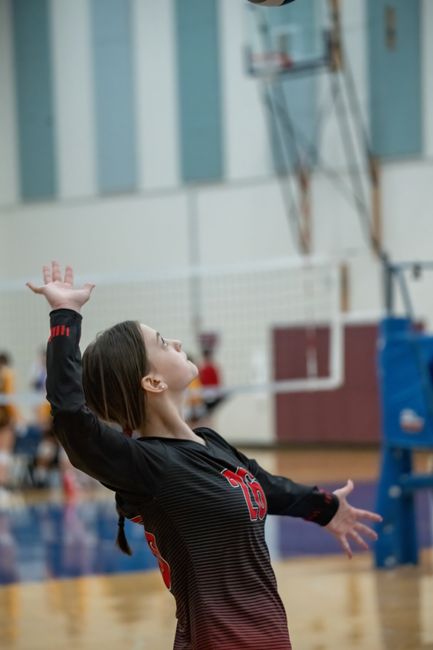
Tied at 23, your team’s serve. The ref’s whistle goes, the gym goes quiet for half a second, and you have a ball in your hand and a whole row of opponents watching you. Every volleyball player knows that moment, from a middle-school gym to a college arena or a hot beach court. Volleyball mental training means practicing the skills between your ears (focus, confidence, routines, bouncing back from errors, talking with teammates) the same way you practice a float serve. This page is about mental performance, which is different from mental health; there is a clear section on that difference below.
Quick answer: Mental skills are trainable habits: the same short routine before every serve, a quick reset after an error, simple imagery, small goals you control, and clear talk with teammates. Research on these tools is promising but mixed, and none of them guarantees better results. If worry, low mood, or trouble eating or sleeping lasts more than a couple of weeks or gets in the way of daily life, see a doctor, licensed psychologist or other qualified professional, and in a crisis call or text 988 (US).
Confidence: built from reps, not hype
Confidence in sport psychology means your belief that you can do a specific thing, like serve tough to zone 5. A 2026 pilot study of 79 elite male Polish volleyball players (Witkowska, Current Issues in Personality Psychology) found that players with higher trait sport-confidence tended to report less cognitive anxiety before competing and to read their pre-match jitters as helpful rather than harmful. The authors call it a pilot, note that some results were small or not significant, and say it needs larger studies. It is a hint that confidence and nerves are linked, not proof that one causes the other.
A practical habit: after every match, write down two things you did well, even in a loss.
Focus, motivation and goals
Volleyball plays in short bursts: a rally lasts seconds, then there is a pause before the next serve. That rhythm makes it a good sport for practicing “narrow focus now, let go after”. A common way to organize goals is to split them into three kinds: outcome (win the set), performance (serve 80% in during practice) and process (use my routine every serve, call every ball). Process goals are fully in your control, so they hold up on a night when the points don’t fall. This split is ordinary coaching practice, not a finding from a single study.
Mindfulness is one tool researchers have tried. In a 2026 randomized trial of 28 female volleyball players aged 17 to 19 (Yaman and colleagues, International Journal of Sports Medicine), the group that did 12 mindfulness sessions over 6 weeks improved more than the control group on forearm pass, overhead pass, serve, spike and block accuracy tests. That is a small trial with one group of elite young women, so treat it as promising, not settled.
Visualization and imagery
Imagery means rehearsing a skill in your mind with as many senses as you can: the toss, the contact sound, the ball curling over the tape. In a 2025 study of 60 male volleyball players aged 15 to 17 (Hassan and Abdulkareem, International Journal of Exercise Science), an 8-week program of imagery, self-talk, attention control and relaxation improved psychological hardiness and some personality measures more than regular training alone. Elite players have also been studied: a 2026 preliminary preprint of nine professional men doing 6 weeks of spike-serve imagery reported changes in brain activity in the motor cortex, though that report has not yet been peer reviewed and says nothing about match results. Imagery works as an add-on to real reps, never a replacement.
- Try 3 to 5 minutes before bed or on the bus: see yourself, through your own eyes, running your serve routine and the ball landing where you aimed.
- Also rehearse the hard version: a loud gym, set point, you staying steady.
- Keep it short and regular. A session that feels like a chore won’t last.
Serving routines
Serving is the one skill in volleyball that is entirely yours: no one passes you the ball. That also makes it the skill where nerves show up loudest. A pre-performance routine is a short, fixed sequence that gets you ready and shuts out noise. The 2026 position statement from Exercise and Sports Science Australia on performance under pressure (Schweickle and colleagues, Sports Medicine) lists pre-performance routines among its evidence-based strategies, alongside psychological skills training and mindfulness-based approaches. It was written for sport in general, not volleyball in particular.
- Keep it short enough for the clock. Under FIVB and NCAA rules a server has 8 seconds after the referee’s whistle (5 in high school), so build a routine that fits, such as: pick the target, bounce the ball twice, one breath, serve. See our volleyball rules guide for the serve rules by level.
- Aim at a spot, not at “don’t miss”. A target is a job; a fear is a distraction.
- Practice it everywhere. Use the identical routine in serving drills, scrimmages and matches, so it feels automatic when the score is tight.
- Plan for the long wait. At tournaments there can be hours between matches. For meals, fluids and re-warming, see the volleyball game day guide.
Handling pressure and nerves
Nerves are normal. The ESSA statement says pressure can have both helpful and harmful effects on performance, and that training environments that add some pressure can help prepare athletes. In practice that means adding stakes to drills: a serving game to 10 with teammates watching, or scrimmage points that start at 22-22. Keep it fair and safe, so it builds readiness rather than fear. A 2026 network meta-analysis of competitive-anxiety interventions across 46 trials (Li and colleagues, Sports Medicine – Open) reported substantial uncertainty in its estimates, so no single technique can be called the best.
After an error: the short-memory reset
Volleyball scores on every rally, so errors come quickly and the next ball follows right away. Many coaches teach a short reset between points: acknowledge it (a breath), take one lesson (“I was late to the ball”), and move to the next job (get in base position). Pick one cue, such as a hand clap or the word “next”, and use it after good plays and bad ones alike so it becomes a habit. This is common coaching practice rather than a single tested method, and we haven’t found a volleyball study that proves it.
Rotation is a natural reset button. When your team wins the serve back and everyone rotates one spot clockwise, that is a built-in moment to take a breath, check the new matchup and leave the last point behind. Rally scoring means a bad stretch can end with one good rally, so the next point always matters.
Communication and teamwork
Volleyball is a team sport where nobody is allowed to hold the ball. Six players have to share the court, and calls like “mine”, “out” and “short” are part of the skill. A 2026 randomized trial of 80 children aged 8 to 12 (Zhang and Zhou, Frontiers in Public Health) found that a 12-week cooperative tactical volleyball program improved social anxiety and peer interaction scores more than standard physical education; the authors had no follow-up data on whether the gains lasted. A 2026 interview study at a university (Xu and Hu, Frontiers in Psychology, 35 participants) described how support from teachers and peers helped students feel safe to try, make mistakes and keep playing. That was an interview study, so it shows experience, not proof.
- Call early, call loud. Short, agreed words beat long sentences.
- Name roles. Setter, hitters, libero and blockers all have jobs; know yours and your neighbor’s.
- Encourage after errors. A touch of hands or a “next ball” helps the player who made the mistake get back to work.
Preparing for competition
Put the mental pieces into the week: one or two imagery sessions, a serving routine practiced under mild pressure, a clear game plan with one or two process goals, and an agreed reset cue for the team. Physical preparation sits in our volleyball training guide, and sleep and bounce-back in the recovery guide. If an injury is part of why you feel anxious about playing, see our volleyball injuries guide, and talk to a sports medicine doctor, physical therapist or athletic trainer before returning.
Young players
Keep it light for kids: fun routines, effort goals and praise for trying. The 2026 IOC consensus statement lists adolescent athletes among groups where research is thinner, so adults should watch for signs of struggle rather than assume mental skills drills are enough. See our youth volleyball guide for age-based guidance.
Mental performance is not mental health care
Routines, imagery and resets are performance tools. Anxiety disorders, depression, disordered eating and burnout are health matters, and they need a qualified professional such as a doctor, licensed psychologist or counselor. The 2026 International Olympic Committee consensus statement on mental health in elite athletes (Reardon and colleagues, British Journal of Sports Medicine) says mental health symptoms and disorders are common in elite athletes, can affect performance, and can be treated, and that with support many athletes keep training and competing. Signs worth raising with a professional: weeks of low mood, constant dread, changes in eating, sleep or weight, pulling away from teammates, or losing interest in a sport you love.
If you or someone you know is thinking about self-harm, call or text 988 or chat at 988lifeline.org (US, free, 24/7, confidential). In immediate danger, call 911. Outside the US, use your local emergency number or crisis line. College athletes can also ask their athletics department about campus counseling and sports medicine staff.
FAQs
How do I stay calm when I’m serving at set point?
Use the same short routine you use in practice, aim at a target, and practice it under mild pressure. Routines are one of the strategies the 2026 ESSA position statement lists as evidence-based, though nothing guarantees a good serve.
How do I stop dwelling on a missed serve or a shanked pass?
Pick a reset cue, such as a breath or a word like “next”, and rehearse it in scrimmages. Then take one lesson from the error and go back to your next job. Use rotation as a built-in pause.
Does visualization help volleyball players?
Some small studies of volleyball players, such as the 2025 adolescent trial above, found benefits from mental skills programs that included imagery. Evidence is limited and mixed across sports, and imagery works best next to real practice.
Is pre-match anxiety normal?
Some nerves are common and can even help, according to the ESSA statement. If worry is constant, causes panic, or disrupts sleep or eating, talk to a doctor or licensed mental health professional.
How can a team communicate better on court?
Agree on short calls and roles, call early, and encourage after errors. Research suggests supportive, cooperative settings help players feel safe to take part, though most of it comes from school and university programs.
Should my young player see a sport psychologist?
Most kids need fun, supportive coaching, not a specialist. If a child shows lasting distress, start with their pediatrician or a licensed mental health professional.
Sources
- Schweickle MJ et al. Performance Under Pressure in Sport: A Position Statement from Exercise and Sports Science Australia. Sports Medicine, 2026. PMID 42271117
- Reardon CL et al. Mental health in elite athletes: International Olympic Committee consensus statement (2026). British Journal of Sports Medicine. PMID 42580854
- Li L et al. Psychological interventions and competitive anxiety: Bayesian network meta-analysis. Sports Medicine – Open, 2026. PMID 41866642
- Witkowska MA. Pre-competition emotions, self-confidence and positional differences in top-level volleyball players: a pilot study. Current Issues in Personality Psychology, 2026. PMID 42959864
- Yaman MS et al. Effects of a mindfulness intervention on volleyball-specific performance: a randomized trial. International Journal of Sports Medicine, 2026. PMID 42570676
- Hassan MFA, Abdulkareem OW. Mental training, psychological hardiness and personality traits in adolescent male volleyball players. International Journal of Exercise Science, 2025. PMID 41210369
- Ince MS et al. Neurovascular correlates of motor imagery training in elite volleyball players: a preliminary fNIRS study (preprint, not peer reviewed), 2026. doi 10.21203/rs.3.rs-11133169/v1
- Zhang Q, Zhou Y. Collective volleyball cooperative tactical training, social anxiety and peer interaction in school-aged children. Frontiers in Public Health, 2026. PMID 43016459
- Xu H, Hu T. Social support and psychological safety in university volleyball. Frontiers in Psychology, 2026. PMID 42220378
- 988 Suicide & Crisis Lifeline
General information for education only, not medical advice. It does not replace a doctor, psychologist or other qualified professional. See how we work in our editorial policy. Back to the volleyball hub.