This article contains affiliate links: if you buy through them we may earn a commission, at no extra cost to you. Read our affiliate disclosure.
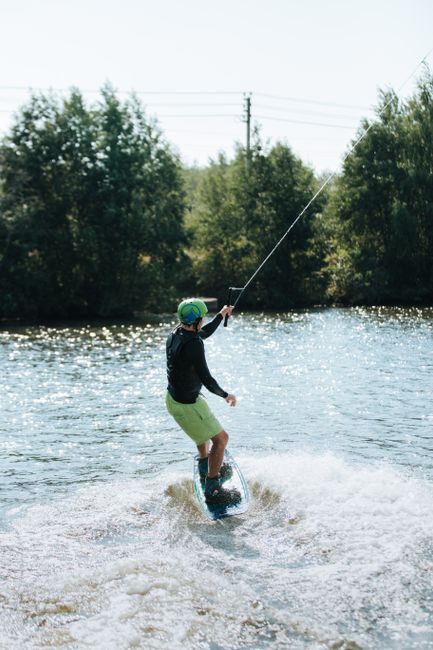
It is the last set of a long Saturday on the lake. The rider’s legs are tired, the sun is low, and the crew on the boat is calling for one more run at the wake. The spotter checks the rope is clear, and the rider, jacket buckled and helmet strapped, shouts “hit it”. That small routine is what wakeboarding injury prevention looks like: the habits riders, drivers and spotters build to lower the odds of a hard landing, a head or face injury, a propeller or rope accident, or a drowning.
Quick answer: Wear a Coast Guard approved life jacket made for towed sports, consider a water sports helmet, put the engine off whenever riders are near the boat, keep a spotter watching the rider, and build jump height slowly with soft, bent knees. See a doctor, physical therapist or athletic trainer for a knee that popped, a shoulder that slipped out, a possible concussion or pain that keeps coming back; call 911 in an emergency.
General information, not medical advice. This page is about lowering risk. For what each wakeboarding injury looks like, what the studies found and when to get help, see our wakeboarding injuries guide. Back to the wakeboarding hub.
Before the first set: warm-up
We did not find a published warm-up program written for wakeboarding, so there is no “wakeboard 11+” to point to. The nearest evidence is from team sports: a 2018 review (Webster and Hewett, Journal of Orthopaedic Research) found that ACL injury prevention programs, which combine strength, landing and balance work, cut ACL injuries by about half in team-sport athletes. Riders borrow the idea. Riders borrow the idea: easy movement on the dock, then squats, lunges and soft-knee landing practice is a sensible way to wake up the legs (general coaching guidance, not a tested protocol). Our training page has the longer version.
Life jackets: the habit with the strongest numbers
In 2024 US recreational boating, the Coast Guard’s statistics report says 76% of people who died drowned, where the cause was known, and 87% of those who drowned were not wearing a life jacket. The CDC says life jackets reduce the risk of drowning while boating for people of all ages and swimming abilities.
- Read the label. The Coast Guard’s Boater’s Guide says some life jackets are NOT APPROVED for water skiing, tubing, personal watercraft or wakeboarding. Federal rules say a life jacket must be used according to its approval label.
- Skip inflatables for towed riding. California’s boating agency says inflatable life jackets are not approved for towed sports, Florida and Pennsylvania require a non-inflatable Coast Guard approved jacket for a towed person, and the Coast Guard does not recommend inflatables for children under 16 or non-swimmers.
- Contest riders: the World Wake Association (WWA) rule book requires a Coast Guard approved jacket or one that will absolutely float an unconscious competitor.
- Fit: the Coast Guard says fit, snug but not tight, is the most important feature.
Helmets: what the evidence supports, and what it does not
A US emergency department study of 2001 to 2003 found head injuries were 28.8% of wakeboarding injuries, compared with 4.3% for water skiing, and cuts, mostly to the face, were the most common injury. Nationwide Children’s Hospital’s injury research center advises always wearing an approved safety helmet when wakeboarding. No study we found measured helmet effectiveness in wakeboarding, so these are recommendations, not a proven percentage, and the CDC’s HEADS UP concussion guidance still applies after any hard fall.
For cable parks, the WWA rule book requires a helmet for anyone riding obstacles or features, and many parks set their own rules, so check before you go. When you shop, separate the standard from the sales copy: water sports helmet makers such as Pro-Tec and Triple Eight say their helmets meet the CE EN 1385 water sports standard, which is the maker’s statement on its listing, not something we tested. Look for the marking and check the fit. More on choosing one is on our gear page.
The boat: driver, spotter and propeller rules
The Coast Guard counted 169 incidents in 2024 with at least one person struck by a propeller, including 30 deaths and 158 injuries, and recorded 19 deaths and 242 injuries involving towed water sports. The fixes are mostly simple.
- Engine off when riders are near the boat. The Coast Guard says the best and safest action when people are in the water near your boat is to shut off the engine, and to keep them on the operator’s side, always in view. California’s pamphlet adds that even in neutral a propeller may still be turning.
- Never back up to a fallen rider. California says never back the boat up; circle around slowly instead, and approach from the driver’s side.
- Use the cut-off switch. Federal law requires the lanyard on boats under 26 feet when on plane.
- Have a spotter, and make it their only job. The BoatUS Foundation says the observer’s job is to watch the rider, receive signals and alert the driver to a fall. Florida requires an observer in a position to watch the person being towed (or a wide-angle rear view mirror), Pennsylvania requires at least one competent observer besides the driver, and California requires an observer 12 or older. Rules differ by state; our rules page has signals.
- Daylight only. California and Pennsylvania prohibit towing from sunset to sunrise (Florida, half an hour either side).
- No alcohol for driver, spotter or rider. The Coast Guard lists it as the leading known contributing factor in fatal boating incidents (20% of deaths in 2024).
Carbon monoxide (CO) is the quiet danger at the back of the boat. The Coast Guard says never to sit, teak surf or hang on the back deck or swim platform while the engines are running, and that teak surfing is never a safe activity. CO can collect at idle and slow speeds, and early symptoms (headache, nausea, dizziness) are easy to mistake for seasickness. Strap in only with the engine off, and treat a “seasick” rider as a possible CO case: fresh air and medical attention.
Falls and handle release
Nationwide Children’s Hospital advises releasing the rope when you fall and making sure the propeller has stopped before anyone re-boards. A case report describes torn shoulder muscles in a wakeboarder whose arms were forced overhead, one reason to let go early (a case report, not a measured effect).
- Let go when the fall starts, rather than being dragged or having the arms yanked.
- Signal when you are okay. The BoatUS Foundation guide shows hands clasped over the head as the rider’s “OK” after a fall.
- A confused rider is not “fine”. The CDC says “when in doubt, sit them out” until a health care provider clears the rider.
Tow rope and handle handling
California’s towing pamphlet warns that a towline “can cut like a knife”, and a published case report describes a wrist strangled by a wakeboard rope.
- Never wrap the rope around a hand, wrist or arm. A wakeboard board’s owner’s manual we reviewed also says not to coil the rope in your hands.
- Keep the rope clear of people and the prop before the driver accelerates, and stow it when not in use.
Knees, shoulders and back
Knees. In a 2012 survey of wakeboarders, 42% of those who answered had torn an ACL, and most described a pop or buckle landing a high jump; only a small share blamed an edge catch. Low response means “common”, not a true rate. The common advice, which is general coaching rather than a tested protocol, is to build jump height slowly, land with soft bent knees, and stop when your legs are tired. Treat the pop, a knee that gives way or swelling within 24 hours (AAOS signs) as a reason to see a doctor.
Ankles. The NATA ankle sprain position statement says a previous sprain is the most consistent risk factor for another, and recommends a balance program of at least three months after one. Checking that bindings fit without pinching is a sensible habit (general guidance).
Shoulders. Shoulder dislocations were 15% of the injuries orthopedic surgeons reported in a 2004 survey. Releasing the handle early and keeping it low and close are the usual coaching cues; neither is from a trial.
Back. We found no wakeboarding-specific back injury study in our sources, so we make no claim about back protection. See a clinician for back pain that radiates, comes with numbness or does not settle.
Building up the load
No authoritative source gives a safe number of sets or hours. The American Academy of Pediatrics’ 2016 clinical report on young athletes suggests one to two days off a week and time away across the year. End the day when landings slip. Land training is on our training page; the night after a big day is on recovery. Kids’ life jacket rules are on our youth page.
Water, weather and sun
- Cold water. The National Weather Service says water 70°F or lower is cold; within 10 minutes you can lose muscle control. Dress for the water.
- Heat. The NATA position statement on exertional heat illness says cold-water immersion is the most effective treatment, and NATA’s fluid statement says to drink to thirst when you do not know your sweat rate and avoid overdrinking.
- Lightning. NATA says to wait 30 minutes after the last thunder. Get off the water.
- Sun. The CDC notes UV reflects off water; the American Academy of Dermatology advises SPF 30 or higher, water resistant, reapplied at least every two hours.
- Water quality. The CDC says to stay out of water that smells bad or looks discolored, scummy or foamy, and to follow local advisories.
Day-of logistics, hydration and rotation are on our lake day and contest day page.
Protective gear that fits
The Coast Guard approval label is a verified standard; “comfortable” or “pro-level” is the maker’s wording. Two examples that match the points above, with details from the makers’ Amazon listings:

O'Neill Men's SuperLite USCG Life Vest
- USCG Type III, sold for wake, ski and tubing
- Four buckles
- Sizes S to 4XL
$49.95 at Amazon, as of Nov 17, 2026 02:07 UTC
Check price on Amazon
Pro-Tec Ace Water Helmet
- Maker says it meets CE EN 1385
- 15 vents, ABS shell
- Three shell sizes
$84.99 at Amazon, as of Nov 17, 2026 02:07 UTC
Check price on AmazonWhat prevention cannot do
No jacket, helmet, spotter or warm-up removes the risk. The research on wakeboarding is small: survey studies and case reports, not trials of prevention methods, and the only prevention figures we cite come from team sports. Treat all of this as lowering the odds, not a guarantee.
When to see a professional
- Call 911: an unconscious or confused rider, concussion danger signs, a propeller injury or heavy bleeding, trouble breathing after being under water, or a suspected neck or back injury.
- See a doctor soon: a knee that popped or gave way, an ankle you cannot walk on, a shoulder that slipped out, a deep cut, or a possible concussion.
- See a physical therapist or athletic trainer: pain that keeps returning or a joint that feels unstable.
Wakeboarding injury prevention: FAQs
Do wakeboarders have to wear a helmet?
Not by federal law that we found. The WWA rule book requires a helmet for riders hitting obstacles or features, and Nationwide Children’s Hospital’s injury research center advises always wearing one. Check your park and state.
When should the driver shut off the engine?
Whenever a rider or swimmer is near the boat, especially at the back or when someone is getting in or out. The Coast Guard calls shutting off the engine the best and safest action when people are in the water near your boat.
Can I wear an inflatable life jacket?
Not for towed riding in states such as California, Florida and Pennsylvania, and the Coast Guard notes some jackets carry a label saying they are not approved for wakeboarding. Check the label.
Can I let go of the handle during a fall?
Yes, and Nationwide Children’s Hospital’s advice for wakeboarding and water skiing is to release the rope when you fall. Never wrap the rope around your hand or arm, so that letting go is always possible.
Sources
- US Coast Guard, 2024 Recreational Boating Statistics
- US Coast Guard, Boater’s Guide to the Federal Requirements for Recreational Boats (2023)
- 33 CFR 175.15, personal flotation devices required
- US Coast Guard, how to choose the right life jacket
- US Coast Guard, carbon monoxide: how to protect others and yourself
- California Division of Boating and Waterways, Safety Hints for Towing Sports
- Florida Statutes 327.37
- Pennsylvania Code, 58 Pa. Code 109.4
- BoatUS Foundation, water sports study guide
- World Wake Association, rule book
- Nationwide Children’s Hospital, Waterskiing and wakeboarding
- Hostetler and colleagues, water skiing and wakeboarding injuries in US emergency departments, American Journal of Sports Medicine, 2005
- Carson, wakeboarding injuries, American Journal of Sports Medicine, 2004
- ACL injuries in wakeboarding: prevalence and mechanism, Sports Health, 2012
- Case report, bilateral teres major tears in a wakeboarder
- Case report, wrist strangulation by a wakeboard rope, Cases Journal, 2009
- Webster and Hewett, ACL injury prevention programs meta-analysis, Journal of Orthopaedic Research, 2018
- Brenner, sports specialization and intensive training in young athletes, Pediatrics, 2016
- NATA position statement, management of acute and chronic ankle instability (Kaminski and colleagues, 2013)
- AAOS OrthoInfo, ACL injuries
- CDC HEADS UP, concussion signs and symptoms
- CDC, drowning prevention
- CDC, harmful algal blooms prevention
- National Weather Service, hazards of cold water activities
- NATA position statement, exertional heat illnesses (Casa and colleagues, 2015)
- NATA position statement, fluid replacement (McDermott and colleagues, 2017)
- NATA position statement, lightning safety (Walsh and colleagues, 2013)
- CDC, sun safety
- American Academy of Dermatology, how to apply sunscreen
General information for education only, not medical advice. It does not replace a visit with a doctor, physical therapist or athletic trainer. See how we write and check our pages in our editorial policy.