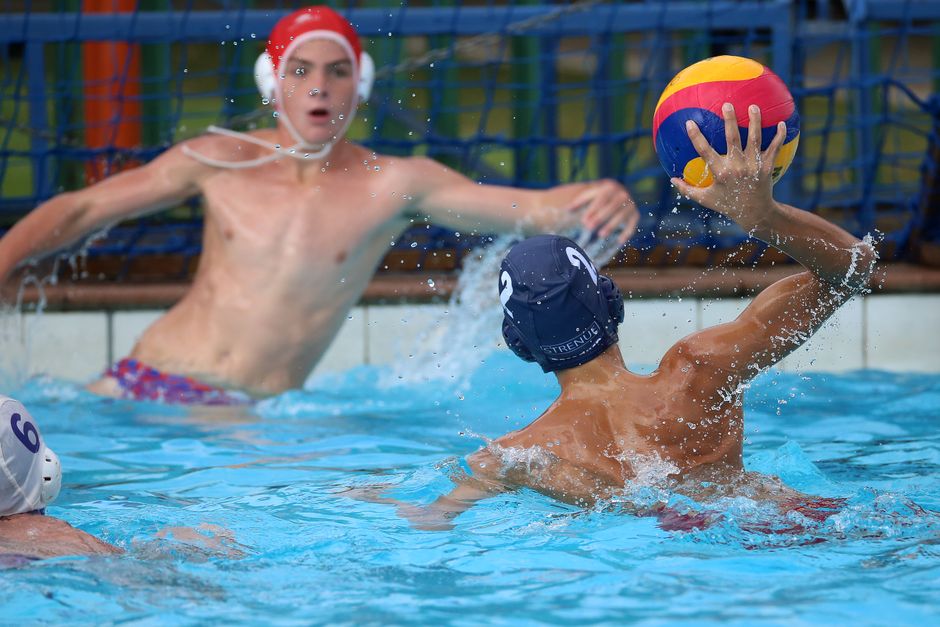
Fourth period, one goal down, and a defender grabs your suit under the water where the referee cannot see it. Then the whistle goes the other way: an exclusion, a penalty throw, and the whole pool goes quiet for one shooter and one goalkeeper. Every water polo player knows that the hardest part of the game is often not the swimming. Water polo mental training means practicing the skills between your ears (composure when the contact turns rough, nerve at the five-meter line, clear decisions on tired legs, a quick reset after a bad play, and trust in six teammates) the way you practice your eggbeater. It is about mental performance, which is different from mental health; see the section on that difference below.
Quick answer: Mental skills are trainable habits: a breath and a cue before a penalty throw, a simple reset after a foul or a goal against, agreed plans for power plays, and goals you control. Research on these tools is promising but not settled, and none of them guarantees a win. If worry, low mood, or trouble eating or sleeping lasts more than a couple of weeks or gets in the way of daily life, see a doctor, licensed psychologist or other qualified professional, and in a crisis call or text 988 (US).
Why pressure feels real in the pool
Nerves before a match are not imagined. In a 2026 study of 16 male players in Italy’s third-tier league (Tayyar and colleagues, Sports), saliva cortisol, a stress hormone, was higher before official matches than before training matches. Players also reported more cognitive and somatic anxiety and lower self-confidence before competition, and the players with higher cortisol reported more anxiety and less confidence. It is a small observational study at one level, so it describes what players feel, not what to do about it. The ESSA position statement on performance under pressure (Schweickle and colleagues, Sports Medicine, 2026) adds that pressure can help as well as hurt. The aim is not to remove nerves, but to have a plan for them.
Composure under contact and fouls
Water polo is a contact sport that happens mostly out of the referee’s sight. Our water polo rules guide explains the system: exclusion fouls send you out for 18 to 20 seconds, a third personal foul ends your game, and a violent action under World Aquatics rules ends it at once and gives the other team a penalty throw. An analysis of a full Italian first-league season (Perazzetti and colleagues, 2023) found that center forwards drew the most exclusions when they had the ball, about 48% of them.
- Decide your response before the match. Retaliating is how a defender collects a personal foul or a violent-action ejection. Many coaches teach one rule: the referee sees the second push, so do not give it. This is common coaching advice, not a sourced finding.
- Use the six seconds after a whistle. A slow breath out, shoulders down in the water, then eyes to your next job: where is the ball and who is my player?
- Practice it with contact. The ESSA statement describes training under pressure as part of preparing for it. Wrestling drills with a teammate calling fouls, or scrimmages with a point penalty for retaliation, are simple ways to do it.
Penalty-shot pressure
A penalty throw is taken from the five-meter line, one shooter against the goalkeeper, and a tied game can end in a penalty shootout under World Aquatics rules (see rules). We found no water polo study of penalty-throw psychology, so what follows is general sport psychology applied to the situation, not a water polo finding. The ESSA statement describes pre-performance routines as a standard way to manage pressure. A routine is a short fixed sequence you can repeat every time: a breath, a target picked before the whistle, one cue word, then the throw. Rehearse it in practice with something at stake (the loser swims extra, or the team’s cool-down depends on it), so the real moment feels familiar. A 2023 meta-analysis of psychological interventions (Reinebo and colleagues, Sports Medicine) found moderate effects on performance, though they were not stable once weaker studies were removed, so treat routines as helpful, not magic.
The goalkeeper’s mindset
Goalkeepers are the only players who can use both hands and who see every shot coming at them, and mistakes are visible on the scoreboard. We found no study of goalkeeper psychology, so the following are widely used coaching ideas, not research findings: a goalkeeper who treats each shot as a separate event, who has a short phrase to restart after a goal against, and who talks to the defenders are all using the same reset skills described below. There is one health point that is sourced. Studies of college and national-team players found goalkeepers had the highest concussion rates, 26.2% against 16.0% for field players in Pac-12 teams (Lee and colleagues, 2025), mostly from ball-to-head contact. Concussion is a medical matter, not a mindset one: see our water polo injuries page and never play through a suspected head injury.
Decisions when you are tired
Everyone assumes tired players make worse decisions. In a 2025 study of 13 women at the 2022 World Championships (Dong and colleagues, Journal of Sports Sciences), the researchers judged 4,491 offensive on-ball decisions across six games as good or poor. Players reported being more fatigued after matches and later in the tournament, but there was no general rise in poor decisions as a match went on, and the pattern varied a lot between matches and teams. That does not mean fatigue is harmless; it suggests other factors matter too, which is encouraging, because some of them are trainable. The game’s rhythm gives you time to prepare: our water polo training page notes that real games are long chains of play, so you will make choices while breathing hard.
- Simplify under load. Agree defaults in advance: the first option, the safe option, and when to swim for a foul rather than force a shot.
- Train decisions in tired conditions. Short small-sided games at the end of a swim set make the pass-or-shoot choice happen when you are already breathing hard.
- Rest is part of thinking. Sleep and recovery are covered on our water polo recovery page.
Resetting after a mistake, a goal against or an exclusion
Games are decided in runs, and water polo gives you little time to dwell: a turnover becomes a counterattack in seconds. The most practical reset skill is a three-beat routine: a breath, a cue word, then one concrete job (get back, find your player, take the position). Review the mistake later, at the break or after the game, when you can think clearly. This is common coaching practice; the ESSA statement supports routines in general, but no water polo reset trial was found. A related tactical point comes from 97 European Championship matches (Lupo and colleagues, Frontiers in Psychology, 2025): coaches believe calling a time-out before a power play helps, but those power plays actually produced fewer goals than power plays without a time-out. It is an association in elite and youth matches, not a rule, but it is a reminder that a time-out is a chance to calm and set the plan, not a guaranteed advantage. Use the minute well, with one clear message.
Confidence, motivation and goals
Confidence is built from evidence: practice reps you completed, plays you drilled, shots you scored. A habit many players use is writing down two things that went well after every game, including losses. Goals work best when you control them (a process goal such as “swim back on every turnover” or “first look, then pass”) rather than only the score. Motivation matters in the pool too. In a 2026 study of 17 masters players aged around 50 (Lupo and colleagues, PLOS ONE), swimming sessions had the lowest enjoyment ratings, and players’ ratings of effort and enjoyment did not line up well with their coach’s estimates. A coach who asks players how a session felt is getting information the coach cannot see from the deck.
Teamwork in the water
A team of seven shares one ball and constant noise. Water polo players cannot always hear each other, so signals, hand cues and shared plans matter more than shouting. The Italian season analysis above described team performance as the sum of every player’s actions. Practical team habits include naming a captain for the power play, agreeing who communicates with the referee, and a quick huddle after a goal against that is about the next plan, not blame. These are coaching suggestions; we found no water polo study of team cohesion to cite.
Imagery, routines and match preparation
Imagery (mentally rehearsing a skill) is used by many athletes. The 2023 meta-analysis above found moderate benefits across psychological interventions, but not stable ones, and imagery works best as an addition to real pool time. Try a short version: before a match, picture one exclusion defended, one power-play goal and one penalty throw, each with the cue word you will use. For a tournament weekend, treat each match as its own event, with the same warm-up and breathing routine. The practical side (food, drinks, warm-up in the water, outdoor safety) is on our water polo game day page.
Younger players
A 2025 study of 106 Croatian players aged about 14 (Kovacevic and colleagues) found that wings were faster than center-forwards on a Stroop test of response inhibition, one cross-sectional snapshot of how differently positions can think. For young players, keep the mental side simple and fun, and see our youth water polo page for how programs work.
Mental performance is not the same as mental health
Everything above is about performance skills. Anxiety disorders, depression, disordered eating and burnout are health matters, not mindset problems, and they are not fixed by a better routine. The 2026 International Olympic Committee consensus statement on mental health in elite athletes (Reardon and colleagues, British Journal of Sports Medicine) treats them as medical and psychological care issues. A friendly team can be a good support, but it is not treatment.
Signs to take seriously include worry or low mood lasting weeks, panic before matches, withdrawing from teammates, big changes in eating or sleep, or dreading a sport you used to love. Start with your doctor, a licensed psychologist or other qualified mental health professional. In the US, you can call or text 988 (Suicide & Crisis Lifeline) at any time.
Frequently asked questions
How do I stay calm when I am being held or hit underwater?
Decide your response before the match: breathe, keep your hands legal and let the referee see the foul. Retaliating risks your own personal foul, and three personal fouls end your game under the rules.
How do I handle a penalty throw?
Build a short routine (breath, target, cue word) and rehearse it in practice with something at stake. The ESSA statement supports routines for pressure, but no water polo penalty study was found, and routines do not guarantee a goal.
Do tired players really make worse decisions?
Not automatically. In 4,491 offensive decisions at the 2022 World Championships, fatigue rose but poor decisions did not increase in a general way. The pattern varied by match and team.
Does calling a time-out before a power play help?
In 97 European Championship matches, power plays after a time-out scored less often than those without one. That is an association, not proof, so use the time-out to calm and give one clear plan.
Are pre-match nerves normal?
Yes. In one small study, players showed more anxiety and higher cortisol before official matches than before training matches. If worry is constant, causes panic, or disrupts sleep or eating, talk to a doctor or licensed mental health professional.
Sources
- Tayyar NN et al. Competitive Stress Elicits Distinct Psychophysiological and Immunological Responses in Sub-Elite Water Polo Players. Sports, 2026. PMID 42347478
- Dong L et al. The relationship between match-play decision making and fatigue in elite women’s water polo. Journal of Sports Sciences, 2025. PMID 40249061
- Lupo C et al. Water polo coaches believe they gain an advantage by calling time-out before playing power-play, but is that really true? Frontiers in Psychology, 2025. PMID 40191572
- Lupo C et al. Well-being issues: its influence on RPE and enjoyment in masters water polo training and the player-coach gap. PLOS ONE, 2026. PMID 41529024
- Perazzetti A et al. Assessment of the Offensive Play in Elite Water Polo Using the Team Sport Assessment Procedure over an Entire Competitive Season. J Funct Morphol Kinesiol, 2023. PMID 37754963
- Kovacevic N et al. Positional Differences in Youth Water Polo Players: Cognitive Functions, Specific Swimming Capacities and Anthropometric Characteristics. J Funct Morphol Kinesiol, 2025. PMID 40407435
- Lee MC et al. Increased Prevalence of Concussion in Collegiate Water Polo Goalkeepers. Clinical Journal of Sport Medicine, 2025. PMID 40227165
- World Aquatics. Water Polo Rules (in force 5 July 2023). PDF
- Reinebo G et al. Effects of Psychological Interventions to Enhance Athletic Performance: A Systematic Review and Meta-Analysis. Sports Medicine, 2023. PMID 37812334
- Schweickle MJ et al. Performance Under Pressure in Sport: A Position Statement from Exercise and Sports Science Australia. Sports Medicine, 2026. PMID 42271117
- Reardon CL et al. Mental health in elite athletes: International Olympic Committee consensus statement (2026). British Journal of Sports Medicine. PMID 42580854
- 988 Suicide & Crisis Lifeline
General information for education only, not medical advice. It does not replace a doctor, psychologist or other qualified professional. See how we work in our editorial policy. Back to the water polo hub.