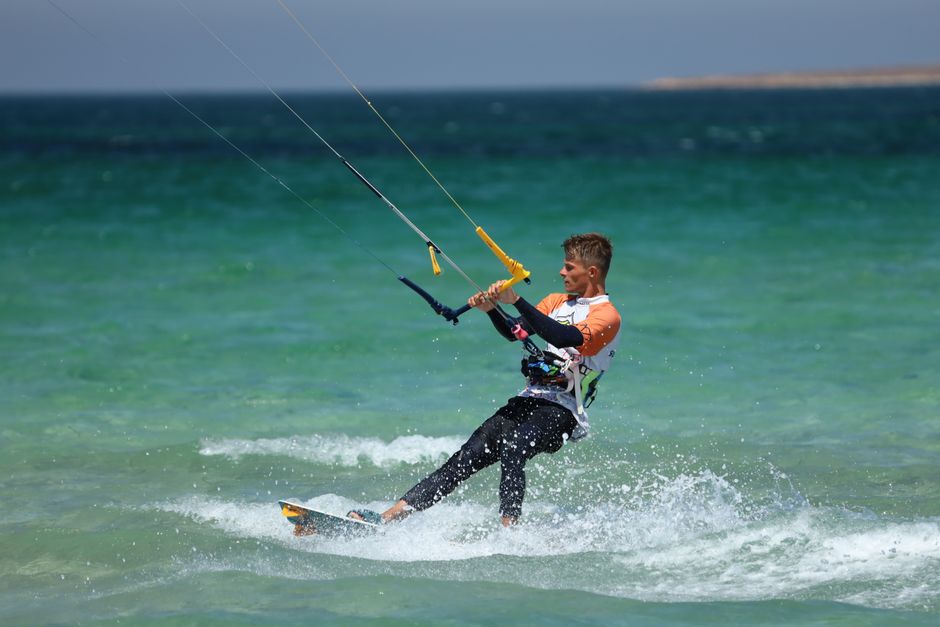
You are standing on the beach with the kite laid out. The app says 22 knots and the sky says gusty, your friends are already rigging, and the best session of the month is waiting. Part of you wants to go. Part of you wants to carry the bag back to the car. Every rider knows that moment, and so does the other one: the kite drops, you get dragged, you pick yourself up and wonder whether you want to try again. Kitesurfing mental training is the practice of the skills that live between your ears (judging risk, staying calm, rebuilding confidence, progressing at a pace your skills can carry) in the same way you practice your water start. This page is for riders of every level. It is about mental performance, which is different from mental health; a section below spells out the difference.
Quick answer: Good kiting judgment is a habit you can train: decide your go/no-go rules on the beach before you feel the pull of the wind, rebuild confidence in small steps after a crash, rehearse your emergency steps until they are automatic, and move up in conditions only as your skills catch up. Studies of kiting accidents point to misjudged wind and lack of experience, and none of the mental tools here guarantees safety or better results. See a doctor, licensed psychologist or other qualified professional if fear, low mood or trouble sleeping lasts more than a couple of weeks or gets in the way of daily life, and in a crisis call or text 988 (US).
Fear is information, not weakness
Kitesurfing involves real forces: the pull of a power kite, speed on the water and, for jumpers, a landing from height. A healthy respect for that is part of staying safe. We found no published trials of fear management specific to kitesurfing, so the habits below are common kite-school and coaching practice, not proven treatment. What the research does show is where the danger usually comes from. In a Norwegian study of 29 kiteboarders with 33 injuries (Torland and colleagues, BMC Sports Science, Medicine and Rehabilitation, 2024), operator error and lack of experience were the most frequently reported causes of accidents, at 82%. Misjudging wind is a decision problem, and decisions can be trained.
Go or no-go: deciding about wind before you rig
The hardest decision in kiting is made on dry sand, with the kite still in the bag. The wind, gust and storm facts live in our kitesurfing Session Day guide, including the Norwegian finding that nine of the serious accidents came from misjudging strong wind and that gusts were a factor in eight. This page is about the mind that makes the call.
- Set your rules in advance. Write down the maximum average wind, the maximum gust gap and the conditions that always mean no (building storm, offshore wind without a rescue boat, no buddy). A rule made calmly on Tuesday is easier to follow at 4 p.m. The VDWS safety rules, for example, say not to kite in gusting wind.
- Watch for the pull of the crowd. Seeing other riders on the water makes it feel safe, but their kite size, weight and skill are not yours.
- Check yourself, not only the sky. A study of wingfoiling injuries (Gangl and colleagues, Open Access Journal of Sports Medicine, 2023), a sister sport with similar kit, found riding errors due to fatigue behind 77.5% of injuries in the 415 riders surveyed. Tired, cold or hungry is a reason to come in, and a session you stop early still counts.
One more pattern is worth knowing. A 2026 survey of 442 Brazilian kitesurfers with at least one year of experience (Debieux and colleagues, Journal of Sports Medicine and Physical Fitness) found injuries more common among riders who rated themselves advanced, and most happened in moderate wind (11 to 27 knots) within 50 meters of shore. The study did not measure time on the water, so it cannot say advanced riders are less careful, but confidence can run ahead of conditions.
Confidence after a crash
A hard crash, a long drag or a kite loop that went wrong can leave a rider tense for weeks: gripping the bar too hard, riding below their level, or avoiding the water altogether. There is little kitesurfing-specific research on this, so the steps below are general coaching practice.
- Get hurt things checked first. Concussion, rib and knee injuries are among the more common injuries in the large 2026 survey of 3,138 kitesurfers (Offerhaus and colleagues, BMC Sports Science, Medicine and Rehabilitation), and fear that follows an injury is not something to push through. See our kitesurfing injuries guide, and let a health care provider decide when you can return.
- Go back to a level that feels easy. A lighter wind, a smaller trick or a flat-water session is a reasonable first step. Then raise one thing at a time (wind, trick or distance from shore), not all three.
- Work out what actually happened. Was it gear, wind, a trick that was too big or a moment of lost focus? A clear reason turns a scary event into a lesson.
- Rehearse in small pieces. Practice kite control on land with a small trainer kite (see kitesurfing training) and re-learn the quick release on the beach until your hand finds it without thinking.
Staying calm when something goes wrong
A kite that will not depower, a line tangle, a lost board far from shore or a sudden gust is the real test of mental skill. The research on kiting emergencies is unusually clear on one point. A study of 30 air rescues in Cape Town (Exadaktylos and colleagues, British Journal of Sports Medicine, 2005) found 25 attributed to inability to detach the kite from the harness, with exhaustion and hypothermia among the other problems, and recommended riding with a fellow kiter and wearing a life vest. Modern kites are built to the ISO 21853 standard, whose release has to open within set force and time limits, but the release only helps if you reach for it in time.
Calm under pressure is usually practiced calm. Ideas that kite schools and coaches commonly teach, which we treat as practice and not as proven fixes:
- Know your steps in order. Ask your school which sequence they teach (usually assess, release or depower, then self-rescue or signal) and use theirs.
- Rehearse on the beach. Pull the release on dry land with your eyes closed. Repeat the signals with your buddy. What you have done twenty times is what your hands do when you are scared.
- Decide your point of no return. For example: if I cannot get back to the beach in a set time, or I am getting cold or tired, I release and signal early, not late.
Progression: moving up without rushing
The numbers are clear that experience matters. In the 3,138-rider survey, the overall injury rate was 4.8 injuries per 1,000 hours, ranging from 65 per 1,000 hours for beginners to 1.1 for professionals, and the authors identified skill level as the most relevant risk factor. A smaller German study of 66 riders (Bockmann and colleagues, Journal of Bodywork and Movement Therapies, 2024) also found experienced riders were injured less often. Both are surveys, so they show a pattern, not proof that any one plan cuts risk.
- Move up one step at a time. Raise wind, trick difficulty, board type or distance from shore, but not several at once.
- Use process goals. “Hold the edge through the whole upwind leg”, “release the bar smoothly on the landing” or “land three clean jumps at this height” are goals you control. “Jump higher than Sam” is not.
- Take lessons at each new level. Instructors can see what you cannot, and the same decision habits are taught in every good school.
Focus, imagery and routines
Imagery means rehearsing a move in your mind: the pull of the kite, the edge, the pop and the landing. A 2023 systematic review and meta-analysis of psychological interventions for athletes (Reinebo and colleagues, Sports Medicine) found moderate effects for psychological skills training, mindfulness-based approaches and imagery. However, the effects were no longer significant when non-randomized trials and subjective outcomes were removed, so imagery is a low-cost addition to real practice, not a replacement. Use it one move at a time, on the beach or on a no-wind day.
A short pre-session routine can also help you start in the right frame of mind: walk the spot, read the wind, check the release, agree your signals, and take one breath before you launch. A 2026 position statement from Exercise and Sports Science Australia (Schweickle and colleagues, Sports Medicine) lists pre-performance routines, psychological skills training, mindfulness-based approaches and implicit attentional strategies among evidence-based strategies for performance under pressure, and says pressure can have both helpful and harmful effects.
Racing and competition
Formula Kite and other racing add pressure: starts, crowded marks, and results that count. The same tools apply. Build a start routine, set process goals for each race (a clean start, a clear lane at the mark) and plan a short reset between races. Rules and race formats are in kitesurfing rules, and rest between heavy days is in kitesurfing recovery.
Young riders
Young riders learn best with fun and supervision, and with an instructor who sets conditions. A 2018 review of aquatic adventure sports injuries in children (Buzzacott and Mease, Research in Sports Medicine) noted that kitesurfing and surfing generate more injuries to the head and face than to other body parts, and called for more research on prevention in children. See our youth kitesurfing guide for more.
Mental performance is not the same as mental health
Everything above is about performance skills. Anxiety disorders, depression, disordered eating and burnout are health matters, not mindset problems, and a better routine does not fix them. The 2026 International Olympic Committee consensus statement on mental health in elite athletes (Reardon and colleagues, British Journal of Sports Medicine) says mental health symptoms and disorders are common among elite athletes, can have sport-related causes and can affect performance, and recommends screening and monitoring with validated instruments. Signs worth taking seriously include worry or low mood that lasts weeks, panic before sessions, big changes in eating or sleep, withdrawing from friends, or dreading a sport you used to love.
Start with your doctor, a licensed psychologist or another qualified mental health professional. In the US, you can call or text 988 (Suicide & Crisis Lifeline) at any time.
Kitesurfing mental training: FAQs
How do I decide whether it is too windy to kite?
Set your limits on the beach before you rig, using wind strength, gusts, direction and storms, and compare them with your own level. VDWS says not to kite in gusting wind. If you are unsure, the answer is no. See the Session Day guide for what to check.
How do I get my confidence back after a bad crash?
Get injuries checked first, go back to an easier level, change one thing at a time, and work out what actually happened. If fear lasts weeks or spreads to daily life, talk to a doctor or licensed mental health professional.
Does visualization really help kitesurfers?
A 2023 review across sports found moderate effects for imagery, but they were not stable once weaker studies were removed. It is best used alongside real practice, not instead of it.
How can I stay calm if my kite will not depower?
Practice your release and rescue steps on the beach until they are automatic, ride with a buddy and wear a life vest. In the Cape Town air-rescue study, most missions involved riders who could not detach from the kite.
When should I move up to bigger wind or bigger tricks?
When the current level feels easy and repeatable, and you can say what you will change. Raise one thing at a time and take a lesson. No study gives an exact timetable.
Sources
- Torland and colleagues, 2024, BMC Sports Science, Medicine and Rehabilitation, kitesurfing and snowkiting injuries in Norway: PubMed 38254180
- Exadaktylos and colleagues, 2005, British Journal of Sports Medicine, kite surfing rescue missions in Cape Town: PubMed 15849279
- Offerhaus and colleagues, 2026, BMC Sports Science, Medicine and Rehabilitation, kitesurfing injuries by discipline and skill level: PubMed 41620742
- Debieux and colleagues, 2026, Journal of Sports Medicine and Physical Fitness, epidemiology of kitesurfing injuries: PubMed 41664971
- Bockmann and colleagues, 2024, Journal of Bodywork and Movement Therapies, equipment and experience in kitesurfing injuries: PubMed 39663095
- Gangl and colleagues, 2023, Open Access Journal of Sports Medicine, wingfoiling injuries: PubMed 37916042
- Buzzacott and Mease, 2018, Research in Sports Medicine, pediatric injury in aquatic adventure sports: PubMed 30431355
- Reinebo and colleagues, 2023, Sports Medicine, psychological interventions meta-analysis: PubMed 37812334
- Schweickle and colleagues, 2026, Sports Medicine, ESSA position statement on performance under pressure: PubMed 42271117
- Reardon and colleagues, 2026, British Journal of Sports Medicine, IOC consensus statement on mental health in elite athletes: PubMed 42580854
- VDWS, kitesurfing safety rules: vdws.de
- Global Kitesports Association, ISO 21853 product norm: global-kitesports.org
- 988 Suicide & Crisis Lifeline: 988lifeline.org
General information for education only, not medical advice. It does not replace a doctor, psychologist or other qualified professional, or a certified kitesurfing instructor. See how we work in our editorial policy. Back to the kitesurfing hub.