This article contains affiliate links: if you buy through them we may earn a commission, at no extra cost to you. Learn more.
A Thursday afternoon when the sea breeze fills in and the beach car park turns into a rigging area: kites pumped up on the sand, someone giving a thumbs-up for a launch, a dozen riders already crisscrossing the bay. A teenager lands her first jump. A foiler glides silently upwind past the sandbar at dusk. And on a summer morning in 2028, the first Olympic medals of the Los Angeles Games will go to kiteboarders racing hydrofoils off Long Beach. Kitesurfing is one of the most addictive sports on the water, and one of the most misunderstood.
Kitesurfing, page by page
- Rules: how the game works at every level
- Leagues & associations: pro, college, high school and youth
- Youth & high school: ages, safety and recruiting, for players and parents
- Injuries & sports health: prevention, concussion, when to see a pro
- Training & conditioning: before: off-season to in-season
- Game day: during: fueling, hydration, heat
- Recovery: after: games, tournaments, sleep
- Nutrition & supplements: what to eat, tested supplements
- Best wearables: trackers and watches for the sport
- Gear: the complete equipment list
Buying guide · Our Kitesurfing buying guide compares the gear we'd pick, with prices and sizing:
This page covers kitesurfing in all its forms: twin-tip freeriding, freestyle tricks, big air, riding waves and kitefoiling. You’ll find how it works, what it looks like from first lesson to the Olympics, and, most of all, how to stay healthy doing it. Kitesurfing safety runs through all of it: the injuries riders get, the quick-release systems that let you let go, concussion, cold water and sun, and when to see a professional. Then training, recovery and the gear you really need. Windsurfing has its own guide in our windsurfing section; if you also ride waves without a kite, see our surfing section.
Kitesurfing at a glance
| What it is | A large kite on long lines, steered with a control bar and hooked to a harness, pulls you across the water on a board. Kitesurfing and kiteboarding are two names for the same sport. |
|---|---|
| Ways to ride | Freeride on a twin-tip, freestyle tricks, big air jumps, wave riding on a kite surfboard, and kitefoiling on a hydrofoil board (including racing). |
| Olympic event | Formula Kite, raced on hydrofoil boards, debuted at Paris 2024. At LA28 the men’s and women’s kite finals on July 19, 2028, are the first sailing medals of the Games. |
| Governing bodies | World Sailing worldwide (kiteboarding is a sailing discipline); US Sailing in the US; the International Kiteboarding Association (IKA) runs the Formula Kite class. |
| Lessons and certification | IKO (International Kiteboarding Organization) and PASA (Professional Air Sports Association) certify kite instructors and schools in the US. IKO’s first-level Discovery course has a minimum age of 12. |
| Pro tour | GKA Kite World Tour: Freestyle, Kite-Surf (waves), Big Air and Hydrofoil Big Air, all sanctioned by World Sailing. |
| Most common injuries | Cuts and abrasions, rib injuries, foot, ankle and knee injuries, and concussions. Studies report roughly 4 to 10 injuries per 1,000 hours, and far more for beginners. |
How kitesurfing works
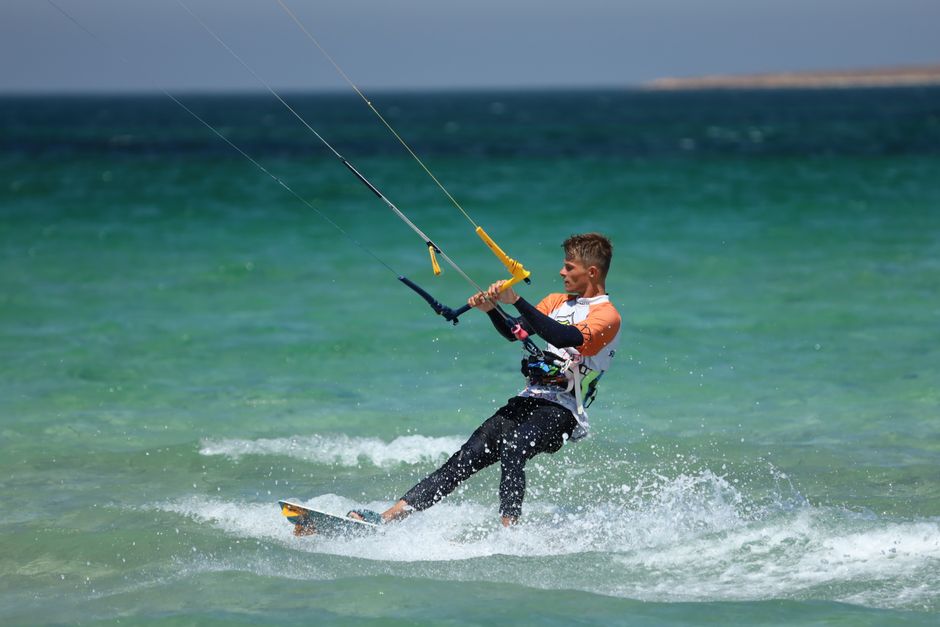
You fly a large inflatable kite on long lines, steering it with a control bar. The kite’s pull runs through a harness around your waist or hips, so your arms steer rather than hold the full load. Pulling the bar toward you adds power; pushing it away takes power off. Riders move the kite through the “wind window”, the area downwind of you where the kite can fly, diving it through the middle (the power zone) to make pull and parking it at the edge to rest. Then you edge the board against the pull to ride across the wind and, with practice, upwind.
Every modern kite bar has a quick-release and a safety leash, so you can depower or let go of the kite in an emergency. That one system is the heart of kite safety, and a kite keeps pulling until you take its power away; you can’t simply stop the way you would on a bike. Our rules of the road and safety page explains it step by step.
The ways to ride
- Freeride: cruising, carving and small jumps on a twin-tip board you can ride in both directions. This is where almost everyone starts and where most riders stay.
- Freestyle: technical tricks, often “unhooked” from the harness, judged in heats on the pro tour.
- Big Air: huge jumps and kiteloops (looping the kite during a jump). Spectacular, and the discipline where rib injuries and concussions are most common in the research.
- Kite-surf (waves): riding waves on a directional surfboard, using the kite for speed and to get back out.
- Kitefoiling: the board sits on a hydrofoil, a mast and underwater wings that lift it clear of the water once you have speed. It feels like flying, works in lighter wind and is what Olympic kite racers use.
Kitesurfing at every level
Kids and first lessons
Almost everyone starts with lessons, and for kiting that isn’t optional in practice: the kite generates real power from the first minute, and IKO itself calls kiteboarding “an extreme sport that can be dangerous.” IKO’s Discovery course, the first step of its kiteboarder pathway, takes about two hours on average, requires a minimum swimming level and has a minimum age of 12; instructors who teach younger children must complete IKO’s online course on teaching children. Next come Intermediate (relaunching the kite, self-rescue, body dragging, the water start) and Independent (about eight hours on average, including riding upwind and launching and landing on your own). IKO says most lesson packages run 6 to 9 hours. A small trainer kite on the beach is a common first step. Our youth page answers parents’ questions.
Youth racing and high school age
Young racers have a clear ladder. US Sailing’s Youth Team welcomes athletes under 19, Formula Kite included, chosen through qualifying events, with up to four places in the class (the top two women and top two men). The 2026 U.S. Youth Championship, October 9 to 12 at Alamitos Bay Yacht Club in Long Beach, includes Formula Kite. On the freestyle side, the GKA runs a Youth World Tour with U14, U16 and U19 brackets; its main tour has a minimum age of 14 in the year of competition.
College
Kitesurfing isn’t a college varsity sport in the US. College sailing, run by the Inter-Collegiate Sailing Association (ICSA), races mostly dinghies, so young kiters keep training through clubs, regattas and US Sailing’s programs while at school. Daniela Moroz, a multiple Formula Kite world champion from California, attended the University of Hawaii during her racing career.
The pro tour
The GKA Kite World Tour runs four World Sailing-sanctioned disciplines: Freestyle, Kite-Surf, Big Air and Hydrofoil Big Air. Riders get in through the rankings, video applications or local wildcards. As of the 2026 season, the freestyle title is decided over three events, including Puerto Vallarta in Mexico, and the kite-surf tour opens and closes the year. Racers follow the Formula Kite circuit of world and continental championships on the road to the Olympics. Our leagues and associations page has the full map.
The Olympics
Kiteboarding joined the Olympics at Paris 2024 with Formula Kite: Austria’s Valentin Bontus and Great Britain’s Eleanor Aldridge won the first gold medals, and the US’s Daniela Moroz finished fourth. Formula Kite isn’t one-design: riders choose from registered production kites, boards and foils, with a maximum kite size of 21 square meters for men and 19 for women. At LA28, World Sailing’s schedule starts kite qualifying on July 16 and puts the men’s and women’s kite finals on July 19, 2028, the first sailing medals of the Games, at Belmont Shore in Long Beach.
Adult and recreational riders
Most riders never race. They chase wind on weekends and holidays, and many start well into adulthood: in a 2026 survey of 442 Brazilian kitesurfers, ages ran from 18 to 70 with an average near 42. The sport rewards patience more than youth. Take lessons, ride within your level and build hours steadily; the injury numbers below show why those first seasons matter so much.
Sports health for kitesurfers
Kitesurfing mixes speed, height, hard water and a power source you can’t switch off by stopping. Most riders go years without a serious injury, but the risks are real. This section is general information, not medical advice. If you’re hurt, see a professional.
What the research shows
- Injury rates: a 2004 study that followed 235 kitesurfers through a season found 7 injuries per 1,000 hours. A 2025 German study of 66 riders found 4.3 per 1,000 hours, and a North Sea hospital study found 7.0 per 1,000 hours of kitesurfing.
- Experience is the big one: the largest survey so far (3,138 kitesurfers from 103 countries, published in 2026) counted major injuries only and found 4.8 per 1,000 hours overall, but about 65 for beginners against 3.3 for intermediates and 1.1 for professionals.
- What gets hurt: in that survey, cuts and abrasions led (23% of major injuries), then rib injuries (12%), knee ligament injuries (6%), foot and ankle fractures and sprains (5% each) and concussions (5%). In the 2004 study, foot and ankle injuries led (28%), followed by the head (14%), chest (13%) and knee (13%).
- Why: in the 2004 study, 56% of injuries were blamed on riders who couldn’t detach from the kite after losing control of it. In a Norwegian study, riders blamed operator error or lack of experience for 82% of accidents, and half of the head, face and neck injuries were concussions. In a 2026 Brazilian survey, most injuries happened within 50 meters of the shore, where the beach, shallows and other people are.
Kitesurfing safety: the quick release and the basics
Since 2020, the international standard ISO 21853 sets how kite-bar quick-releases and safety leashes must perform: a release force of 170 newtons or less and an opening time of 2 seconds or less, tested in sand, water and cold conditions. Practice your release on land and on the water until it’s automatic. Research hasn’t settled how much release systems cut injuries (the 2004 study saw a trend toward fewer, a 2025 study saw no difference, and in the North Sea study only 31% of injured riders who had a release actually used it), so the release is a last line of defense, not a license to push it. The basics that matter most:
- Take lessons from a certified instructor (IKO or PASA).
- Check the forecast and the wind direction; avoid offshore wind and gusty, building conditions, and keep a clear zone downwind with no buildings, roads, trees or people.
- Get a competent kiter to help launch and land; never ask an unskilled onlooker to grab your kite.
- Ride with others, know the right-of-way rules and leave space for swimmers.
- Wear a helmet and impact vest when you’re learning, jumping or foiling, and dress for the water temperature.
Concussion: recognize and remove
A hard landing, a crash into the water from a jump or a hit from your own board can cause a concussion. The CDC’s HEADS UP program lists signs to watch for: looking dazed or confused, being slow to react, headache, dizziness or balance problems, sensitivity to light or noise, and trouble concentrating. Stop riding for the day, don’t go back out until a healthcare provider clears you, and call 911 for danger signs such as seizures, passing out, a headache that gets worse or one pupil larger than the other. On the water, a rider who seems confused needs help back to shore, and that may mean releasing the kite first.
Cold water and sun
Windy days are cold days on the water. The National Weather Service advises dressing for the water temperature, not the air, and the US Coast Guard warns that cold shock hits in the first minute and that cold water can weaken your arms and legs within about 10 minutes. A wetsuit of the right thickness and a plan for getting back to shore (including kite self-rescue) matter more than any other gear. The other constant is sun: the American Academy of Dermatology recommends a broad-spectrum, water-resistant sunscreen of SPF 30 or higher, reapplied every two hours and after swimming or sweating.
When to see a doctor, physical therapist or athletic trainer
See a professional for a knee that gave way or swelled after a landing, an ankle you can’t walk on, chest or rib pain after a crash, shoulder or back pain that lingers, a deep cut from a fin or foil, or any concussion signs. A sports medicine physician manages most sports injuries without surgery, a physical therapist guides the rehab and return to riding, and an athletic trainer works with athletes on prevention and care. Our kitesurfing injuries page goes deeper.
Training and conditioning for kitesurfing
Kiting asks for strong legs to hold an edge and absorb landings, a strong core and back to hang in the harness, and balance for foiling. A 2021 GPS study of 42 Olympic Formula Kite sailors found that the best riders were faster on every point of sail, which suggests technique and speed matter more than tactics at that level. In practice that means time on the water first, with off-water strength, mobility and balance work to support it. Our training page lays out a plan, and our speed and agility equipment guide and mental training tools help on land.
Session day: eat a familiar, carbohydrate-based meal a few hours before, bring water and a snack, and drink between runs. Long sessions in the wind and sun dry you out faster than you notice; many riders carry an electrolyte drink. See our session day and race day page.
Recovery after a big session
After three hours on the water, your legs, lower back and core let you know. Recovery starts with sleep: the CDC, citing the American Academy of Sleep Medicine, recommends 8 to 10 hours for teens and 7 or more for adults. Then food and fluids, a warm shower and some easy mobility. Many riders roll out their back and legs with a foam roller or massage gun, and slip into soft recovery shoes after a day barefoot on sand. These are for comfort, not treatment. Our recovery page has a full routine.
Kitesurfing gear
The big-ticket items (kite, bar and board) are best chosen with your instructor or a local shop once you’ve had lessons, because the right size depends on your weight, your level and your local wind. Before that, a trainer kite teaches you how a kite flies. The Slingshot B3 trainer kite (about $269) is a 3-meter, two-line foil kite that the maker pitches as a way to develop kite skills before paying for a lesson. Safety gear comes next: the Pro-Tec Ace Water helmet (about $66) meets the CE EN 1385 water-sports helmet standard, and the Ride Engine Defender HF impact vest (about $164) is made for kite and foil riding. Impact vests are not life jackets; the maker says so plainly. Our full gear guide covers boards, harnesses, wetsuits and more.
Slingshot B3 Trainer Kite (3 m)
- 3 m two-line foil kite
- Practice before lessons
- Builds wind sense
Pro-Tec Ace Water Helmet
- CE EN 1385 water-sports standard
- 15 vents for drainage
- Sizes XS to XL
Ride Engine Defender HF Impact Vest
- Built for kite and foil riding
- Impact shells in high-risk areas
- Not a life jacket
OOFOS OOahh Slide
- OOfoam slide
- APMA Seal of Acceptance
- Machine washable
For more after the session, browse Recovery & Regeneration and Training & Performance.
Kitesurfing FAQs
Is kitesurfing dangerous?
It carries real risk, mostly from losing control of the kite near the beach or obstacles. Studies report about 4 to 10 injuries per 1,000 hours, and beginners are hurt far more often than experienced riders. Lessons from a certified instructor, a working quick-release, sensible wind choices and a clear zone downwind lower the risk a lot.
How many lessons do I need to kitesurf?
It depends on you and the conditions. IKO’s Discovery course takes about two hours on average, and IKO says most kitesurfing lesson packages run 6 to 9 hours. Your instructor will tell you when you’re ready to ride without supervision.
What’s the difference between kitesurfing and kiteboarding?
They’re the same sport; both words are used. Some riders say kitesurfing for riding waves on a surfboard and kiteboarding for twin-tip riding, but there’s no strict rule.
Is kitesurfing in the Olympics?
Yes. Formula Kite, raced on hydrofoil boards, debuted at Paris 2024, and men’s and women’s kite will be the first sailing medals decided at LA28, on July 19, 2028.
Do I need a helmet and impact vest?
They’re strongly recommended while learning, foiling and jumping. A Norwegian study of kite injuries recommended a helmet and a flotation vest, and fewer than 30% of injured riders in a North Sea study used any protective gear. Remember that impact vests are not life jackets.
Kitesurfing gives back what you put in: more time on the water, bigger days and sunsets you’ll remember for years. Learn properly, respect the wind and look after your body. Next: rules of the road and safety, kitesurfing for kids, gear, or compare with our surfing and sailing sections.