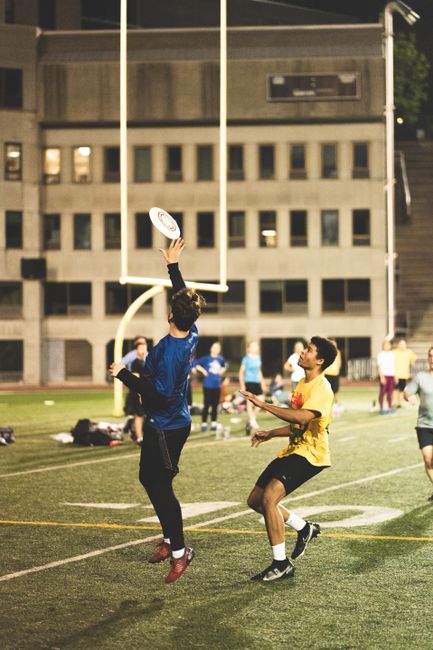
It is universe point. The disc is on the sideline, a foot-block call comes from the other team, and you are sure you were in bounds. There is no referee to settle it: you and the player across from you have to sort it out, then line up for the next pull with your heart still pounding. Every ultimate player, from a mixed rec league to a college club final, knows a moment like that. Ultimate frisbee mental training means practicing the skills between your ears (composure, focus, quick decisions, bouncing back from a turnover, working with seven teammates) the way you practice your forehand. It is about mental performance, which is different from mental health; see the section on that difference below.
Quick answer: Mental skills are trainable habits: a short reset after every turnover, a calm way to talk through a contested call, simple goals you control, and a plan for the next point after a bad one. Ultimate is self-officiated, so composure and respect are part of the game itself. Research on these tools is promising but not settled, and none of them guarantees a win. If worry, low mood, or trouble eating or sleeping lasts more than a couple of weeks or gets in the way of daily life, see a doctor, licensed psychologist or other qualified professional, and in a crisis call or text 988 (US).
Composure on contested calls and the Spirit of the Game
Ultimate is one of the few team sports where the players are also the referees. The Spirit of the Game puts responsibility for fair play on the players, and USA Ultimate’s rules list mutual respect, adherence to the rules, safety and the basic joy of play as its tenets. The rules also say a foul call has to be one you perceive with certainty and that most discussions should not exceed thirty seconds, which is a useful clue about the mental job: state what you saw, listen, and move on. The mechanics are on our ultimate frisbee rules guide.
Is composure learnable, or just personality? The research is descriptive, not a training trial, but it is encouraging. In a 2024 cross-sectional study of five international tournaments in 2022 (Amoroso and colleagues, Frontiers in Sports and Active Living), teams rated their opponents’ Spirit after each match, and “positive attitude and self-control” was the highest-scoring category overall, while knowledge of the rules scored lowest. A separate 2022 study of 160 players at the 2019 European Beach Ultimate Championship (Amoroso and colleagues, Sports) found that players with high Spirit levels also did better on the fouls and body contact and positive attitude ratings. Neither shows that Spirit causes better play, but both fit the idea that composure and competitiveness can go together.
- In the moment: one slow breath before you speak, then say what you saw in plain words. Talk to the other player the way you would want to be talked to.
- After the call: whether it went your way or not, let it go with the next pull. Changing a call you no longer believe in is listed as good Spirit by WFDF, so there is no shame in it.
Confidence: built from evidence, not slogans
Sport psychologists often call confidence self-efficacy: your belief that you can do a specific thing, such as complete a flick huck against a hard mark. It grows mostly from evidence you can point to, like throwing sessions and plays you drilled. A habit that helps many players: after every game, write down two things that went well, even after a loss.
Decision-making at pace
An ultimate point is a stream of decisions: throw or reset, cut deep or clear out, poach or stay with your player. Researchers who tracked Australia’s under-24 women’s team at the 2018 world championships (Palmer and colleagues, Journal of Strength and Conditioning Research) found players spent roughly two minutes at a time on the field and about 13 minutes on the bench between stints, so you make fast choices while tired and then have a long gap in which to think. A small 2022 study of 43 secondary school novices (Portillo and colleagues, IJERPH) found that fitter students showed more offensive decision-making and passes in a simulated game. That is an association in beginners, not proof; conditioning is covered on our ultimate training page.
- Agree defaults as a team: what you do if the first look is covered, and what the reset option is. A default is faster than a debate at pace.
- Train decisions in small games: 3-on-3 and 4-on-4 give many more touches and decisions per minute than a full scrimmage.
Resetting after a turnover
A turnover in ultimate swings the point instantly: your drop or blocked throw becomes the other team’s offense, and you have to switch from thrower to defender in seconds. That switch is where many players lose a second to frustration. We found no ultimate-specific trial of reset routines, so what follows is common coaching practice rather than proven. A simple version is three beats: acknowledge it (one breath), name one thing to do now ("get back, pick up my player"), and go. Talk to yourself the way you would talk to a teammate. Review the lesson on the sideline, not during the point.
The 2026 position statement from Exercise and Sports Science Australia on performance under pressure (Schweickle and colleagues, Sports Medicine) lists pre-performance routines and psychological skills training among the evidence-based strategies, and says pressure can help as well as hurt performance. In ultimate that might mean scrimmage points that start at 14-14.
Focus, goals and imagery
Many coaches split goals into three kinds: outcome (win the bracket), performance (complete 90 percent of my throws) and process (set my pivot before I look, call the count loudly as the marker). Process goals are fully in your control, so they hold up on a day the score goes the wrong way. Write down one process goal per game and check it off afterward.
Imagery means rehearsing play in your mind with as many senses as you can: the sound of the disc leaving your hand, the feel of the plant before a cut, the sight of the end zone. A 2023 systematic review and meta-analysis of psychological interventions across sports (Reinebo and colleagues, Sports Medicine) found moderate effects for imagery, multimodal psychological skills training and mindfulness-based approaches compared with controls. The authors report that the effects were not stable: when non-randomized trials and subjective outcomes were removed, they were no longer significant. So imagery is a low-cost add-on to real field time, not a replacement for it. If you do not see vivid pictures, try sounds and body feelings instead.
Tournament weekend focus
A tournament is a marathon of short efforts. In the Australian under-24 study, the last matches of the world championship were shorter but more intense than the first ones, so the mental job changes across a weekend: sharp in game one, composed and decisive when tired in game six. Under USA Ultimate’s rules a standard game goes to 15, and event organizers can set time caps, so check the cap before you play.
- Play the next game, not the bracket. One process goal for each game, and a short reset between games: same snack, same warm-up order, one note to yourself.
- Protect your energy. Cheer, but also rest your head in the shade. Food and fluids between games are on our ultimate game day page; sleep is in our recovery guide.
Teamwork, motivation and group climate
Ultimate teams run on communication: on the line, on the field and with the other team. A 2021 systematic review of psychological research on ultimate (Amoroso and colleagues, Frontiers in Psychology) found only four papers that met its criteria, so the evidence is thin. Within those, it reported that group goals and promoting teamwork predicted social cohesion and that communication mediated the link between teamwork and task cohesion.
Two 2026 studies from China add to this, both cross-sectional, so they show links, not cause. In 368 ultimate participants (Li and colleagues, Acta Psychologica), a better group climate (more engagement, less conflict) was associated with more autonomous motivation, which was associated with more flow experience. In 390 vocational college students in ultimate courses (Chen and colleagues, Frontiers in Psychology), higher perceived team cohesion went with higher mental resilience, partly through intrinsic motivation and need satisfaction. The takeaway for captains is modest: agree line roles and sideline communication early, and make room for newer players to speak up.
Preparing for competition and young players
In the week before a tournament, rehearse your reset routine, set one process goal per game, and get enough sleep. Practical preparation is in our training guide and logistics are in the game day guide. If an injury is part of why you feel anxious about cutting or jumping, read our ultimate injuries guide and talk to a sports medicine doctor, physical therapist or athletic trainer.
Keep it light for young players: fun routines, effort goals and praise for trying. We found no ultimate-specific trial of mental skills in youth, so we do not claim one. USA Ultimate does limit youth teams to 3 full-length games a day and 6 per weekend at its events, a reminder that kids need rest as well as focus. Age-based guidance is on our youth ultimate page.
Mental performance is not the same as mental health
Everything above is about performance skills. Anxiety disorders, depression, disordered eating and burnout are health matters, not mindset problems, and they are not fixed by a better routine. The 2026 International Olympic Committee consensus statement on mental health in elite athletes (Reardon and colleagues, British Journal of Sports Medicine) treats them as medical and psychological care issues. A friendly team can be a good support, but it is not treatment.
Signs to take seriously include worry or low mood lasting weeks, panic before games, withdrawing from friends or teammates, big changes in eating or sleep, or dreading play you used to enjoy. Start with your doctor, a licensed psychologist or other qualified mental health professional. In the US, you can call or text 988 (Suicide & Crisis Lifeline) at any time. Sleep and food are covered in our recovery and nutrition and supplements guides, but a clinician should lead care for a health concern.
Frequently asked questions
How do I stay calm when someone makes a bad call in ultimate?
Take one breath, say what you saw in plain words, and listen to the other player. USA Ultimate’s rules say most discussions should not exceed thirty seconds.
Can you be competitive and still follow the Spirit of the Game?
Yes. The rules call for highly competitive play but not at the expense of mutual respect, the rules, safety or joy of play. In a study of 160 beach championship players, those with high Spirit levels also rated well on fouls and attitude, though that shows a link, not a cause.
How do I recover mentally from a turnover?
Pick a reset routine, such as a slow breath and a cue word, and rehearse it in scrimmage. Then do one concrete job (get back, find your player) and review the mistake later.
Does visualization really help ultimate players?
A 2023 review across sports found moderate benefits for imagery, but the effects were not stable once weaker studies were removed. It works best alongside real field time, and we found no ultimate-specific imagery trial.
How do I stay focused through a long tournament weekend?
Treat each game as its own event: one process goal, a repeatable between-game routine, food and fluids on schedule, and rest.
Is it normal to be nervous before a big game?
Some nerves are common, and the ESSA statement says pressure can have helpful as well as harmful effects. If worry is constant, causes panic, or disrupts sleep or eating, talk to a doctor or licensed mental health professional.
Sources
- USA Ultimate. Official Rules of Ultimate (Spirit of the Game, making calls, game format). usaultimate.org/rules
- Amoroso JP et al. Assessing ethical behavior and self-control in elite ultimate championships: a cross-sectional study using the spirit of the game scoring system. Frontiers in Sports and Active Living, 2024. PMID 38756188
- Amoroso JP et al. Ultimate Frisbee Players: Characteristics according to Their Competitive Level and Spirit of the Game. Sports, 2022. PMID 36548494
- Amoroso JP et al. Teamwork: A Systematic Review of Implications From Psychosocial Constructs for Research and Practice in the Performance of Ultimate Frisbee Games. Frontiers in Psychology, 2021. PMID 34512471
- Li P-A et al. From group climate to flow in ultimate frisbee: an indirect pathway through autonomous motivation. Acta Psychologica, 2026. PMID 42826552
- Chen G et al. Team cohesion and mental resilience among vocational college students in ultimate frisbee courses. Frontiers in Psychology, 2026. PMID 41937817
- Portillo J et al. Influence of secondary school students’ physical fitness on sports performance during an ultimate frisbee competition. IJERPH, 2022. PMID 35409680
- Palmer et al. Physical demands of elite women’s ultimate frisbee between halves and across matches in an international tournament. J Strength Cond Res, 2022. PMID 32108719
- USA Ultimate. Athlete Health and Safety Packet, requirements for youth participants. PDF
- Reinebo G et al. Effects of Psychological Interventions to Enhance Athletic Performance: A Systematic Review and Meta-Analysis. Sports Medicine, 2023. PMID 37812334
- Schweickle MJ et al. Performance Under Pressure in Sport: A Position Statement from Exercise and Sports Science Australia. Sports Medicine, 2026. PMID 42271117
- Reardon CL et al. Mental health in elite athletes: International Olympic Committee consensus statement (2026). British Journal of Sports Medicine. PMID 42580854
- 988 Suicide & Crisis Lifeline
General information for education only, not medical advice. It does not replace a doctor, psychologist or other qualified professional. See how we work in our editorial policy. Back to the ultimate frisbee hub.