This article contains affiliate links: if you buy through them we may earn a commission, at no extra cost to you. Learn more.
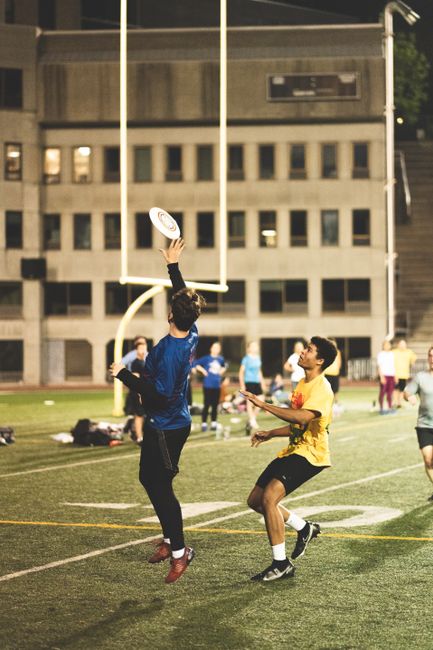
A Tuesday-night summer league at the park: fourteen players in mismatched jerseys, a white disc floating toward the end zone, someone laying out full-length on the grass and coming up with it. Nobody blows a whistle, because there’s no referee. The two players sort out the call themselves, and after the game both teams sit in a circle and say what they liked about each other. That’s ultimate frisbee, the sport most players just call “ultimate.” It started with students in Maplewood, New Jersey, in 1968, according to the World Flying Disc Federation (WFDF), and it’s now played in over 100 countries.
Ultimate Frisbee, page by page
- Rules: how the game works at every level
- Leagues & associations: pro, college, high school and youth
- Youth & high school: ages, safety and recruiting, for players and parents
- Injuries & sports health: prevention, concussion, when to see a pro
- Training & conditioning: before: off-season to in-season
- Game day: during: fueling, hydration, heat
- Recovery: after: games, tournaments, sleep
- Nutrition & supplements: what to eat, tested supplements
- Best wearables: trackers and watches for the sport
- Gear: the complete equipment list
Buying guide · Our Ultimate Frisbee buying guide compares the gear we'd pick, with prices and sizing:
This page is ultimate for the people who play it: kids learning to throw a backhand, high school and college teams, club players chasing nationals, the pro leagues and adults in rec leagues. It covers how the game works, every level from youth to the World Games, and above all how to stay healthy. Ultimate is non-contact on paper, but it’s all sprinting, cutting and diving, and ultimate frisbee injuries are real: hamstring strains, ankle sprains, knee injuries and collisions on layouts. We cover the injuries players get most, concussion, heat and sun, and when to see a professional. Then training, recovery and the gear you really need.
Ultimate frisbee at a glance
| Players per side | 7 on the field (mixed division: 4 of one gender match and 3 of the other). Beach ultimate is usually 4v4 or 5v5. |
|---|---|
| How you win | Standard game to 15 points under USA Ultimate and WFDF rules, often with a time cap at tournaments. Halftime when one team reaches 8. |
| Field | USA Ultimate: 70 × 40 yards between the goal lines, with 20-yard end zones. WFDF: 100 × 37 meters in total, with 18-meter end zones. |
| Disc | A 175-gram disc. In USA Ultimate-sanctioned play it must be on the USA Ultimate approved list; the Discraft UltraStar is the official disc. |
| Officiating | Self-officiated under the Spirit of the Game; observers at some events; referees in the pro UFA. |
| Governing bodies | WFDF worldwide (recognized by the IOC since 2015); USA Ultimate in the US. |
| Most common injuries | Lower-limb injuries: thigh muscle strains, ankle sprains, knee injuries; bruises and collisions; some concussions. |
How ultimate works
Each point starts with a pull: one team throws the disc the length of the field to the other, like a kickoff. The receiving team moves the disc by passing; you can’t run while holding it. Catch it on the run and you stop as quickly as you can and establish a pivot foot, as in basketball. You score by catching a pass in the end zone you’re attacking. After every goal the teams switch directions and the scoring team pulls.
Any incomplete pass, a disc that hits the ground, goes out of bounds or is knocked down or intercepted is a turnover, and the other team goes on offense right where the disc stopped. The defender guarding the thrower, the “marker,” counts out loud from one to ten: the stall count. If the disc is still in the thrower’s hand at “ten,” it’s a turnover. Ultimate is a non-contact sport, so contact that affects play is a foul. Players make their own calls, discuss them and agree, or send the disc back to the last thrower if they can’t. That’s the Spirit of the Game: competitive play, but never at the cost of respect, the rules, safety or the joy of play. The full details, including fouls, picks and observers, are on our ultimate frisbee rules page.
Ultimate at every level
Kids and youth
USA Ultimate’s Learn to Play program is built for kids ages 7–15 and connects them with local teams. Its rules include optional youth adaptations: under-12 players can use a lighter youth disc, play 3v3 or 4v4 on a smaller field, and play without zone defense or defensive layouts, with an arm’s-length “disc space” for the marker. Youth club teams play through the summer, and the Youth Club Championships crown national champions in under-20 and under-17 divisions; the 2026 event had 103 teams in seven divisions, the largest yet. Our youth ultimate guide has the full picture for parents.
High school
Most school ultimate is a club sport, and USA Ultimate runs middle and high school state championships around the country. A few states have gone further: in 2017 Vermont became the first state to approve ultimate as a high school varsity sport, starting in spring 2019, as the NFHS reported.
College
College ultimate isn’t an NCAA sport. It’s run by USA Ultimate as a club sport, and it’s big: more than 18,000 student-athletes on 800-plus teams, according to USA Ultimate. The spring season leads to the Division I College Championships over Memorial Day weekend (20 men’s and 20 women’s teams) and the Division III Championships for schools with up to 10,000 students. In 2026 Carleton’s women finished an undefeated 37-0 season with the D-I title, Massachusetts won the D-I men’s title, and Middlebury swept both D-III divisions.
Club, pro and international
Elite ultimate in the US is club ultimate: more than 15,000 athletes on 600-plus USA Ultimate club teams in men’s, women’s and mixed divisions, playing the Triple Crown Tour toward the fall National Championships. There are pro leagues too. The Ultimate Frisbee Association (UFA) had 22 teams across the US and Canada in 2026, and the Oakland Spiders won the title 21-16 over the Minnesota Wind Chill. The Western Ultimate League (WUL) and the Premier Ultimate League (PUL) are pro leagues for women and non-binary athletes; Seattle Tempest won the 2026 WUL title.
Internationally, WFDF runs world championships for national teams and clubs, and ultimate has been part of The World Games since 2001. At The World Games 2025 in Chengdu, the USA won mixed gold for the sixth straight time, 13–12 over Canada. WFDF has full IOC recognition since 2015, but ultimate isn’t an Olympic sport: it didn’t make the shortlist for Los Angeles 2028, and WFDF says it is working toward Brisbane 2032. More in our leagues and associations guide.
Adult rec, masters and beach
Local disc organizations run summer and fall leagues, hat tournaments and pickup games for every level, and USA Ultimate has masters divisions for older players. Beach ultimate is the sand version: 4v4 or 5v5 on a smaller field, barefoot (shoes and cleats aren’t allowed under USA Ultimate’s beach rules), games to 13. Diving on sand is more forgiving than on grass, which is part of its charm. If you love throwing but want something quieter, disc golf is the other big flying disc sport.
Sports health for ultimate players
Ultimate is constant sprinting, hard cuts, jumping for discs and, at higher levels, laying out: diving full-length for a catch or a block. Contact isn’t allowed, but bodies still meet in the air and on the ground. This section is general information, not medical advice. If you’re hurt, see a professional. Our ultimate frisbee injuries page goes deeper.
The most common ultimate injuries
- Lower-limb injuries come first: a 2020 systematic review of 11 studies found the lower limb was the most injured region, with the knee and thigh the most frequent locations. Muscle injuries and bruises were the most common types.
- Hamstring and thigh strains, ankle sprains: in the first injury study of pro ultimate (16 men’s teams, 2017 season), 72% of injuries were to the lower body. Thigh muscle strains (12.7%) and ankle ligament sprains (11.4%) led the list, and running was the most common mechanism.
- Collisions and layouts: the same review found direct contact with another player was the most common injury situation. At the 2007 college championships, laying out was one of the most common activities when an injury timeout was called, and it accounted for all of the men’s head injuries recorded there.
- Concussions: in the review, about a quarter of players reported a concussion at some point in their playing life (26%). The pro study found a low concussion rate, but collisions were involved in 29% of all injuries.
- Games are riskier than practice: in US college ultimate, injuries happened about twice as often in games as in practices, and the rate was the same for men and women. Pro injuries were more likely in the second half of games.
Since most injuries hit the legs, the prevention basics are the ones that work in other cutting sports: a real dynamic warm-up, leg strength (especially hamstrings), balance and landing practice, and building up training gradually. Learn to lay out with good technique before you do it in games, and keep your eyes on other players, not just the disc. Many players with old ankle sprains wear a brace (see our ankle brace guide), and some like knee sleeves for warmth and support.
Concussion: recognize and remove
Ultimate’s self-officiating doesn’t change the safety rule. The CDC’s HEADS UP program asks coaches, teammates and parents to watch for a player who looks dazed or confused or is slow to react, and to listen for headache, dizziness, balance problems, sensitivity to light or noise, or feeling “foggy.”
- Remove the player from play right away after a knock to the head or body if you see signs. Any teammate can call an injury timeout for them.
- Keep them out for the rest of the day and until a healthcare provider clears them. Don’t try to judge how serious it is yourself.
- Return slowly: getting back to sport goes in steps and usually takes a week or more.
- Call 911 for danger signs: seizures, passing out or growing drowsiness, a headache that gets worse and won’t go away, or one pupil larger than the other.
Heat, sun and tournament days
Ultimate is a summer sport with long tournament days in the open: several games a day, often with little shade. The EPA notes that about 9,000 US high school athletes are treated for heat-related illness each year, and the National Athletic Trainers’ Association (NATA) recommends easing athletes into the heat over 7–14 days. Drink before you’re thirsty, bring shade, and call 911 for confusion, collapse or very hot skin. For the sun, the American Academy of Dermatology recommends a broad-spectrum, water-resistant sunscreen of SPF 30 or more, reapplied every two hours and after sweating, and the CDC suggests sunglasses that block both UVA and UVB rays. Our game day and tournament day page has the full plan.
When to see a doctor, physical therapist or athletic trainer
Don’t play through pain. See a professional for pain that doesn’t settle, swelling, a knee that “pops” or gives way, an ankle you can’t put weight on, a shoulder that feels out of place after a layout, or any concussion signs. A sports medicine physician manages most sports injuries without surgery, a physical therapist guides rehab and the return to play, and athletic trainers, licensed or regulated health care professionals in all 50 states, are often on site at big tournaments. College and club teams without one should know where the nearest urgent care is.
Training and conditioning for ultimate
Ultimate fitness is repeated sprints with short recoveries, many changes of direction and a lot of jumping, sometimes over a long point that lasts minutes. A good off-season builds leg and hip strength, especially the hamstrings, plus core and landing work. In the preseason, add interval running, agility drills (a speed ladder or cones help) and lots of throwing, because a tired thrower makes turnovers. Through the season, keep some strength work and watch your total load, especially when league, club and tournaments stack up. Many players track sleep and strain with a wearable (see Whoop vs Oura vs Garmin and HRV for athletes), and some teams use GPS trackers to measure sprint load. Full plans are on our ultimate training page.
Eating for a tournament: the sports nutrition position statement from the American College of Sports Medicine and two dietitians’ groups recommends a pre-exercise meal high in carbohydrate, moderate in protein, low in fat and fiber, made of familiar foods and eaten about 1–4 hours before. Between games, small carb-based snacks and fluids keep you going; on hot days many players add electrolytes (see our electrolyte powder guide). More on nutrition and supplements for ultimate.
Recovery after games and tournaments
A two-day tournament can mean six or more games, so recovery starts between rounds: shade, fluids, food and dry clothes. Afterwards, sleep comes first. The CDC, citing the American Academy of Sleep Medicine, recommends 8–10 hours a night for teens and 7 or more for adults. Then real meals; a protein shake helps when a meal is hours away (see our protein powder guide).
Simple tools help many players feel better between tournament days: a foam roller or massage gun for tight hamstrings and calves, compression boots after a long weekend and soft recovery shoes once the cleats come off. They’re about comfort, not treatment. Pain or swelling that doesn’t go away needs a professional. See our ultimate recovery page and the recovery tools guide.
Gear for ultimate
- Disc: a 175-gram disc from the USA Ultimate approved list for sanctioned play. The Discraft UltraStar is the official disc of USA Ultimate; kids under 12 can use a lighter approved youth disc.
- Cleats: molded soccer or football cleats are the norm. USA Ultimate rules ban cleats with dangerous parts, such as metal baseball cleats, track spikes or worn studs with sharp edges.
- Gloves (optional): many players wear grippy gloves, like Friction Gloves, for wet, cold or dusty days.
- Sun kit: sport sunglasses, sunscreen and a hat for long tournament days.
Three picks for an ultimate bag: the Discraft UltraStar, the 175-gram disc used at USA Ultimate championships; Friction Gloves, with rubberized palms and fingers for grip in any weather; and the OOFOS OOahh Slide, the soft slide from our recovery shoes guide, for between games. Full list on our ultimate gear page.
Discraft UltraStar 175g Ultimate Disc
- 175 g
- Official disc of USA Ultimate
- About $13
Friction Gloves Ultimate Frisbee Gloves
- Rubberized palm and fingers
- For wet, cold or dusty days
- About $32
OOFOS OOahh Slide
- OOfoam slide
- APMA Seal of Acceptance
- Machine washable
Prices are what we saw on Amazon in October 2026; check the current price before you buy. For more, browse Recovery & Regeneration and Training & Performance.
Ultimate frisbee FAQs
Is ultimate frisbee a contact sport?
No. Both USA Ultimate and WFDF rules describe it as non-contact, and contact that affects play is a foul. But collisions still happen when players go for the same disc, and studies find contact with another player is a common cause of injury, so play safe and watch the space around you.
Why are there no referees in ultimate?
Ultimate is self-officiated under the Spirit of the Game: players call their own fouls and line calls and talk them through, even at world championships. Some high-level events add observers, who help resolve disputes when asked and rule on things like time limits and lines. The pro UFA is the exception and uses referees.
How long is an ultimate game?
It’s played to points, not a clock: a standard game is to 15 under USA Ultimate and WFDF rules. Tournaments add time caps, and WFDF’s basic rules mention a 100-minute cap. Youth games are often shorter, for example games to 9–11 with a 45–60 minute cap for under-12s.
Is ultimate frisbee an Olympic sport?
Not yet. WFDF has had full IOC recognition since 2015, and ultimate is played at The World Games, but it wasn’t added for Los Angeles 2028. WFDF says it is working toward Brisbane 2032.
What are the most common ultimate frisbee injuries?
Mostly lower-body injuries: thigh and hamstring strains, ankle sprains and knee injuries, plus bruises from collisions and layouts. Warming up, leg strength, landing practice and good layout technique help. Pain or swelling that doesn’t settle is a reason to see a sports medicine doctor, physical therapist or athletic trainer.
Do I need cleats to play ultimate?
On grass, cleats help a lot with cutting; most players wear molded soccer or football cleats. Metal baseball cleats and track spikes aren’t allowed. On the beach, you play barefoot or in socks.
Ultimate gives back a lot: friends, fitness and a game you can play for decades. The players who last are the ones who warm up, sleep, eat, wear sunscreen and listen to pain. Keep exploring: our recovery tools guide, electrolytes for tournament days, soccer for another sport built on sprints and cuts, and the other sports on our sports hub.