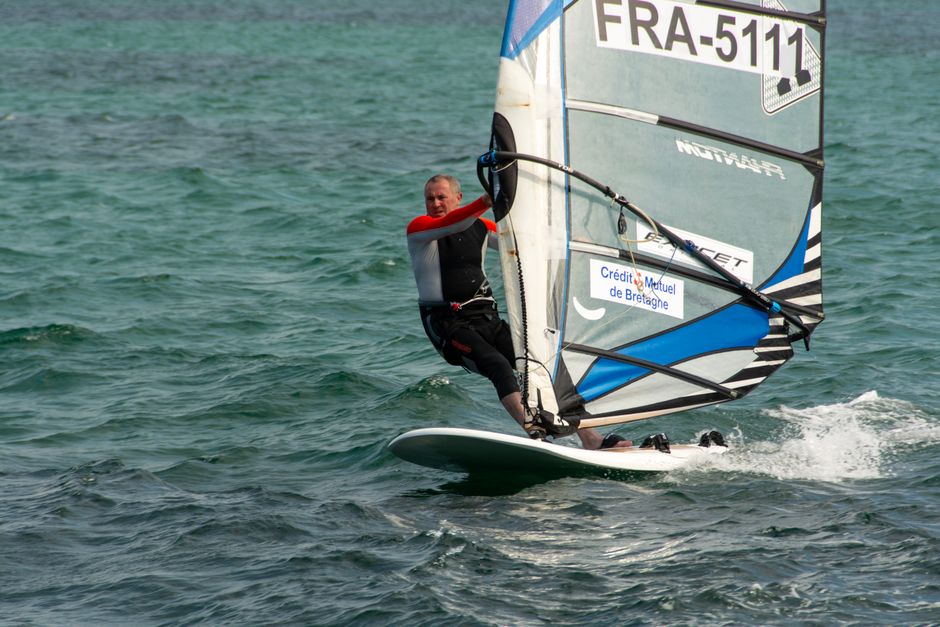
The wind has been creeping up all morning. The flags on the rigging lawn are snapping, whitecaps are showing past the breakwater, and the sailor next to you is saying “it’ll ease off after lunch”. You have a 5.3 in one hand and a 4.2 in the other, and a small voice asking how much of this you really want. Every windsurfer has stood there. So has the one who has just been catapulted over the boom, surfaced, and wondered whether to uphaul again. Windsurfing mental training means practicing the skills that happen between your ears: making a calm go or no-go call, handling fear of strong wind and falling, keeping your head when something breaks, and settling into a routine before a race. This page is for sailors of every level, from first-summer learners to slalom, wave, foil and iQFOiL racers. It is about mental performance, which is different from mental health; a section below explains the difference.
Quick answer: Decide your wind limits on the beach before you feel the pull of a good forecast, rig smaller when unsure, rehearse your self-rescue steps in easy conditions until they are automatic, and rebuild confidence after a crash one small change at a time. Reviews of psychological skills for athletes find moderate but unstable effects, so treat these tools as an addition to real sailing time, never a guarantee of safer or faster sessions. See a doctor, licensed psychologist or other qualified professional if fear, low mood or poor sleep lasts more than a couple of weeks or gets in the way of daily life, and in a crisis call or text 988 (US).
Fear of strong wind and falling is normal
Windsurfing puts a big sail in your hands, and the pull, speed and falls are real. A 2024 scoping review of 39 studies on extreme-sport participants (Martinho and colleagues, BMC Psychology) found no single personality profile and described risk and fear as natural parts of taking part, alongside positive things such as planning and confidence. Fear is information. What matters is whether it helps you decide or freezes you.
We found no published trials of fear management specific to windsurfing, so the habits on this page are common windsurf-school and coaching practice, not proven treatment. What research does show is where trouble comes from. A German survey of 327 windsurfers (Sportverletzung Sportschaden, 2003) found most accidents happened in Beaufort force 5 to 6 winds and after about two hours on the water, and in 46 cases sailors had underestimated the weather. A study of 44 semi-professional racers at the German Windsurf Cup (Sportverletzung Sportschaden, 1999) linked 43% of accidents to being overpowered by a sail that was too big. Those are decisions, and decisions can be practiced.
Go or no-go: the decision you make on the beach
The facts on reading wind, gusts, direction and storms are in our windsurfing Session Day and Race Day guide. This section is about the thinking behind the call.
- Write your limits down in advance. A top average wind, a gust gap you will not sail, and the conditions that always mean no: a building storm, offshore wind with no rescue boat, no buddy. A rule made calmly on Tuesday is easier to follow at 4 p.m. VDWS, the German association of water-sports schools, asks windsurfers to check weather, area and equipment before every session and not to go out alone in questionable conditions.
- Rig for the wind you see, not the one you hoped for. VDWS says sail size, board volume and fin should suit wind, weight and skill. When unsure, going smaller is a reasonable default, because you can always change up.
- Notice the pull of the crowd. Other sailors on the water make conditions look friendly, but their weight, sail and skill are not yours.
- Check yourself as well as the sky. The German survey’s authors suggested a longer break after about an hour. Cold, hungry or tired is a good reason to come in, and a session you end early still counts.
- Decide where “no” is allowed. Agree with your buddy beforehand that either of you can call it off with no teasing.
Staying calm when something goes wrong
A broken boom, a mast base that lets go, wind that dies a long way out or a lost board is the moment mental skill earns its place. VDWS gives a short list for emergencies: stay calm and save energy, stay with your board, send clear distress signals, raise your rig now and then so you can be seen, and only leave your equipment if you absolutely must. Schools also teach self-rescue: de-rig in the water, roll the sail around the mast, lie on the board and paddle in.
Calm under pressure is usually calm that has been practiced. Ideas coaches commonly use, which we treat as practice and not as proven fixes:
- Learn the sequence in easy conditions. Do a full self-rescue on a mild day close to shore, with your buddy watching, then again with fatigue in mind.
- Say it in steps. “Stay with the board. Look. Signal. Then decide.” A short script gives a frightened mind something to follow.
- Set a point of no return. For example: if I am cold, tired or drifting away from the beach, I signal early, not late.
Gear that you trust helps, too; see windsurfing gear for helmets, vests and what to check before launching.
Confidence after a crash
A catapult, a slam in the shore break or a footstrap that kept your foot can leave sailors tense for weeks: gripping the boom too hard, avoiding wind they used to enjoy, or skipping the water. The research here is thin for windsurfing, so these steps are general coaching practice.
- Get hurt things checked first. Head blows, back pain and knee or ankle injuries are covered in windsurfing injuries. Fear after an injury is not something to push through, and a health care provider decides when you can go back.
- Go back to a level that feels easy. A smaller sail, lighter wind or flatter water is a fine first session. Then raise only one thing at a time: wind, spot or move.
- Work out what actually happened. Was it gear, an oversized rig, a gust, a hard move or a tired body? A clear cause turns a scary story into a lesson.
- Practice falling. Falling away from the rig, with feet out of the straps, is something instructors teach and you can rehearse on safe days.
Focus, imagery and goals
Imagery means rehearsing a move in your mind: the water start, the gybe, the pump onto the foil. A 2024 systematic review and meta-analysis of psychological interventions in athletes (Reinebo and colleagues, Sports Medicine) found moderate effects for psychological skills training, mindfulness-based approaches and imagery. However, when non-randomized trials and subjective performance measures were removed, the effects were no longer significant, so imagery is a cheap addition to real water time, not a substitute for it. Use it one move at a time, on the beach or on a no-wind day (our windsurfing training page has things to do on land).
Goals work best when you control them. “Keep the board flat through the gybe”, “hook in early on every reach” or “make three clean pumps before the next lull” are process goals. “Beat Sam” is not. A 2026 survey of 192 sailors with recent regatta experience (Hsu, Frontiers in Psychology) found that competition and novelty-seeking motivations went with stronger flow, meaning focus, a sense of control and losing track of time, while a purely relaxation-oriented motivation went with weaker flow in regatta settings. It is an association from a questionnaire, not proof that any mindset changes results, but it fits a simple idea: bring a clear job to the race, not only a mood.
Race routines, pressure and tactics
A 2026 position statement from Exercise and Sports Science Australia (Schweickle and colleagues, Sports Medicine) says pressure can have both helpful and harmful effects and lists four evidence-based strategies for performing under pressure: pre-performance routines, implicit attentional strategies, psychological skills training and mindfulness-based approaches. A 2026 network meta-analysis of 24 randomized trials (Chen and colleagues, Frontiers in Psychology) found sport psychology interventions reduced anxiety in competitive athletes overall, with arousal regulation, cognitive-behavioral and mindfulness-based approaches showing advantages over no intervention. Anxiety scores were measured, not race results.
Putting that into a regatta day, as common coaching practice:
- Make a short start routine. The same few steps before every start: check the equipment, look at the line and the wind, one slow breath, one clear task such as “full speed at the gun”.
- Plan a reset between races. Drink, eat something, change your clothes if needed, and write one note on what the wind did. Then let the last race go.
- Expect to wait. Postponements and wind drops are part of regattas; a plan for the beach (shade, layers, food, something to do) stops waiting from wearing you out. Logistics are in the Race Day guide.
Tactics are decisions made under load. In a 2026 survey of 22 Masters sailors at the 2023 Australian Laser Masters Championships (McIntosh and colleagues, European Journal of Sport Science), mental and physical fatigue, stress and workload rose over the event, and complex decision making and weather were named as important modulators of fatigue. Dinghy and windsurfing differ, so read this as a hint that long regattas tire the mind as well as the body. Coaches of Olympic-class ILCA dinghy sailors (Winchcombe and colleagues, PLoS One, 2025) named “pattern recognition” and “feel”, built by sailing in many conditions, and keeping the joy in training. We did not find windsurfing-specific research on starts, shifts or laylines, so for tactics, ask your class coach and see leagues and associations for where to race.
Mental performance is not the same as mental health
Everything above is about performance skills. Anxiety disorders, depression, disordered eating and burnout are health matters, not mindset problems, and a better routine does not fix them. The 2026 International Olympic Committee consensus statement on mental health in elite athletes (Reardon and colleagues, British Journal of Sports Medicine) says mental health symptoms and disorders are common among elite athletes, can have sport-related causes and can affect performance, and that with appropriate support and treatment many athletes can continue to train and compete safely. Signs worth taking seriously include worry or low mood that lasts weeks, panic before sessions, big changes in eating or sleep, withdrawing from friends, or dreading a sport you used to love.
Start with your doctor, a licensed psychologist or another qualified mental health professional. In the US, you can call or text 988 (Suicide & Crisis Lifeline) at any time.
Windsurfing mental training: FAQs
How do I decide whether it is too windy to windsurf?
Set your limits on the beach before you rig, covering average wind, gusts, direction and storms, and compare them honestly with your skill. If you are unsure, rig smaller or stay ashore. The Session Day guide lists what to check.
How do I get over my fear of falling in strong wind?
Go back to a level that feels easy, change one thing at a time and practice falling away from the rig in safe conditions. A lesson helps. If fear lasts weeks or spreads into daily life, talk to a doctor or licensed mental health professional.
What should I do if I get stuck far from the beach?
VDWS advises staying calm, staying with your board, sending clear distress signals and raising the rig now and then to be seen. Practice self-rescue in easy conditions so the steps feel automatic.
Does visualization help windsurfers?
A 2024 review across sports found moderate effects for imagery, but not once weaker studies were removed. Use it next to real practice, not instead of it.
How can I stay calm before a race start?
Build a short, repeatable routine and give yourself one clear task. A 2026 position statement lists pre-performance routines among the evidence-based strategies for performing under pressure. No routine guarantees a result.
Sources
- VDWS, windsurfing safety rules: vdws.de
- Mechanisms and prevention of windsurfing injuries, 2003, Sportverletzung Sportschaden, German survey of 327 windsurfers: PubMed 12975726
- Injury mechanisms in windsurfing regatta, 1999, Sportverletzung Sportschaden, German Windsurf Cup: PubMed 10670063
- Martinho and colleagues, 2024, BMC Psychology, psychological traits of extreme sport participants: PubMed 39380030
- Reinebo and colleagues, 2024, Sports Medicine, psychological interventions meta-analysis: PubMed 37812334
- Schweickle and colleagues, 2026, Sports Medicine, ESSA position statement on performance under pressure: PubMed 42271117
- Chen and colleagues, 2026, Frontiers in Psychology, sport psychology interventions and anxiety, network meta-analysis: PubMed 42656332
- Hsu, 2026, Frontiers in Psychology, motivation and flow in competitive sailing: PubMed 42183541
- McIntosh and colleagues, 2026, European Journal of Sport Science, fatigue and stress in Masters sailors: PubMed 41420566
- Winchcombe and colleagues, 2025, PLoS One, coaches’ insights on ILCA dinghy sailing: PubMed 40489500
- Reardon and colleagues, 2026, British Journal of Sports Medicine, IOC consensus statement on mental health in elite athletes: PubMed 42580854
- 988 Suicide & Crisis Lifeline: 988lifeline.org
General information for education only, not medical advice. It does not replace a doctor, psychologist or other qualified professional, or a certified windsurfing instructor. See how we work in our editorial policy. Back to the windsurfing hub.