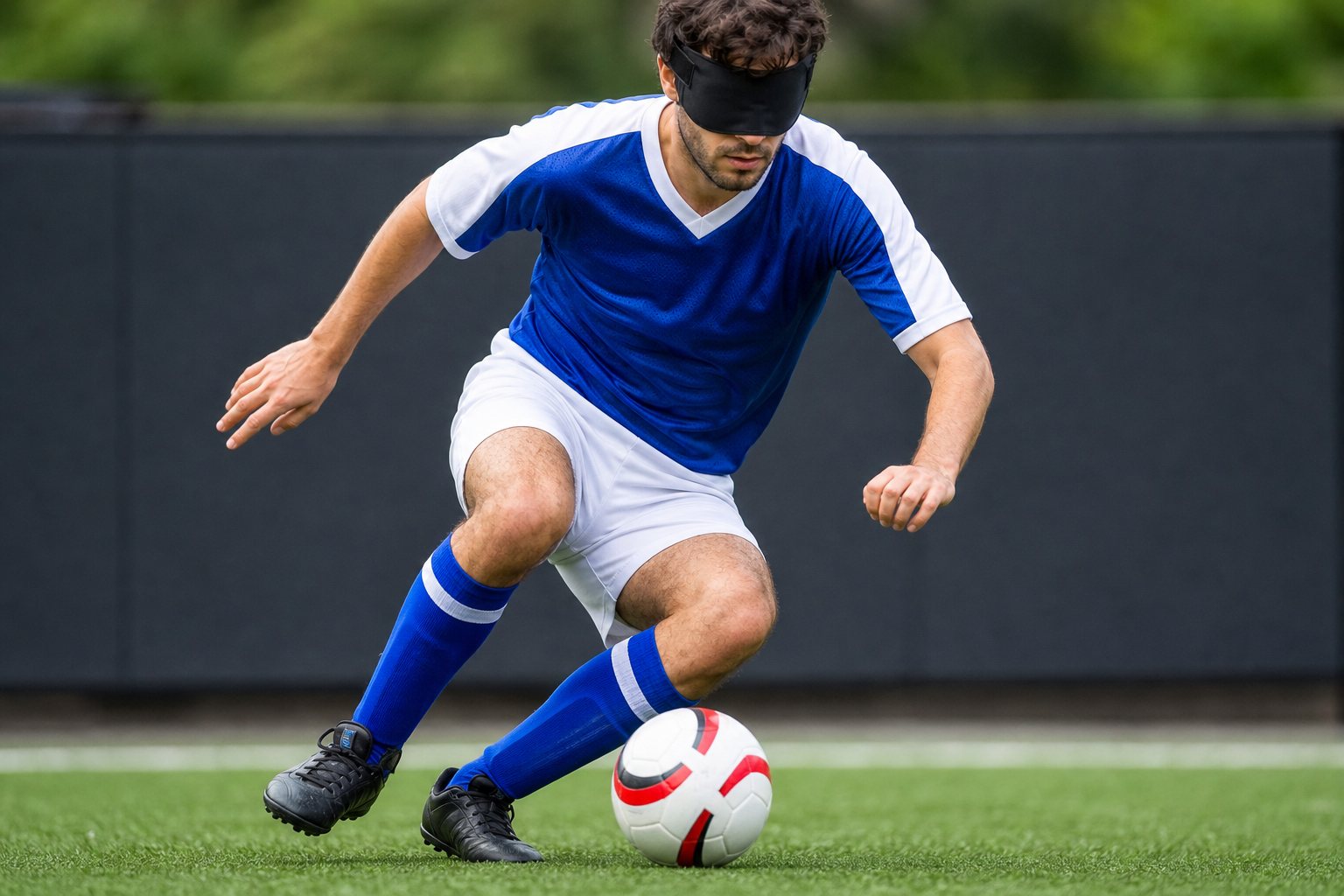
The match is over, the crowd can talk again, and the players sit on the floor with a drink and a towel. The legs are heavy, the ears are tired from a day of concentrating, and tomorrow there is another game. Recovery in blind football is everything you do between sessions so that you can train and play well again: sleep, food and fluids, rest, easy movement and a plan for the week. This page is about recovery, not treatment; for injuries see blind football injuries. The overall sport is in the hub.
Quick answer: The best-supported recovery habits are the simple ones: enough sleep, eating and drinking after hard sessions, rest days and sensible load across the week. Many popular recovery tools have weak or mixed evidence, so treat them as optional extras. Normal soreness fades within a few days; sharp, localized or worsening pain, swelling or a head knock is not normal soreness, so see a sports medicine doctor, physical therapist or athletic trainer.
Sleep comes first
The CDC says adults need at least 7 hours of sleep a night, and teens 8 to 10 (the American Academy of Sleep Medicine’s pediatric consensus gives 8 to 10 hours for ages 13 to 18, and 9 to 12 for ages 6 to 12). A review of sleep and recovery in elite football players (Nédélec et al., Sports Medicine, 2015) says evening matches, caffeine or alcohol before bed, screens and variable wake times can interfere with sleep, and that a consistent sleep pattern and appropriate napping are recommended. Blind football often involves travel, tournaments and late games, so protect a routine where you can: a regular wake-up time, a dark and quiet room, and a wind-down after matches. If you have trouble sleeping most nights, ask a doctor.
Rest days and managing the week
The American Academy of Pediatrics (AAP) clinical report on specialization recommends at least one to two days off a week from the main sport for young athletes. For older players the principle is the same: a hard week needs easy days. The IOC’s 2016 consensus on training load and injury risk says load should be monitored and managed. After a match, research in sighted football (Silva et al., 2018) found that muscle force, performance and soreness could still be affected 72 hours later, so a tournament with games on consecutive days leaves less recovery time. Blind football tournaments are often compact, so rotate substitutes, keep warm-ups short and consistent, and plan easy sessions afterward. We did not find recovery-time data for blind football itself.
Refuel and rehydrate
The 2016 joint position of the American College of Sports Medicine (ACSM), the Academy of Nutrition and Dietetics and Dietitians of Canada says that after hard exercise, athletes should replace carbohydrate and fluid and eat some protein early in recovery, particularly when the next session is soon. Details are on our nutrition page. Practical points: have a snack and a drink ready before you leave the pitch, and set it where you can find it, since a kit bag in an unfamiliar room is a hassle.
Mobility and cool-down
Mobility work such as hip, ankle and calf stretches and easy movement helps many players feel looser, and a short cool-down can bring heart rate down. The evidence is modest. A 2018 review of cool-downs (Van Hooren and Peake, Sports Medicine) found that an active cool-down was largely ineffective for next-day performance, did not appear to prevent injury and mostly did not reduce soreness, though it may help the cardiovascular and respiratory systems recover faster. So do it if you like it, but do not expect more from it than that.
Flexibility and mobility work is also practical for balance and body awareness, which matter in a sport where you move without sight. Keep the area clear, and use a wall or a partner for support if needed.
Recovery methods: what the evidence supports
- Sleep, food and rest: best supported.
- Cold-water immersion: a review of recovery in soccer (Nédélec et al., 2013) found it effective in congested fixture periods, though it is not for everyone; check with a doctor if you have a heart condition or circulation problem.
- Stretching, compression garments, massage and electrical stimulation: the same review said evidence was lacking that they speed return to performance. Many athletes still like how they feel, and there is little reason not to use them if comfortable, but they are not proven.
- Foam rollers and massage guns: we found no blind-football-specific evidence, and a device is not a substitute for the basics.
Be honest with yourself about what each method does: comfort is a fine reason to use something, as long as it does not replace sleep and food.
Soreness or injury?
Delayed muscle soreness is a dull, widespread ache that builds after unaccustomed or hard work and fades over a few days. It is a sign of work, not of damage that needs treatment. Warning signs are different: sharp pain in one place, pain that gets worse with use, swelling, bruising, a joint that feels unstable, pain at rest or at night, or any symptoms after a head knock. Those need a professional. For concussion, follow the CDC HEADS UP steps: remove from play and have a healthcare provider decide when return is safe.
Recovery for tournament and travel weeks
In a tournament week, make a short checklist: a consistent bedtime, a recovery snack after each match, hydration, easy movement the next morning, and a plan for how you will get around the venue safely with your guide or team. International competition is built around tournaments, so this is where a plan helps most.
Blind football recovery FAQs
How much sleep do I need?
The CDC says at least 7 hours for adults, and the AASM consensus recommends 8 to 10 hours for teens aged 13 to 18.
Do I need a rest day?
Most training plans include at least one. The AAP recommends one to two days off a week from the main sport for young athletes.
Does stretching prevent soreness?
Evidence is limited. A review of cool-downs found that they mostly did not reduce soreness. Stretch if it feels good.
Are ice baths worth it?
Evidence is mixed. A review in soccer found cold-water immersion effective in congested fixture periods. Check with a doctor before using one if you have a health condition.
When is soreness a problem?
When it is sharp, in one place, getting worse, or comes with swelling or after a head knock. See a sports medicine doctor, physical therapist or athletic trainer.
Sources
- CDC: about sleep
- AASM pediatric sleep duration consensus
- Nédélec et al., sleep hygiene and recovery strategies in elite soccer players, Sports Med 2015
- Nédélec et al., recovery in soccer part II, Sports Med 2013
- Silva et al., acute and residual soccer match-related fatigue, Sports Med 2018
- Van Hooren and Peake, do we need a cool-down after exercise? Sports Med 2018
- Brenner et al., AAP clinical report on sports specialization and intensive training, Pediatrics 2016
- Soligard et al., IOC consensus on load in sport and risk of injury, 2016
- ACSM, Academy of Nutrition and Dietetics and Dietitians of Canada: nutrition and athletic performance, 2016
- CDC HEADS UP: responding to a concussion
General information for education only, not medical advice. It does not replace a visit with a doctor, physical therapist or athletic trainer. See how we write and check our pages in our editorial policy.