This article contains affiliate links: if you buy through them we may earn a commission, at no extra cost to you. Read our affiliate disclosure.
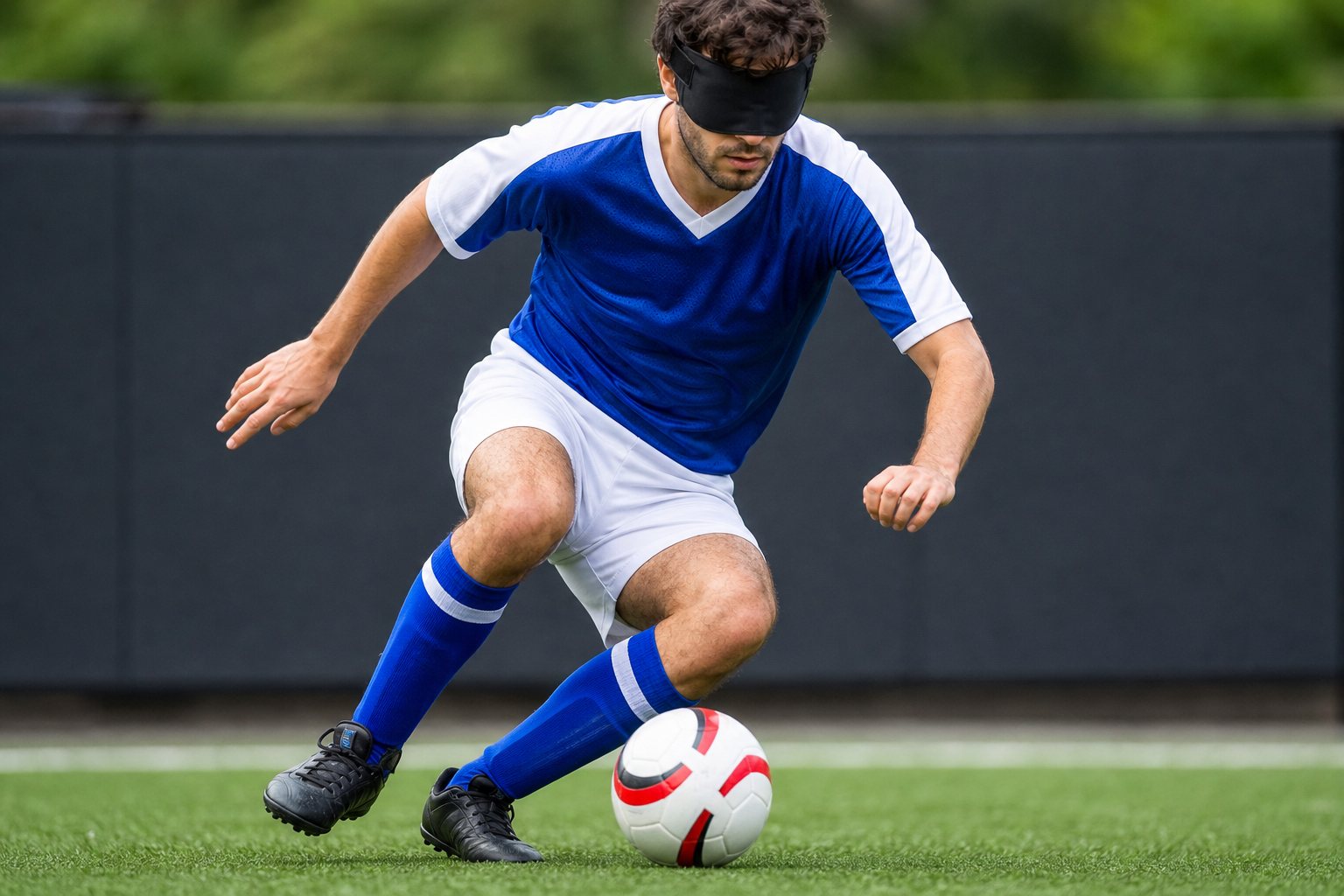
Imagine a stadium so quiet you can hear the ball. At a blind football match the crowd is asked to stay silent until a goal is scored, because the players cannot see: four outfield players in eyeshades listen for the rattle of the ball, the calls of teammates (“voy,” meaning “I’m coming”) and the voice of a guide behind the goal telling the shooter where to aim. At the Paris 2024 Paralympic Games, France won gold, Argentina silver and Brazil bronze, ending Brazil’s run of golds at every Games before it. Blind football, also called blind soccer or football 5-a-side, is five-a-side football for athletes who are blind or have a severe vision impairment, played with a ball that makes noise.
Blind Football guides: what do you need?
New to blind football? Start with the first card. Everything here is general education, not medical advice.
History & Origins of Blind Football
According to the International Blind Sports Federation (IBSA), Spain was the pioneer of blind football in the 1920s, where the game was often played in schools for people with visual impairments. Brazil became active in the 1960s and held its first national championships in 1974. Before 1996 there was no governing body, so countries played with different rules, balls, pitches and surfaces, and friendly international tournaments helped the game spread (IBSA football history).
In 1996 IBSA took over the sport and wrote international rules. It split football into two disciplines that still compete separately: blind football for B1 athletes, and partially sighted futsal for B2 and B3 players. Continental and world competition followed quickly, and in 2004 blind football joined the Paralympic Games in Athens. Brazil won that first final on penalties and then won every Paralympic title until 2024. We cover the documented milestones only; the exact early history in each country is not fully recorded in the sources we reviewed.
- 1920s: Spain begins playing blind football, often in schools for the blind (IBSA).
- 1974: Brazil holds its first national championships (IBSA).
- 1996: IBSA takes over the sport and develops international rules.
- 1997: First European Championships (Barcelona, won by Spain) and first Americas Championships (Asuncion, won by Brazil).
- 1998: First IBSA Blind Football World Championship, won by Brazil at home.
- 2004: Blind football debuts at the Athens Paralympics; Brazil beats Argentina 3-2 on penalties after a 0-0 draw.
- 2016: Brazil wins a fourth straight Paralympic gold, beating Iran 1-0 in Rio (Paralympic.org).
- 2023: First women’s world champion crowned, at the IBSA World Games in Birmingham (see the unconfirmed note in our sources file).
- 2024: France wins Paris 2024 gold on penalties, the first Paralympic title for a country other than Brazil.
- 2028: Blind football is on the Los Angeles Paralympic programme, with the United States making its debut as host.
Legends of the Sport
Athletes from different eras, not ranked. Selected from the players named in official reports.
- Ricardinho (Ricardo Alves, Brazil): goal-scoring captain who scored the only goal of the Rio 2016 final against Iran, Brazil’s fourth straight Paralympic gold (Paralympic.org).
- Jefinho (Jeferson Gonçalves, Brazil): won Paralympic golds in 2008, 2012, 2016 and 2020 according to IBSA, and scored twice in the Rio 2016 semi-final against China (IBSA).
- Silvio Velo (Argentina): long-time captain of Argentina’s team, a medallist at several Paralympic Games, including Rio 2016 bronze (Paralympic.org profile).
- Frédéric Villeroux (France): scored France’s goal in the Paris 2024 final and the winning penalty in the shootout; at 41 he helped France to its first Paralympic title (Paralympic.org).
- Maximiliano Espinillo (Argentina): scored Argentina’s equalizer in the Paris 2024 final.
- Alessandro Bartolomucci (France): goalkeeper who made key saves in the Paris 2024 final (the goalkeeper may be sighted or partially sighted).
Official results and records
We only list champions and records here after checking them on the official source. For the latest results, go to:
- Paralympic.org Paris 2024
- Paralympic.org Tokyo 2020
- IBSA football history
- Paralympic.org
- ibsasport.org
- England Football
- Paralympic.org on Rio 2016
How we keep this current: we re-check facts after each major championship and update this page. Spot an error? See our editorial policy.
This page explains how the game works, who plays it, what the United States is doing to be ready for its first Paralympic blind football tournament as the LA28 host, and how to stay safe in a sport where collisions are the main worry. For the sighted game, see soccer.
Blind football at a glance
| What it is | Five-a-side football (four outfield players and a goalkeeper) with a noise-making ball, adapted from football and futsal rules. |
|---|---|
| How it is won | Score more goals. Two 20-minute halves under IBSA’s overview; a penalty shootout decides a tied medal match. |
| Pitch | 40 m by 20 m, ideally outdoors, bordered by kickboards. Goals are 3.66 m wide and 2.14 m high. |
| Who plays | Outfield players are classified B1 (severe vision impairment) and wear eye patches and eyeshades, so all are equally blind on the pitch. The goalkeeper is sighted or partially sighted (B2 or B3) and stays in the goal area. |
| Governing body | International Blind Sports Federation (IBSA); in the US, the U.S. Association of Blind Athletes (USABA). |
| Season | Mostly international tournaments (regional championships, World Championships) and the Paralympics every four years. Domestic competition varies by country. |
How blind football works
The game follows football’s laws with changes. There is no offside and there are no throw-ins, but corner kicks and penalties are used. The ball contains bells or another sound system, and both teams use sound to play: players call “voy” when they go for the ball so that others can locate them, the goalkeeper can shout instructions to his defenders, and a guide stands behind the opposing goal, making noise to show the shooter where the goal is. The kickboards keep the ball in play, and the reduced pitch keeps the game fast.
What a first-time viewer notices: the dribbling is close and low, the touches are small, and the passing is surprisingly accurate. On a team there are four outfield substitutes and one goalkeeper substitute, with up to six substitutions allowed per half, and each team can ask for one one-minute time-out per half.
Who plays it and at what level
Roots and community play. Paralympic.org says the sport was developed in Spain in the 1920s, and IBSA became its governing body, with rules unified in 1996. Today local clubs, schools for the blind and adaptive sports programs run introductory sessions. In the US, USA Blind Soccer is a Team USA program run by USABA; ask USABA about clinics and tryouts.
Youth, school and college. We found no national youth or college league structure for blind football in the US. Ask USABA or a local adaptive sports organization what youth clinics are offered near you.
Elite and international. Blind football has been in every Paralympic Games since Athens 2004, where Brazil beat Argentina 3-2 on penalties in the first final. Brazil has won the most golds (five, per paralympic.org) and Ricardo Alves has the most individual golds (four). The Paralympic event has only ever been for men; there has never been a women’s blind football event at the Games.
The United States and LA28. The US has never fielded a Paralympic team, but it will debut at LA28 as host. On 3 June 2025 the IPC confirmed blind football for LA28 (15 to 27 August 2028) as one men’s medal event with 64 athlete places, an eight-team tournament at the Allianz Beach Arena on Alamitos Beach in Long Beach. USABA named the first US men’s national team in November 2022, and the team will need to qualify for 2032, according to a paralympic.org feature. As of 2026, check the official programme for the current Games and USABA for tryouts.
Physical demands
Blind football is a fast, intermittent sport: repeated sprints and turns, quick acceleration and deceleration, and constant small adjustments of balance. Players need leg strength, agility and fitness for two 20-minute halves of a game played at futsal pace, and they need trust: orientation depends on listening, so hearing and communication are as important as legs. Goalkeepers train reaction and communication rather than sprinting. As with every adaptive sport, training should be built around the individual and their coach.
Health and safety in blind football
This is general information, not medical advice. If you are hurt, see a sports medicine doctor, physical therapist or athletic trainer.
What injury studies show
A 2026 analysis of the London 2012, Rio 2016 and Tokyo 2020 Paralympics reported 60 injuries in 49 blind football athletes, an incidence of 21.5 per 1,000 athlete days. The lower limb had the highest incidence (11.0), followed by the head, face and neck (4.4). Most injuries were sudden, direct contact was the main mechanism (56%), and 61% caused no time loss. No confirmed concussions were reported, but the authors say concussions are suspected in blind football despite low recognition and reporting. At Paris 2024, football 5-a-side was among the sports with higher injury incidence (22.3 per 1,000 athlete days) than most, along with taekwondo and sitting volleyball.
Collisions, head contact and concussion
Because players cannot see, head-to-head and head-to-board contact are the sport’s particular risk. A 2024 review of concussion in athletes with vision impairment found they may be more likely to sustain concussions than non-disabled athletes and athletes with other impairments, that real incidence numbers are lacking, and that the value of most prevention measures is still unknown. The practical rules are the CDC’s HEADS UP steps: recognize the signs (headache, dizziness, confusion, balance problems), remove the player from play, and have a healthcare provider decide when a return is safe. Call 911 for danger signs such as repeated vomiting, a seizure or worsening confusion. Teams can help by enforcing the “voy” call every time, keeping the pitch clear and coaching safe contact.
Legs, feet and the pitch
With the lower limb the most common injury site, a sensible warm-up (easy jogging, hip and ankle mobility, light ball work) before play is worthwhile. Shin guards are standard football protection; check your league’s rules for what is required. Keep the pitch dry and free of debris, and make sure guides, goalkeepers and coaches know the layout and the safe routes on and off the pitch.
Training, recovery and nutrition pointers
Work on first touch, turning and passing with a noise ball, often with a partner calling. Add agility and sprint-and-turn work, leg strength and balance, and plenty of listening drills with a guide. Recovery starts with sleep: the CDC recommends at least 7 hours for adults and 8 to 10 for teens. Eat well before and after training, and drink water through the day. The soccer pages have broader guidance: soccer training, recovery and nutrition; ask your coach how to adapt it.
Gear
You need very little. The most important pieces are the specialised ones: a noise-making ball (with bells or a sound system, as the IBSA overview describes), eyeshades and eye patches so all outfield players are equally blind, and a pitch with kickboards. A club or program usually provides these. Players bring flat-soled shoes or turf shoes for the surface, shin guards, and comfortable kit. We do not list eyeshades or noise balls because we could not confirm a specific product that meets IBSA’s rules, so buy them through your club or USABA.
Vizari Malaga Shin Guards
- Hard shell
- Hook-and-loop straps
- Kids 4-6 to adult sizes
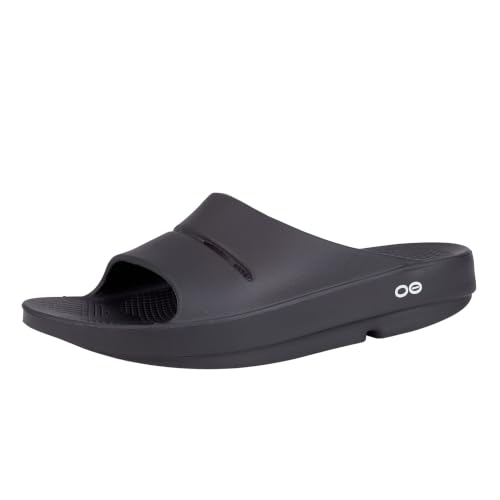
OOFOS OOahh Slide
- OOfoam slide
- APMA Seal of Acceptance
- Machine washable
$59.95 at Amazon, as of Nov 17, 2026 02:07 UTC
Check price on AmazonRelated sports and disciplines
Parent: Soccer. Another sport built on sound and trust, also run by IBSA: goalball. More adaptive sports: para table tennis and para athletics.
Blind football FAQs
Is blind football a Paralympic sport?
Yes. It has been on the programme since Athens 2004 and the IPC confirmed it for LA28 as one men’s event. Check the official programme for the current Games.
How do players know where the ball and goal are?
The ball makes noise, players call “voy” as they approach, the goalkeeper gives instructions and a guide behind the opposing goal makes noise to show where the goal is. Spectators stay quiet until a goal is scored.
Does the goalkeeper see?
Yes. The goalkeeper is sighted or partially sighted (B2 or B3) and cannot leave the goal area.
How long is a match?
Two 20-minute halves according to IBSA and the LA28 venue page. Paralympic.org also mentions a fifteen-minute half in one place, so check the current rulebook for your competition.
How can I try blind football in the US?
Contact the U.S. Association of Blind Athletes (USABA), which runs USA Blind Soccer, or a local adaptive sports organization, and ask about clinics. Sighted friends and family can often join sessions as guides or in eyeshades.
Sources
- Paralympic.org: blind football
- IBSA: football overview
- IPC: LA28 Paralympic medal event programme and athlete quotas
- LA28: blind football
- Paralympic.org: US blind football team prepares for LA28
- USABA: blind soccer
- Injury patterns in blind football, three Paralympic Games (J Sci Med Sport, 2026)
- Injury and illness at the Paris 2024 Paralympic Games (Br J Sports Med, 2026)
- Concussion in para sport for athletes with vision impairment (2024)
- CDC HEADS UP: responding to a concussion; CDC: sleep
Keep exploring: the soccer hub, soccer injuries, the sports hub, our recovery tools guide and recovery shoes guide.