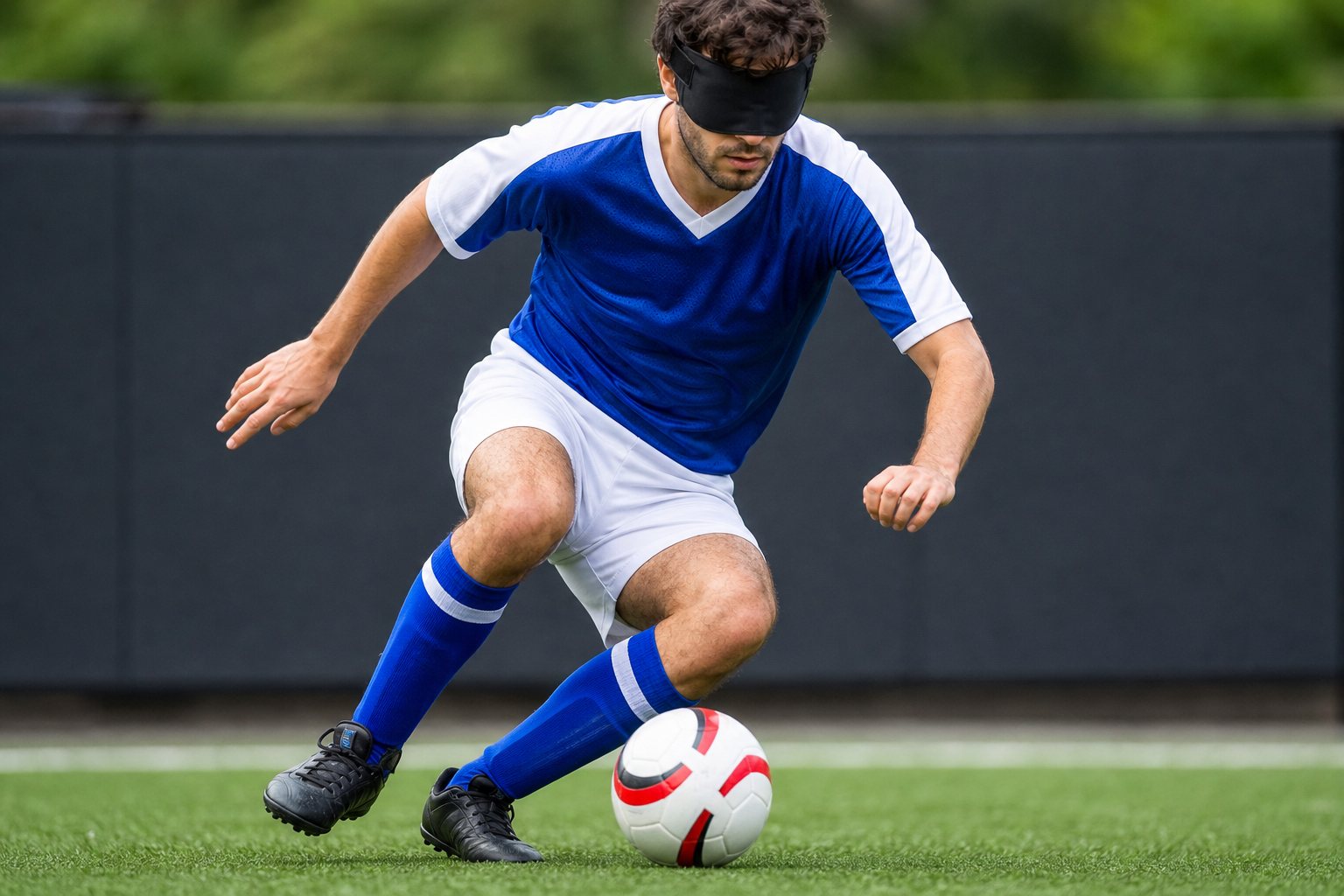
The team is split across a quiet gym floor. One player rolls a ball with bells toward a partner, who calls “voy,” steps in, and taps it back. Nothing about the drill looks fast, yet it is the base of everything else on match day. Blind football training blends ordinary fitness work with skills that depend on hearing, trust and communication. This page covers the physical demands, a sensible weekly shape, strength and conditioning, and how to build load gradually. It sits in our blind football hub; for rules and the basic skills see rules and getting started.
Quick answer: Blind football asks for repeated short sprints, quick turns and balance, plus excellent listening and communication. A simple week mixes two or three skill sessions with a noise ball, one or two strength sessions, some speed and agility work, and rest days. Build load slowly, work with a coach who has adapted-sport experience, and see a sports medicine doctor, physical therapist or athletic trainer if pain persists.
What the sport asks of the body
Matches are two 20-minute halves on a 40 m by 20 m pitch, according to the International Blind Sports Federation (IBSA), with up to six substitutions per half. That is a small, quick pitch. In general terms, the game is intermittent: short sprints, sharp stops and turns, then lower-effort movement while the ball is elsewhere. Leg strength, balance and the ability to change direction safely matter, and so does fitness, because a player who is tired listens and moves worse. We did not find published studies of the energy demands of blind football, so these are general descriptions of the format, not measured numbers.
Two features are particular to the sport. First, orientation: outfield players cannot see, so they rely on sound from the bell ball, from teammates’ “voy” calls and from a guide behind the opposing goal. A 2024 study in PLOS ONE reported that players who turned their heads toward the ball trapped it better, so how a player holds and moves the head is trainable. Second, goalkeepers are sighted or partially sighted and have a different workload: reaction, positioning, diving and constant talking to defenders.
A sensible weekly shape
There is no published “best week” for blind football that we could find, so treat this as an example to adapt with a coach, not a prescription. The CDC says adults with disabilities who are able should aim for 150 minutes of moderate-intensity aerobic activity a week, and that those who cannot meet it should be as active as their abilities allow and avoid inactivity. For a player with football training on top, one common arrangement looks like this:
- Two or three skill sessions. Ball work with a noise ball, passing and receiving drills, small-sided play and guide shooting. Short sessions are fine; quality of listening matters more than length.
- One or two strength sessions. Legs, hips, trunk and upper back, with a simple progression.
- One short speed and agility block. Sprints, turns and stop-starts, on a safe and familiar surface.
- Easy aerobic work. Walking, cycling or swimming, whichever suits your access and schedule.
- At least one full rest day. See recovery.
Players who also work or study full time will often combine sessions. The aim is regular, repeatable weeks rather than occasional very hard ones.
Skills training with sound
Skill work is where blind football differs most from the sighted game. Ideas that coaches commonly use include:
- Listening drills. Locating a rolling ball, then a teammate calling “voy,” then a guide’s voice, with the player describing where each sound comes from.
- Close control and first touch. Short touches, trapping balls coming along the floor, turning with the ball.
- Passing in pairs and threes. The passer calls or taps; the receiver aligns before the pass arrives.
- Guided shooting. Shooting at a goal with a guide behind it, then without the cue to test memory of the goal’s position.
- Goalkeeper work. Reaction saves, communication, and distribution.
Paralympic.org quotes the US head coach saying that guiding blind players differs from guiding sighted players: do not steer players like a joystick, and give detailed descriptions. Good coaching adds details slowly so players learn to build their own picture of the pitch.
Strength, speed and conditioning
Football-style conditioning is the usual base: strength training for legs and trunk, balance work, short sprints and turns, and aerobic fitness. Soccer pages on our site cover general principles that carry over where they fit; see soccer training, and ask your coach to adapt it. Safe space matters most: a familiar, clear training area, a guide where needed, and equipment kept in the same place so no one trips over it.
Building load gradually
The IOC’s 2016 consensus statement on training load and injury risk says load should be monitored and managed and warns about large, sudden changes. In plain words: raise how much or how hard you train step by step, and do not jump from little to a lot, for example before a tournament. We did not find a blind-football-specific rule such as a safe weekly increase, so there is no number here. Practical signs to back off include pain that stays in one spot, worsening soreness and poor sleep; a doctor or athletic trainer can help decide what to do.
Periodisation basics
Periodisation means planning the year in phases. A simple version for a player in a tournament sport has a base phase of general fitness and skills, a build phase with more speed and match-like play, a competition phase with sharper, shorter sessions, and a rest phase after the main event. Because international blind football is built around tournaments and the Paralympics every four years, players and coaches commonly plan backward from those dates. USA Blind Soccer’s national team has held regular training camps at the US Olympic and Paralympic Training Center in Colorado Springs, per Paralympic.org.
Training safely
Training is also where many avoidable bumps happen. Enforce the “voy” call in every drill, use a guide and clear boundaries, and warm up first; see injury prevention. If someone has a head knock, stop and follow the steps on the injuries page.
Blind football training FAQs
How often should I train?
There is no sourced rule for blind football. A typical arrangement is two or three skill sessions plus strength and some conditioning each week, with a rest day, adapted to your schedule and your coach’s advice.
Do I need a guide to train?
For shooting and orientation drills, a guide or a teammate calling is very helpful. You can also practise ball control alone in a familiar, clear space, with a ball that makes noise.
Can I train alone at home?
Yes, within limits. Ball touches against a wall or board, strength work and walking or cycling are all possible. Keep the space clear and tell someone where you are.
Is strength training important for goalkeepers too?
Goalkeepers also benefit from leg, trunk and shoulder strength and from reaction work. Ask a coach who works with goalkeepers.
What should a beginner focus on?
Listening, close control, safe contact and basic fitness before speed. See rules and getting started.
Sources
- IBSA: football overview
- Paralympic.org: blind football
- Paralympic.org: US blind football team prepares for LA28
- CDC: physical activity for adults with chronic conditions and disabilities
- Soligard et al., IOC consensus on load in sport and risk of injury, Br J Sports Med 2016
- PLOS ONE 2024: head movements and ball trapping in blind football
General information for education only, not medical advice. It does not replace a visit with a doctor, physical therapist or athletic trainer. See how we write and check our pages in our editorial policy.