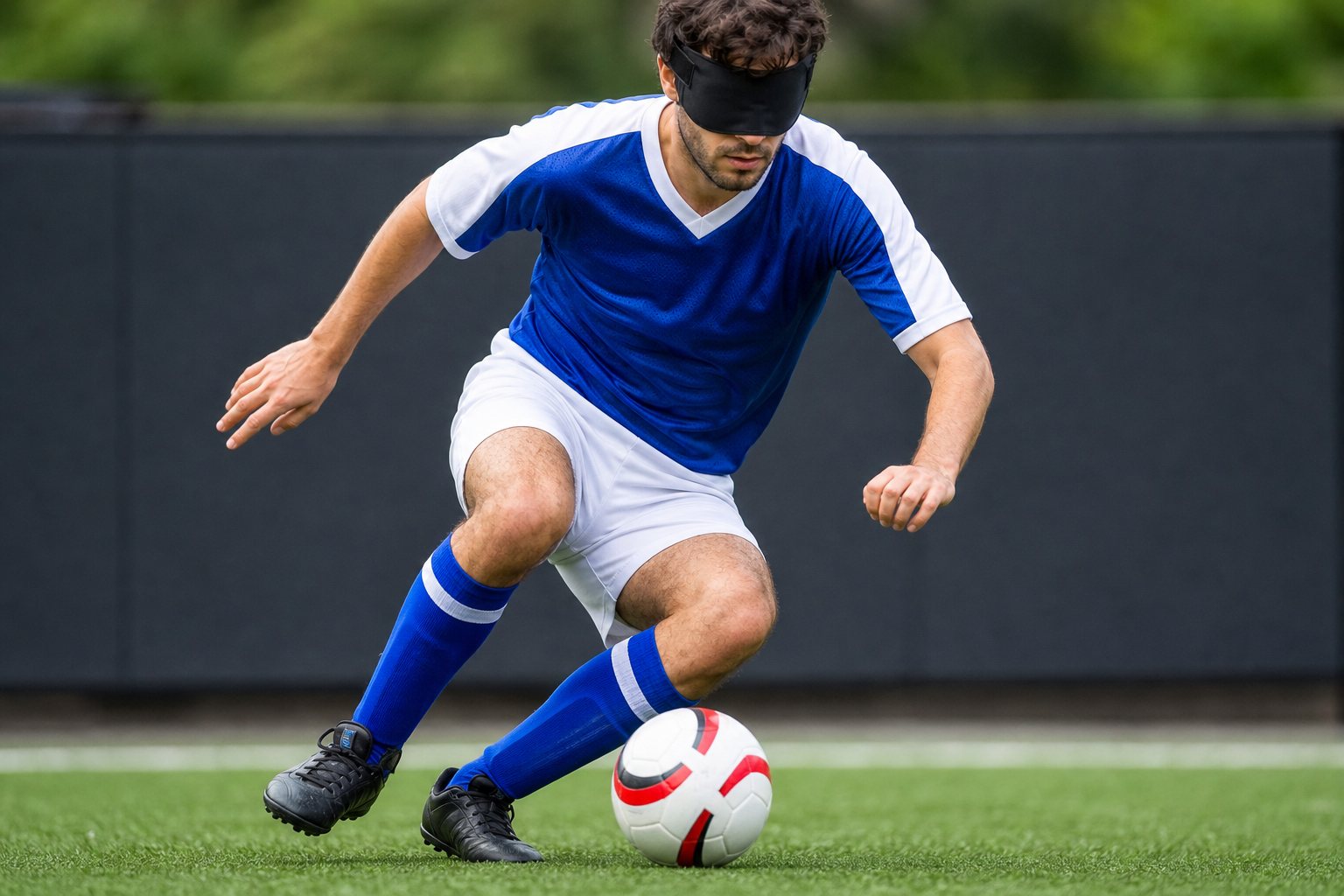
Two defenders and an attacker all head for the same loose ball. Nobody can see the others, and the only warning is a voice: “voy.” When it is said in time, the players adjust and the ball is won cleanly; when it is missed, heads and shins meet. Injury prevention in blind football means the habits, rules, conditioning and equipment choices that lower the chance of getting hurt, with the main focus on collisions. It cannot remove risk. What each injury looks like is on our blind football injuries page, so this page stays on prevention; the sport as a whole is in the blind football hub.
Quick answer: The best-supported steps are the ones that match how injuries happen: always call “voy,” keep the pitch clear and consistent, warm up, build strength and balance, build training load gradually, and take any head knock seriously. Most evidence comes from injury counting, not from tests of prevention programs in blind football, so treat these as sensible habits, not guarantees. See a sports medicine doctor, physical therapist or athletic trainer for pain that stays, and call emergency services after a head injury with danger signs.
Where the risk is
A 2026 analysis of the London 2012, Rio 2016 and Tokyo 2020 Paralympics (J Sci Med Sport) reported 60 injuries in 49 blind football athletes, 21.5 per 1,000 athlete days. Lower-limb injuries had the highest incidence (11.0 per 1,000 athlete days), followed by head, face and neck (4.4); direct contact was the main mechanism (56%), and 61% caused no time loss. At Paris 2024, football 5-a-side was among the sports with higher injury incidence (22.3 per 1,000 athlete days), according to a 2026 report in the British Journal of Sports Medicine. Those figures come from elite tournaments, so they do not map perfectly onto club or school play, but they show what to prevent: contact and lower-limb injuries.
The “voy” call and communication
Because contact is the main mechanism, prevention starts with sound. Paralympic.org explains that players call “voy” when they decide to approach the ball so that teammates and opponents know where they are. Make it a rule, enforced by coaches and referees, in every drill and every match, and teach it first to new players. The goalkeeper and the guide also give information, and the goalkeeper should speak up before a defender and a ball collide. Teams can also agree on simple words for common situations.
A US coach quoted by Paralympic.org says mistakes in guiding can risk serious injury and that guides should describe the space in detail. Sighted guides, helpers and coaches need training too, so keep guides in a program rather than leaving them to improvise.
Warm-up
No published warm-up program has been tested in blind football that we could find. In sighted football, FIFA’s Medical Network describes the FIFA 11+ as a structured warm-up of running, strength, balance and plyometric exercises that takes about 20 minutes and is used at least twice a week; a 2017 meta-analysis (Thorborg et al., Br J Sports Med) found injury reductions of about 39% in the studies it pooled. Players in blind football can borrow its ideas, adapted by a coach: easy jogging, hip and ankle mobility, balance work, then light ball work with calls before full contact. Ask a coach or athletic trainer to adapt any program for your needs.
Strength and balance
Lower-limb injuries are the most common injuries in blind football, so leg, hip and trunk strength and balance work are sensible. Our training page has a sample week. Strength work is not a guarantee against injury, and the studies behind football programs involve sighted players, so see this as general reasoning rather than proven protection.
Load and rest
The IOC’s 2016 consensus on training load and injury risk says load should be monitored and managed, with sudden large changes a concern. Raise training slowly, particularly after time off or before a tournament, and keep rest days. See recovery.
Head contact and concussion
Head contact deserves its own plan. A 2024 narrative review of concussion in athletes with vision impairment found they may be more likely to sustain a concussion than non-disabled athletes and athletes with other impairments, that real incidence numbers are lacking, and that the value of most prevention measures is still unknown. The 2026 injury analysis reported no confirmed concussions but said they are suspected in blind football despite low recognition and reporting.
- Teach safe contact. Approach the ball with the call, arms in a protective position, and head up toward the sound as coaches teach it.
- Know the signs. The CDC’s HEADS UP guidance lists headache, dizziness, confusion and balance problems among signs of concussion. Recognize, remove from play, and let a healthcare provider decide on return.
- Use the substitution rule where it applies. IBSA says that a temporary concussion substitution rule has applied at its official blind and partially sighted football competitions since 1 January 2021: a suspected player leaves the pitch to be assessed and can be replaced.
- Danger signs mean 911. Repeated vomiting, a seizure or worsening confusion need emergency care.
About headgear: it is not part of the equipment list in the official overview pages we read. A Paralympic presentation lists a trial of headgear among issues to consider, and a University of Brighton project on injury prevention in Paralympic football 5-a-side says that designing protective headgear first requires understanding collision forces. So headgear is a research question, not a proven standard. If your league allows it, ask a doctor or the league before buying.
The pitch and the environment
IBSA says kickboards border the pitch, and USABA says the surface should be solid, smooth, flat and non-abrasive. Keep it free of debris and puddles, and keep the layout the same so players know where the boards and goals are. Make sure the space around the pitch is clear, with safe routes for players on and off. For heat, the National Athletic Trainers’ Association (NATA) position statement on exertional heat illnesses says that gradual acclimatization and hydration help lower risk; the nutrition page has more on fluids. In hot weather ask for extra breaks.
Footwear and protective equipment
Shin guards are standard football protection; check your league’s rules for what is required. Flat-soled or turf shoes that match the surface help footing. Eyeshades and eye patches are required for outfield players, according to IBSA’s overview, so check that they fit securely and do not slip; they are competition equipment, not protective gear. The gear page covers fit and inspection.
What prevention cannot do
Even with every precaution, collisions and falls happen. Good programs reduce risk but cannot promise to prevent injury, and the evidence in blind football specifically is thin. The aim is fewer and milder injuries, spotted early.
When to see a professional
See a sports medicine doctor, physical therapist or athletic trainer for pain that persists, is getting worse, shows up at rest, or changes how you move. After any head knock with symptoms, stop playing and see a healthcare provider.
Blind football injury prevention FAQs
What is the biggest injury risk in blind football?
Collisions. In the three-Games analysis, direct contact was the main mechanism, and lower-limb injuries had the highest incidence.
Do players wear helmets?
Not as a standard item, based on the official pages we read. Headgear is being discussed as a research topic. Ask your league and a doctor.
Does the FIFA 11+ work for blind football?
It has been studied in sighted football, not in blind football as far as we could find. A coach can adapt some of its ideas.
Is concussion common?
Reported numbers are low, but researchers suspect under-recognition. Treat any suspected concussion seriously.
How can beginners stay safe?
Learn the “voy” call first, train in a clear space with an experienced guide, and warm up. See rules and getting started.
Sources
- Injury patterns in blind football at three Paralympic Games, J Sci Med Sport 2026
- Injury and illness at the Paris 2024 Paralympic Games, Br J Sports Med 2026
- Concussion in para sport for athletes with vision impairment, 2024
- CDC HEADS UP: responding to a concussion
- CDC HEADS UP: signs and symptoms
- IBSA: football overview
- IBSA: blind football temporary concussion substitution policy (PDF)
- Paralympic.org: blind football
- Paralympic.org: US blind football team prepares for LA28
- USABA: blind soccer
- University of Brighton: injury prevention in Paralympic football 5-a-side
- Thorborg et al., 11+ meta-analysis, Br J Sports Med 2017
- Soligard et al., IOC consensus on load in sport and risk of injury, 2016
- NATA position statement: exertional heat illnesses
General information for education only, not medical advice. It does not replace a visit with a doctor, physical therapist or athletic trainer. See how we write and check our pages in our editorial policy.