This article contains affiliate links: if you buy through them we may earn a commission, at no extra cost to you. Read our affiliate disclosure.
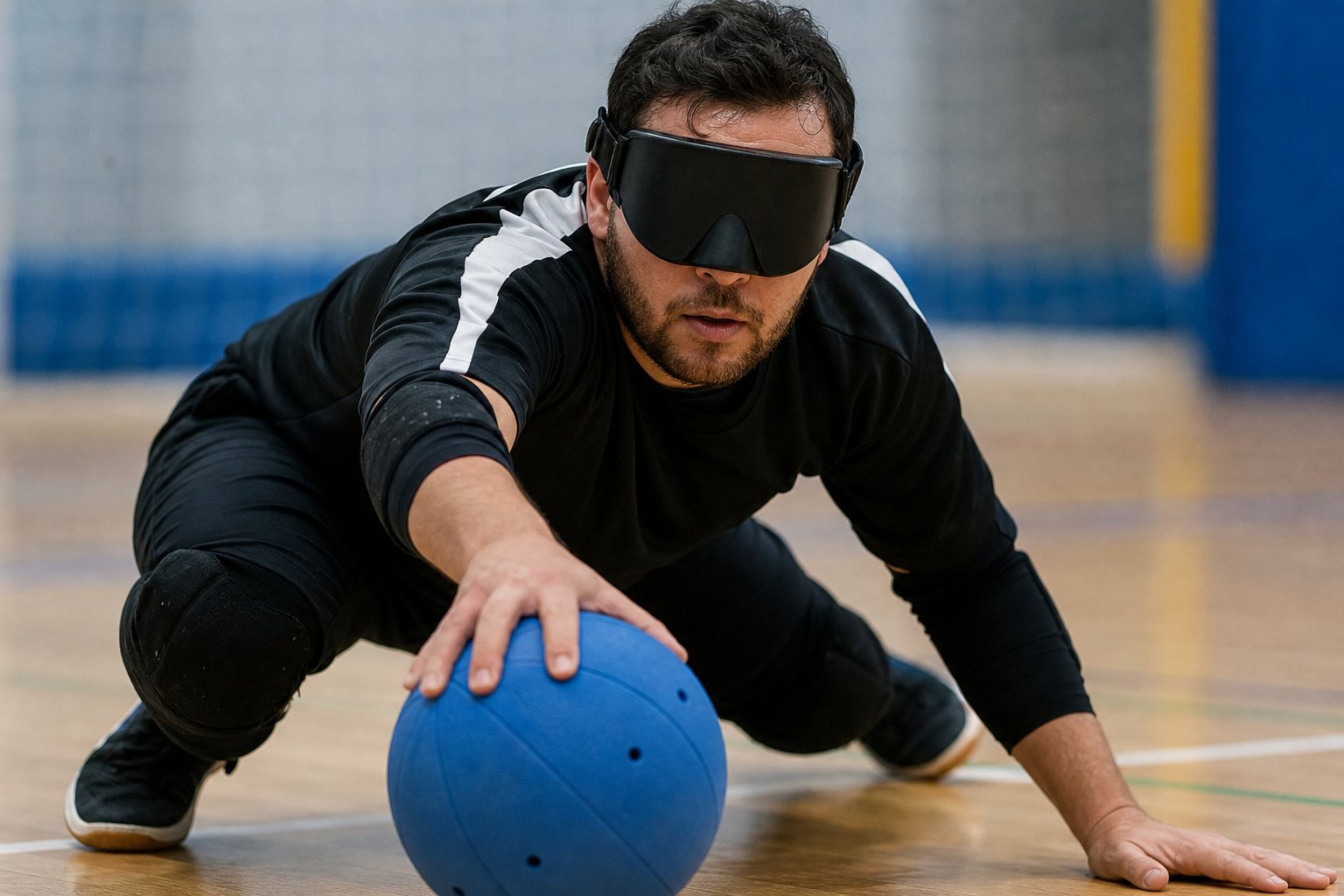
Eighteen metres of taped court, a crowd told to stay silent, and six athletes in blackout eyeshades listening for the jingle of a ball. At Paris 2024, the men’s gold-medal game ended 3-3 in regulation, and Japan scored in overtime to beat Ukraine 4-3; in the women’s final, Turkiye beat Israel 8-3 for a third straight Paralympic title. Goalball is a team sport for athletes who are blind or have low vision, in which you roll a ball with bells inside it into the other team’s goal, and it is one of two Paralympic sports (with boccia) that have no Olympic counterpart.
Goalball guides: what do you need?
New to goalball? Start with the first card. Everything here is general education, not medical advice.
History & Origins of Goalball
Goalball was devised in 1946 by Hanz Lorenzen of Austria and Sepp Reindle of Germany as a rehabilitation activity for veterans blinded in the Second World War (IBSA). It was built around sound rather than sight: a ball with bells inside, played in a hall where everyone listens. Goalball was shown as a demonstration sport at the 1972 Paralympic Games in Heidelberg and became a medal sport at Toronto 1976, with men’s teams only. Austria won that first Paralympic title, beating West Germany 4-2 (IBSA).
The sport grew with the International Blind Sports Federation (IBSA), founded in 1981, which took over its governance. Women played at the 1982 World Championships in Indianapolis and joined the Paralympic programme in 1984 in New York. Goalball has no Olympic counterpart: it is one of only two Paralympic sports, with boccia, that do not. Spellings of the founders’ names vary between sources (Hanz or Hans, Reindle or Reindl); we follow IBSA’s.
- 1946: Goalball is devised by Hanz Lorenzen (Austria) and Sepp Reindle (Germany) for blinded war veterans.
- 1972: Demonstration sport at the Heidelberg Paralympic Games.
- 1976: Medal sport at the Toronto Paralympics, men only; Austria wins.
- 1978: First World Championships, in Vöcklamarkt, Austria, men only.
- 1981: IBSA is founded and takes over the sport’s governance.
- 1982: Women first compete at the World Championships (Indianapolis); the USA wins.
- 1983: First European Championships, in Greve, Denmark.
- 1984: Women’s goalball joins the Paralympic Games in New York.
- 2026: First World Championships held in China, in Hangzhou.
Legends of the Sport
Para-athletes from different eras, not ranked. The founders, Lorenzen and Reindle, are covered in the history above.
- Sevda Altunoluk (Türkiye): the only woman to win three Paralympic goalball golds (2016, 2020, 2024); she threw four of Türkiye’s eight goals in the Paris 2024 final (Paralympic.org).
- Leomon Moreno (Brazil): class B1 player who won Paralympic gold at Tokyo 2020 with Brazil’s men, plus world titles in 2014, 2018 and 2022 (Paralympic.org, IBSA records).
- Asya Miller (USA): Paralympic goalball medallist across six Games, including gold at Beijing 2008 and silver at Tokyo 2020.
- Lisa Czechowski (USA): Miller’s long-time teammate, gold at Beijing 2008 and silver at Tokyo 2020, in her sixth Paralympics there.
- Tyler Merren (USA): Paralympic silver medallist with the US men at Rio 2016, with world championship medals in 2003, 2006 and 2014.
Official results and records
We only list champions and records here after checking them on the official source. For the latest results, go to:
How we keep this current: we re-check facts after each major championship and update this page. Spot an error? See our editorial policy.
This page explains the rules, the classes, how to find a team, and what the injury research shows. It is general information, not medical advice. Athletes with eye conditions should ask their eye-care provider and doctor about any contact or impact sport before starting.
Goalball at a glance
| What it is | A three-against-three court sport in which teams throw a ball with bells inside along the floor, trying to score in a goal that spans the whole end of the court while the defenders block with their bodies. |
|---|---|
| How you win | Score more goals than the other team. A game is 24 minutes in two 12-minute halves. A tie goes to a 6-minute overtime (first goal wins), then extra throws. A 10-goal lead ends the game, according to the USOPC. |
| Court | 18 m by 9 m, divided into six 3 m areas, with taped lines that have string under them so players can feel the markings. |
| Goal and ball | Goal 9 m wide and 1.3 m high. Ball 1.25 kg (plus or minus 50 g), 75.5 to 78.5 cm around, with two bells. |
| Players | Six per team, three on court at a time (centre, left wing, right wing). Everyone wears eyeshades, whatever their sport class. |
| Who | Athletes who are legally blind, in classes B1, B2 and B3. Men’s and women’s teams. |
| Governing body | IBSA (International Blind Sports Federation) worldwide; the United States Association of Blind Athletes (USABA) in the US. |
| Paralympics | Men since Toronto 1976, women since 1984; confirmed for LA28 with two events and eight teams in each. |
How goalball works
One player throws, rolling or bouncing the ball low toward the far goal, and the other team’s three players dive to the floor to block it with their bodies. After a block, the defenders become attackers. Elite throwers send the ball faster than 40 miles per hour, according to the USOPC, with straight shots, skip shots and spin that bends the path, and a team typically makes 90 to 100 throws in a regulation game.
Because the game is played by sound, spectators have to be silent while the ball is in play, and they cheer after a goal or stoppage. The main rules in the IBSA rulebook keep play flowing and fair:
- Ten seconds: a team has 10 seconds from the first defensive contact to get the ball across the centre line.
- High ball and long ball: a throw must bounce on the court at least once on or before the high-ball line (6 m) in front of the thrower, and at least once in the neutral area, or the thrower is penalised.
- Eyeshades: intentionally touching your own or another player’s eyeshades without the referee’s permission is a penalty.
- Penalty throws: after a penalty, the penalised team’s player defends alone against one shot, per the USOPC.
Classes and eyeshades
International goalball athletes must be legally blind and officially classified in one of three classes: B1 (totally blind), B2 and B3. The IPC’s guide says international players have less than 10 per cent vision. Because the classes differ in how much sight an athlete has, everyone on the court wears opaque eyeshades the entire time, which puts all athletes on an equal footing. At IPC and IBSA championships, players’ eyes are also covered with gauze patches under the eyeshades, and players may not wear eyeglasses or contact lenses.
Who plays it and at what level
Goalball was invented in 1946 by Hans Lorenzen of Austria and Sepp Reindle of Germany to help rehabilitate veterans who lost their sight in the Second World War. It was a demonstration sport at Heidelberg 1972, a medal sport for men at Toronto 1976, and a women’s event was added in 1984. It is now played in over 120 countries, according to the USOPC.
- Starting out: the USOPC suggests connecting with a local adaptive sports organisation or a USABA goalball club; USABA keeps a club list at usaba.org.
- Youth: USABA has run goalball development camps and a youth national team programme. Youth World Championship entries required an IBSA medical diagnosis form or an ophthalmologist’s documentation. Confirm current dates with USABA.
- National and international: USABA is the national governing body. IBSA runs the world championships every four years, between Paralympic Games.
We could not confirm a school or college goalball league in the US, so we don’t list one.
Paralympic status, edition by edition
Goalball has been on every Paralympic programme since Toronto 1976. At Paris 2024, Japan won the men’s tournament (4-3 over Ukraine in overtime, with Brazil taking bronze) and Turkiye won the women’s (8-3 over Israel, with China taking bronze). The IPC’s LA28 programme (15 to 27 August 2028) confirms two medal events with eight teams and 96 athlete places across both. For anything later, check the official programme for the current Games.
Physical demands
Defenders dive to the ground to block the ball, and attackers throw with a bowling-style motion, according to the IPC and USOPC. Goalball athletes describe it as the only full-contact team sport for blind and visually impaired athletes. We did not find a published breakdown of the sport’s energy systems or strength demands, so we avoid guessing figures.
Health and safety for goalball
Injuries are mostly of the bump, scrape and joint-strain kind, and they cluster in the arms and hands.
- European Championship survey: of 43 players, 44% reported injuries, and 92% of those were in the upper limbs. The most common problems were skin abrasions, bruises and dislocations. For 23%, the injury meant more than a month away from training.
- Paralympic Games: a mixed-method study found the goalball injury incidence fell from 19.5 per 1,000 athlete days at London 2012 to 5.6 at Rio 2016. Acute traumatic injuries were most common at both Games, female athletes reported more than males, and causes included collisions, overuse and poor physical conditioning. The authors linked the drop to equipment, environment and preparation, which suggests those are places to look for safer practice.
- Rules that protect players: the IBSA rulebook calls for a smooth wood, plastic or synthetic floor, limits padding to no more than 10 cm from the body, and requires that any head padding not interfere with the eyeshades. The USOPC lists elbow pads and knee pads among the equipment needed.
- Head impacts: the Concussion in Para Sport Group says concussion is common in para athletes and that return to sport is decided case by case. CDC HEADS UP: anyone who may have a concussion stops playing and sees a healthcare provider before returning.
See a doctor, physical therapist or athletic trainer for pain that doesn’t settle.
Training, recovery and nutrition pointers
Goalball skills are best learned with a coach: throwing mechanics, orientation using the string lines, defensive positioning and communication. Given where injuries land, a warm-up for the shoulders, wrists, hips and knees is worthwhile. Goalball has no parent sport page on this site; for general ideas, see our recovery tools guide and electrolyte guide. Supplements follow the rule used across this site: check with a doctor or dietitian first, and look for third-party testing for sport.
Gear
- The ball: built to the IBSA specification (1.25 kg, two bells, 75.5 to 78.5 cm around). Check which ball your league or club uses.
- Eyeshades: opaque and secure. At IPC and IBSA events, the technical delegate controls the eyeshades and patches; for practice, ask your coach or USABA club.
- Padding: elbow and knee pads (USOPC). The IBSA rulebook says padding may not extend more than 10 cm from the body, so check the rules before buying competition gear.
- Court: tape with string underneath, a smooth floor, and goals 9 m wide.
For a practice-level starting point, the Mizuno LR6 is a low-rise volleyball knee pad (we have not confirmed it meets any goalball standard, so ask your coach first), and a THERABAND resistance band kit suits the light shoulder work a clinician may suggest. We list no elbow pad because we haven’t verified one.

Mizuno LR6 Volleyball Kneepad
- Low-rise, no-fold design
- Kneecap and side protection
- Volleyball pad, not goalball-certified
$29.99 at Amazon, as of Nov 17, 2026 01:07 UTC
Check price on Amazon
THERABAND Resistance Band Beginner Kit
- 3 latex bands
- Yellow, red, green
- For light strength work
$11.99 at Amazon, as of Nov 17, 2026 01:07 UTC
Check price on AmazonRelated sports and disciplines
- Blind football: another Paralympic sport for blind and visually impaired athletes, played with a ball with bells.
- Boccia: the other Paralympic sport with no Olympic counterpart.
- Sitting volleyball and wheelchair rugby: more Paralympic team sports.
- Para athletics and para swimming, for individual sport.
Goalball FAQs
How do goalball players know where the ball is?
By sound. The ball has two bells, the court lines are marked with tape over string so players can feel them, and everyone but the players and officials stays quiet while the ball is in play.
Do all players wear eyeshades?
Yes. Opaque eyeshades are worn by everyone on the court at all times in play, whatever their class, so no athlete has an advantage from remaining sight. Eyeglasses and contact lenses are not allowed.
How long is a goalball game?
24 minutes, in two 12-minute halves. If the score is tied, there is a 6-minute overtime where the first goal wins, and then extra throws if needed.
Is goalball in the Paralympics?
Yes. It has been in every Paralympics since Toronto 1976 and is confirmed for LA28. Check the official programme for the current Games.
Where can I try goalball?
Start with a local USABA goalball club or an adaptive sports organisation near you. USABA’s website lists clubs and youth opportunities.
Sources
- IBSA: Goalball Rules and Regulations 2025 (copy hosted by the Japan Goalball Association)
- IPC: Introduction to goalball
- IPC: LA28 medal event programme and athlete quotas
- USOPC: Sport overview, goalball
- United States Association of Blind Athletes
- Prevalence of injuries and traumas in elite goalball players (PubMed)
- Mechanisms of sports injuries in Paralympic goalball (PubMed)
- Concussion in para sport: position statement (PubMed)
- CDC HEADS UP
Keep exploring: the boccia guide, the blind football guide, our recovery tools guide, and every other sport on our sports hub.