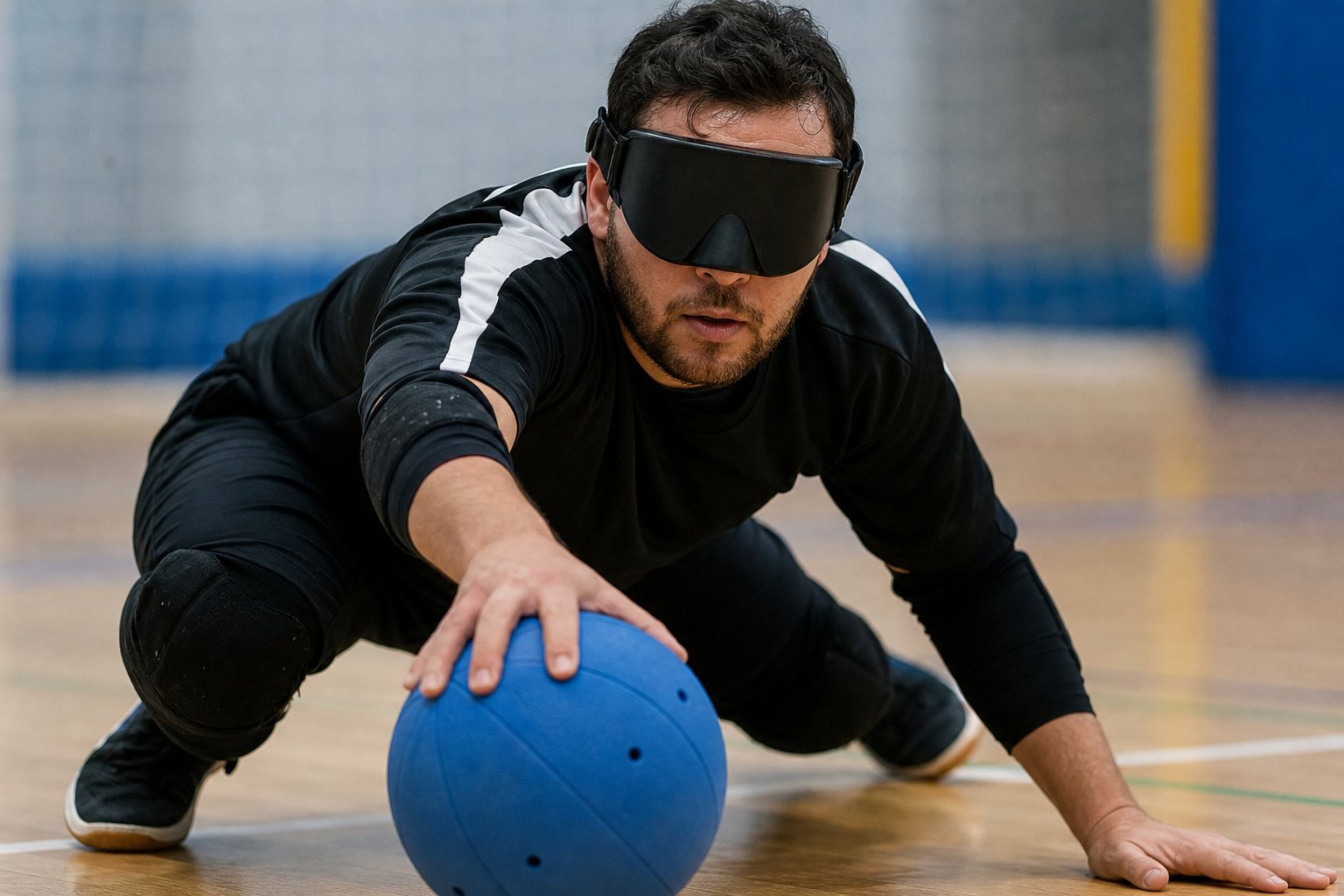
The ball hits a forearm with a crack you can hear across the gym, the defender rolls over, flexes her hand, and waves to the referee for a medical time-out. Most goalball injuries are less dramatic than that, bruises and scrapes on the arms and hips, but a few are serious. Goalball injuries are the strains, sprains, dislocations, abrasions and head blows that come with blocking a 1.25 kg ball with your body, and this page sets out what the published studies found, in plain words.
Quick answer: In a survey of 43 players at a European Championship, 44% had been injured, 92% of those injuries were in the arms and hands, and the commonest were skin abrasions, bruises and dislocations. Paralympic Games data showed far fewer injuries at Rio 2016 than at London 2012. Head blows can cause concussion, and anyone with symptoms should stop and see a health professional. We describe patterns only; a doctor, physical therapist or athletic trainer diagnoses and manages injuries.
General information, not medical advice. To lower your risk, see the injury prevention page. Everything starts at the goalball hub.
What the surveillance numbers say
The most detailed player survey so far (Zwierzchowska and colleagues, International Journal of Environmental Research and Public Health, 2020) covered 43 players, 24 women and 19 men, at the Goalball European Championship. Forty-four percent reported injuries, and 92% of those affected the upper limbs. Epidermal abrasions, contusions and dislocations were the most common traumas. For 23% of the injured, training was interrupted for more than a month, and for 43% for less than a month.
The authors found that playing position did not change how common injuries were, that body mass had a moderate effect, and that with more age and experience, abrasions and bruises became less common while sprains and dislocations became more common. It is a questionnaire from one tournament, so it shows patterns, not rates.
At Paralympic Games, Rebai and colleagues (American Journal of Physical Medicine and Rehabilitation, 2023) analysed goalball injury data from London 2012 and Rio 2016. The incidence was 19.5 per 1,000 athlete days in 2012 (95% confidence interval 12.5 to 26.5) and 5.6 in 2016 (1.7 to 9.5). Acute traumatic injuries were most common at both Games and women reported more injuries than men (P = 0.05). The authors link the fall to equipment, the environment and preparations, and interviewees named collisions, overuse and poor physical conditioning as causes.
For context beyond goalball, Team USA data from Paris 2024 (Post and colleagues, BMJ Open Sport and Exercise Medicine, 2025) put Paralympic athletes at 20.5 injuries per 1,000 athlete days across all sports. That is not goalball-specific, but it shows injuries are part of elite para sport.
Head blows and concussion
Concussion is common in para athletes, according to the Concussion in Para Sport group (Weiler and colleagues, 2021), and return to sport is decided case by case. A 2024 narrative review (Teodoro and colleagues) says athletes with vision impairment may be more likely to sustain concussions than non-disabled athletes and calls for better incidence data. The 2022 Amsterdam consensus statement, published in 2023, added a focus on para athletes.
The CDC HEADS UP guidance is the plain-language rule: anyone who may have a concussion stops playing and sees a healthcare provider, and a provider decides when they return. Danger signs that need emergency care include a headache that gets worse, repeated vomiting, seizure, increasing confusion, slurred speech, weakness or numbness, or one pupil larger than the other.
General principles of rehabilitation
We found no goalball-specific rehabilitation research, so this is general guidance from the American Academy of Orthopaedic Surgeons. A sprain is a stretch or tear of a ligament, and a strain is an injury to a muscle or tendon. AAOS OrthoInfo describes initial care for soft-tissue injuries as rest, ice, compression and elevation, says physical therapy is part of sprain treatment, and describes exercises to restore motion after the first phase. It says to contact a doctor if symptoms persist, and that severe sprains or instability need professional evaluation.
- Stop and get it checked. Pain that stays in one spot, a joint that feels loose, or swelling that does not settle deserves a professional look.
- Do not self-diagnose a dislocation. If a finger, wrist or shoulder looks out of place, stop play and get urgent care.
- Follow the plan you are given. A physical therapist or sports medicine doctor can set the steps back to training for your injury.
- Expect it to vary. In the European survey, time away ranged from under a month for 43% to over a month for 23% of the injured. There is no universal recovery time.
Skin, overuse and everyday soreness
Because abrasions and contusions are the most common traumas in the European survey, skin and bruise care come up often; keep cuts clean and covered and ask a clinician about anything that looks infected or keeps reopening. Overuse is named in the Paralympic interviews, which fits a sport of repeated throws. Our recovery page explains soreness versus injury.
When to see a professional
See a sports medicine doctor, physical therapist or athletic trainer for pain that lasts beyond a few days, pain in the same place every session, weakness, numbness, locking or swelling. Return-to-play clearance after an injury or a head blow is a clinician’s decision, not ours, and not one a coach or teammate should make alone.
Goalball injuries: FAQs
What are the most common goalball injuries?
In a 2020 survey of 43 European Championship players, skin abrasions, bruises and dislocations were most common, and 92% of injuries were in the upper limbs.
Do goalball players get concussions?
They can. The Concussion in Para Sport group says concussion is common in para athletes, and a 2024 review says athletes with vision impairment may be at higher risk. Stop and see a healthcare provider if you suspect one.
How long does a goalball injury take to heal?
It depends on the injury and the person. In the European survey, training stopped for more than a month for 23% of the injured. A clinician can give you an individual timeline.
Are goalball injuries more common in women?
The Paralympic study (Rebai and colleagues) found women reported a higher rate than men, with a P value of 0.05. It is one study and does not explain why.
Why did injuries fall between London 2012 and Rio 2016?
The researchers linked the drop to equipment, the environment and preparation, which suggests those are places to look for safer practice, but they did not prove which change mattered most.
Sources
- Zwierzchowska et al., injuries and traumas in elite goalball players, Int J Environ Res Public Health 2020
- Rebai et al., mechanisms of sports injuries in Paralympic goalball, Am J Phys Med Rehabil 2023
- Post et al., injury and illness patterns among Team USA at Paris 2024, BMJ Open Sport Exerc Med 2025
- Weiler et al., concussion in para sport: position statement of the CIPS Group, Br J Sports Med 2021
- Teodoro et al., concussion incidence in para sport for athletes with vision impairment: narrative review, Healthcare 2024
- Patricios et al., consensus statement on concussion in sport, Amsterdam 2022, Br J Sports Med 2023
- CDC HEADS UP, signs and symptoms
- AAOS OrthoInfo, sprains, strains and other soft tissue injuries
- USOPC, Sport overview: goalball
General information for education only, not medical advice. It does not replace a visit with a doctor, physical therapist or athletic trainer. See how we write and check our pages in our editorial policy.