This article contains affiliate links: if you buy through them we may earn a commission, at no extra cost to you. Read our affiliate disclosure.
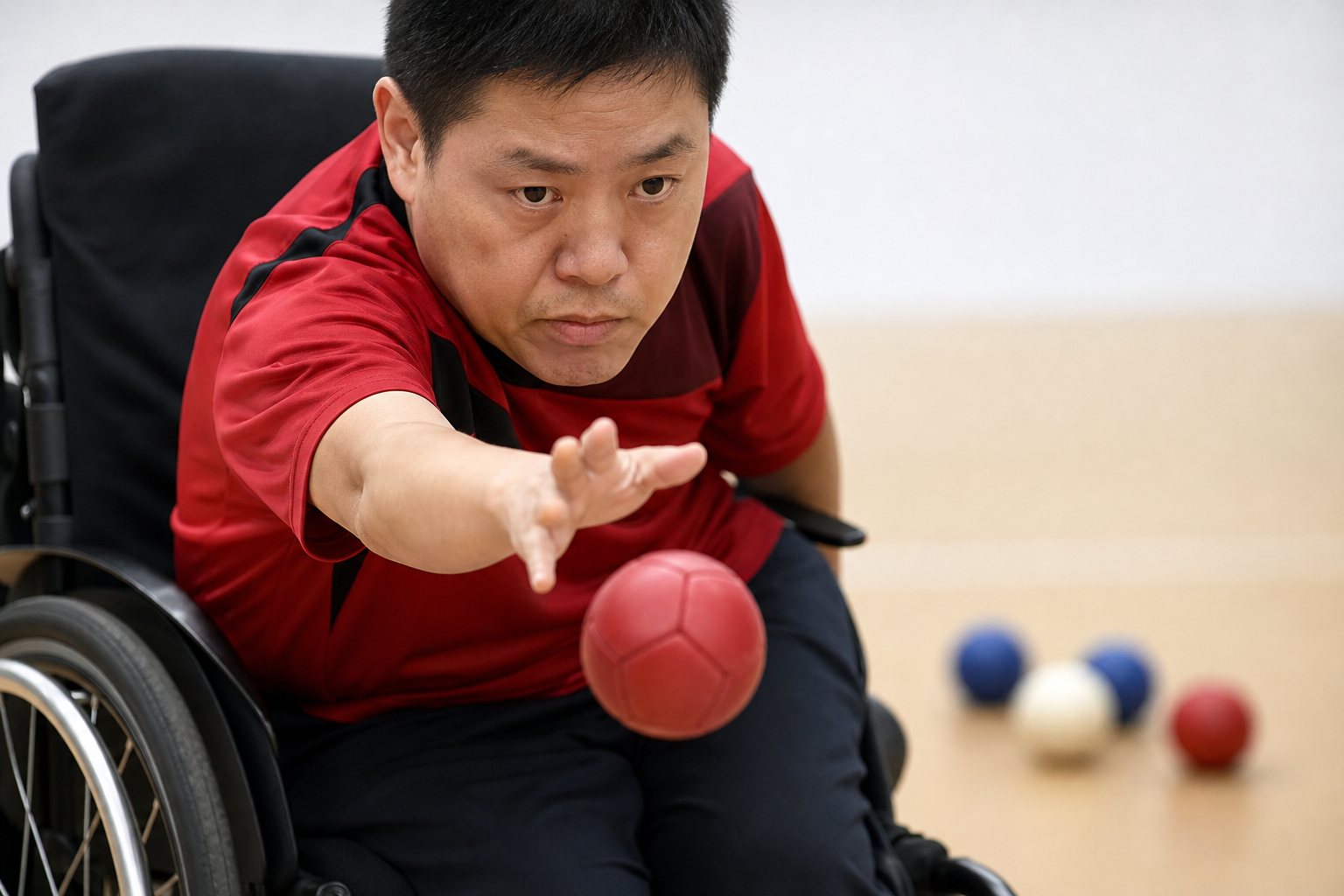
At Paris 2024, China won the mixed team BC1/BC2 gold ahead of Indonesia, who were making their Paralympic boccia debut and still took silver, with Japan third. Boccia is a precision target sport played seated by athletes with impairments that affect movement, and it is open to people who throw, kick or use a ramp to send the ball.
Boccia guides: what do you need?
New to boccia? Start with the first card. Everything here is general education, not medical advice.
History & Origins of Boccia
Boccia is a seated precision-ball sport related to bocce and other traditional ball-and-target games, which have long histories in several countries; no single origin story is settled, so we do not name one. The modern sport was designed for people with cerebral palsy and later opened to athletes with other impairments that affect movement. Competitive boccia first appeared at the Paralympic Games in 1984, and it is one of two Paralympic sports, with goalball, that have no Olympic counterpart (Paralympic.org).
Since then boccia has grown from a handful of nations to a global sport. The Boccia International Sports Federation (BISFed, now branded World Boccia) has governed the sport since 2013 and runs the World Championships, World Boccia Cups and the qualification path for the Paralympics. The Paralympic programme itself changed between Tokyo and Paris: Tokyo 2020 held seven events, while Paris 2024 split the individual events by gender and played 11 medal events, the same number planned for Los Angeles 2028. Our boccia page explains the BC1 to BC4 classes and how a match works.
- 1984: Boccia is played at the Paralympic Games for the first time (New York and Stoke Mandeville).
- 2013: BISFed becomes the sport’s international federation.
- 2014: World Championships in Beijing.
- 2018: World Championships (host listed as Liverpool in World Boccia’s archive file name; not confirmed).
- 2021: Tokyo 2020 Paralympics (held in 2021): seven mixed events.
- 2022: World Championships in Rio de Janeiro.
- 2024: Paris Paralympics: 11 events; Indonesia debuts in Paralympic boccia and wins silver in the mixed team.
- 2026: World Boccia confirms Zagreb and Astana as the two LA 2028 qualification tournaments.
Source: World Boccia; Paralympic.org Paris 2024 results.
Recent Champions
Scope: this list covers the gold medallists at the two latest Paralympic Games (Tokyo 2020 and Paris 2024), the sport’s main championship. It does not cover World Championships, World Boccia Cups or regional games. All athletes are para athletes.
Paris 2024 (29 August to 5 September)
| Event | Men | Women |
|---|---|---|
| Individual BC1 | John Loung (Hong Kong) | Aurélie Aubert (France) |
| Individual BC2 | Worawut Saengampa (Thailand) | Cristina Gonçalves (Portugal) |
| Individual BC3 | Jeong Ho-won (South Korea) | Ho Yuen Kei (Hong Kong) |
| Individual BC4 | Stephen McGuire (Great Britain) | Lin Ximei (China) |
- Mixed pairs BC3: Hong Kong (Ho Yuen Kei and Tse Tak Wah).
- Mixed pairs BC4: Colombia (Edilson Chica and Leidy Chica).
- Mixed team BC1/BC2: China (Yan Zhiqiang, Zhang Qi, Lan Zhijian).
Source: Paralympic.org Paris 2024 boccia results.
Tokyo 2020 (held 2021), mixed events
- Individual BC1: David Smith (Great Britain). BC2: Hidetaka Sugimura (Japan). BC3: Adam Peška (Czech Republic). BC4: Samuel Andrejčík (Slovakia).
- Pairs BC3: South Korea. Pairs BC4: Slovakia.
- Team BC1/BC2: Thailand.
Source: Paralympic.org Tokyo 2020 boccia results; the winners were read from a secondary summary and should be rechecked there.
Results verified through November 13, 2026. The latest completed Paralympic Games is Paris 2024; the next is Los Angeles 2028. We did not verify the 2022 World Championships winners, and no 2026 World Championships appears on World Boccia’s archive. The most recent event on World Boccia’s news page is the São Paulo World Boccia Cup, which began on November 6, 2026 and is outside this list.
Records & Milestones
Boccia scores points per end rather than times or distances, so there are no comparable world records. We list Paralympic milestones from the results above instead.
| Milestone | Who | Detail | Body |
|---|---|---|---|
| Most golds in the sport at Paris 2024 | Hong Kong | Three golds (John Loung, Ho Yuen Kei, and the BC3 pair) and two silvers | IPC |
| First Paralympic boccia medal for Indonesia | Indonesia | Silver in the mixed team BC1/BC2 on debut, Paris 2024 | IPC |
| Gold at both Tokyo and Paris | Worawut Saengampa (THA) | Team gold in 2020, individual BC2 gold in 2024 | IPC |
| Gold at both Tokyo and Paris | Jeong Ho-won (KOR) | BC3 pairs gold in 2020, individual BC3 gold in 2024 | IPC |
Source: Paralympic.org results; medal-table counts were read from a secondary summary. Records verified through November 13, 2026.
Legends of the Sport
Para athletes from recent Paralympic cycles, not ranked.
- Worawut Saengampa (Thailand): Tokyo 2020 team gold and Paris 2024 individual BC2 gold.
- Jeong Ho-won (South Korea): Tokyo 2020 BC3 pairs gold, Paris 2024 individual BC3 gold and pairs silver.
- Samuel Andrejčík (Slovakia): Tokyo 2020 gold in both BC4 individual and BC4 pairs.
- Ho Yuen Kei (Hong Kong): Paris 2024 women’s individual BC3 and mixed pairs BC3 gold.
- Edilson Chica and Leidy Chica (Colombia): won mixed pairs BC4 gold at Paris 2024; Edilson also took men’s BC4 silver.
- Stephen McGuire (Great Britain): Paris 2024 men’s individual BC4 champion.
- Aurélie Aubert (France): Paris 2024 women’s individual BC1 champion.
- John Loung (Hong Kong): Paris 2024 men’s individual BC1 champion.
How we keep this current: we re-check results after each major championship and update the date above. Spot an error? See our editorial policy.
This page covers how a match works, what the BC1 to BC4 classes mean, how to get started, and what to know about health and safety. It is general information, not medical advice; for personal questions, see a doctor, physical therapist or athletic trainer who works with para athletes.
Boccia at a glance
| What it is | A target sport played indoors on a flat, smooth surface. Athletes throw, kick or use an assistive device to place leather balls as close as possible to a white target ball, the jack. |
|---|---|
| How you score | After each end, the side with the ball closest to the jack scores one point for every ball closer than the opponent’s nearest. The higher total after all ends wins. |
| Format | Individual (4 ends, 6 balls each), pairs (4 ends, 3 balls each) or teams of three (6 ends, 2 balls each). |
| Balls | Six red, six blue and one white jack per set. |
| Players | Athletes with impairments that affect motor skills, originally designed for people with cerebral palsy. Classes BC1, BC2, BC3 and BC4. |
| Governing body | BISFed (Boccia International Sports Federation, running World Boccia) worldwide; USA Boccia in the US. |
| Paralympics | Paralympic sport since New York 1984; confirmed for LA28 with 11 medal events. Boccia and goalball are the only Paralympic sports with no Olympic counterpart. |
How boccia works
One side plays red and the other blue. The red side throws the jack first, then the same player throws the first coloured ball and tries to get close to it. The opponent throws next and keeps throwing until a ball of theirs is closer to the jack. From then on, the side whose ball is not closest has to throw, until every ball is played. Players throw, kick (BC1) or, in BC3, use an assistive device such as a ramp with an assistant, as the class descriptions below explain. The balls are leather with plastic granules inside, so they roll but don’t bounce, according to Boccia UK.
Each throw is timed. The USOPC lists the time per end: five minutes for BC1, four for BC2 and BC4, six for BC3 and for teams, seven for BC3 pairs and five for BC4 pairs. Matches are played indoors; the international court is 12.5 m by 6 m.
The four classes in plain words
Classes make sure athletes compete against others with a similar effect of impairment on the sport. Each athlete is assessed individually, with physical, technical and observation parts, and results place them in one of four classes.
- BC1: players propel the ball with the hand or foot. They may have an assistant outside the playing box who steadies or adjusts the chair and hands over the ball when asked.
- BC2: players throw the ball by hand and play without an assistant.
- BC3: players have very severe movement limits in all four limbs, with no sustained grasp or release, so they use an assistive device such as a ramp. They may compete with an assistant who sits with their back to the court and eyes averted from play.
- BC4: players have a severe movement impairment in all four limbs from causes other than cerebral palsy (Boccia UK gives muscular dystrophy and tetraplegia as examples), and can throw the ball onto the court without help.
In the Paralympic format, BC1 and BC2 athletes play individual events and form the three-player teams (with at least one BC1, according to Boccia UK), while BC3 and BC4 athletes play individually and in pairs.
Who plays it and at what level
Boccia was designed for people with cerebral palsy and was played for years as a leisure activity before becoming a competitive Paralympic sport in New York in 1984. Today it welcomes athletes with a range of impairments that affect motor skills.
- Starting out: the USOPC suggests connecting with a local adaptive sports organisation that offers boccia or a local boccia club; find one at uspara.us/findaclub. USA Boccia (usaboccia.org) handles membership and tournaments for athletes, coaches, sport assistants and referees.
- Youth, school and college: we could not confirm a national youth, school or college programme, so ask USA Boccia or your nearest club.
- Competition: once an athlete wants to compete regionally or nationally, national classification is required, according to the USOPC.
- International: BISFed runs World Boccia events, such as the World Boccia Cup, which included athletes from 26 nations in its 2026 Sao Paulo edition.
Paralympic status, edition by edition
Boccia debuted at New York 1984 and has been contested since. Rio 2016 had seven mixed-gender medal events. At Paris 2024 the winners included Loung John of Hong Kong (men’s individual BC1), Worawut Saengampa of Thailand (men’s individual BC2) and China in the mixed team BC1/BC2. The IPC’s LA28 programme (15 to 27 August 2028) confirms 11 medal events (four men’s, four women’s and three mixed or open) with 128 athlete places. For anything later, check the official programme for the current Games.
Physical demands
The USOPC says boccia tests coordination, accuracy, concentration and the ability to strategise. The sport is not a high-impact one. A 2026 study of 11 Paralympic boccia players (six with cerebral palsy) tested whether mental fatigue reduced accuracy at 3, 6 and 9 metres and found no significant effect. A small 2025 study of five world-class BC2 players with cerebral palsy found some had bone mineral density below the range expected for their age and suggested that close monitoring and strength training may be worth discussing; its authors say the findings are preliminary.
Health and safety for boccia
We did not find published injury surveillance specific to boccia, so there are no sport-specific injury rates to quote, and this section sticks to general points that apply to athletes who sit for long periods or have the conditions that boccia athletes often have. Talk with your own medical team about your needs.
- Autonomic dysreflexia: athletes with spinal cord injury at T6 or above (and some at T10 or above), which can include some BC4 athletes with tetraplegia, can have a sudden, dangerous rise in blood pressure that the Christopher and Dana Reeve Foundation calls a medical emergency. Warning signs include a pounding headache, sweating, flushing and blurred vision. Coaches and assistants should know the athlete’s plan; the foundation’s guidance is to sit upright, loosen anything tight, check for triggers and call 911 if blood pressure stays high or no trigger is found.
- Temperature: a review of athletes with spinal cord injury notes that those with tetraplegia have a greater risk of heat illness than those with lower-level injuries, because of reduced sweating and blood-vessel control below the injury. Keep drinks within reach and watch the room temperature.
- Head impacts: the Concussion in Para Sport Group says concussion is common in para athletes and that return to sport is decided case by case. CDC HEADS UP: anyone who may have a concussion stops playing and sees a healthcare provider before going back.
- Assistants: in BC1 and BC3 the sport assistant has defined limits, such as staying outside the playing box or facing away from the court. Know the rules for your class so that help with chair positioning is safe and legal.
Training, recovery and nutrition pointers
Training is mostly practice with a coach, for example accuracy at different distances (the study above tested 3, 6 and 9 m). Off the court, a physical therapist or coach who knows your class can suggest strength, stretching and positioning work. Boccia has no parent sport on this site; for general ideas, see our recovery tools guide and electrolyte guide. Supplements follow the rule used across this site: check with a doctor or dietitian first, and look for third-party testing for sport.
Gear
- Balls and jack: a set of six red, six blue and one white jack, plus a measuring device, timing equipment, scoreboard and colour indicator (USOPC).
- Ramps and assistive devices: chutes, ramps and assistive head, arm or mouth aids are permitted (USOPC). They are fitted to the athlete and the class; get advice from a coach, therapist or occupational therapist before buying.
- Chair and seating: comfort and stable positioning matter for hours of play. We don’t recommend specific chairs or cushions.
Two simple extras for training days: a Nalgene 32 oz bottle to keep within reach, and a THERABAND resistance band kit for light shoulder and arm work that a clinician approves. Neither is boccia-specific; see our resistance band guide for more.

Nalgene Sustain 32 oz Bottle
- 32 oz, wide mouth
- BPA-free Tritan
- Easy to refill

THERABAND Resistance Band Beginner Kit
- 3 latex bands
- Yellow, red, green
- For light strength work
$11.99 at Amazon, as of Nov 17, 2026 01:07 UTC
Check price on AmazonRelated sports and disciplines
- Goalball: the other Paralympic sport with no Olympic counterpart.
- Para archery: another precision sport at the Paralympics.
- Wheelchair rugby and sitting volleyball: Paralympic team sports.
Boccia FAQs
How do you play boccia?
Players or teams take turns throwing, kicking or rolling coloured balls to land closest to a white jack. After all balls are played, a side scores a point for each ball closer than the opponent’s nearest one. Individual and pair matches last four ends; team matches last six.
Who can play boccia?
Athletes with impairments that affect motor skills. It was designed for people with cerebral palsy, and BC4 covers athletes with other conditions that affect all four limbs. International competitors are classified into BC1, BC2, BC3 or BC4.
What is the ramp used for?
BC3 athletes cannot throw or kick the ball, so they use an assistive device such as a ramp to deliver it. An assistant helps position the ramp and sits with their back to the court and eyes averted from play.
Is boccia in the Paralympics?
Yes, since New York 1984, and it is confirmed for LA28 with 11 medal events. Check the official programme for the current Games.
How do I get started in the US?
Look for a local boccia club or adaptive sports organisation at uspara.us/findaclub, and check USA Boccia for membership and tournaments. For competition, you will need national classification.
Sources
- IPC: Introduction to boccia
- USOPC: Sport overview, boccia
- Team USA: boccia classification
- Boccia UK: about boccia
- World Boccia (BISFed)
- IPC: LA28 medal event programme and athlete quotas
- Mental fatigue and accuracy in Paralympic boccia players (PubMed)
- Health-related parameters in world-class boccia players using DXA (PubMed)
- Cooling athletes with a spinal cord injury (PubMed)
- Concussion in para sport: position statement (PubMed)
- Christopher and Dana Reeve Foundation: autonomic dysreflexia
- CDC HEADS UP
Keep exploring: the goalball guide, para archery, our recovery tools guide, and every other sport on our sports hub.