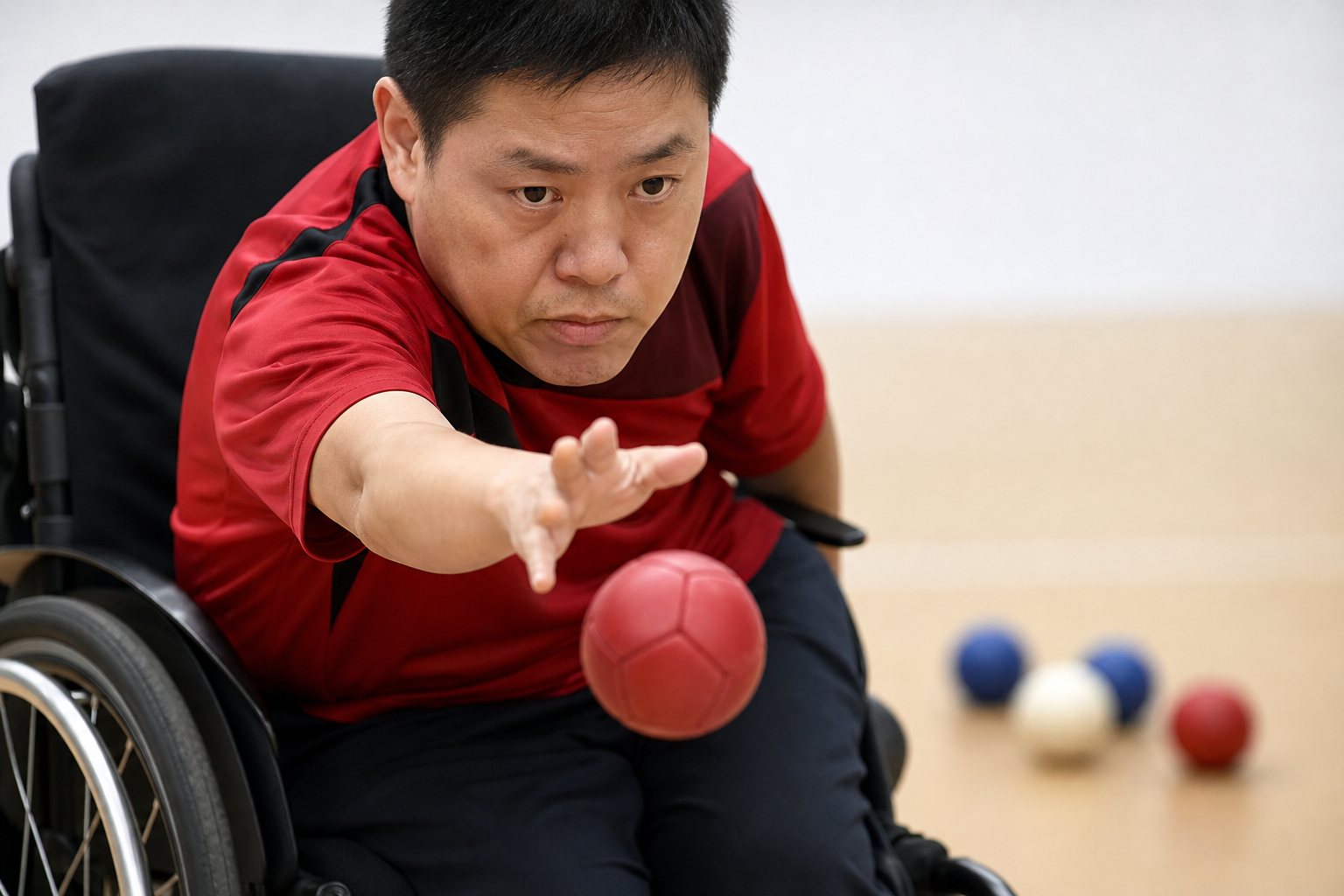
After a long season, a boccia player mentions that her shoulder has been “a bit grumpy” for weeks. Nothing dramatic happened; it just never fully settled. That is how many overuse problems show up in seated sport. This page covers the injury and health patterns that are known for boccia athletes and the wider para-sport group, general rehabilitation principles, and when to see a professional. It does not diagnose anything or tell you when it is safe to return to play.
Quick answer: We found no published injury surveillance made for boccia, so we cannot give boccia injury rates. Wider para-sport data show higher injury and illness rates in Paralympic athletes than Olympic athletes, and shoulder and upper-limb overuse is a recognised concern in wheelchair sport. After any possible concussion, stop playing and see a healthcare provider before returning (CDC HEADS UP). See a sports medicine doctor, physical therapist or athletic trainer for pain that lingers or limits play, new weakness or numbness, skin damage, or a pounding headache with sweating or flushing, which can be an emergency in some spinal cord injuries.
Back to the boccia hub. To lower your risk, see injury prevention; for rest and soreness, see recovery.
What the numbers say, and what they do not
There is no boccia-specific surveillance in the sources we could find, so any “boccia injury rate” would be invented. What does exist is broader:
- Team USA at Paris 2024: the USOPC injury and illness surveillance system covered 862 athletes, alternates and guides. Paralympic athletes had 20.5 injuries per 1,000 athlete-days versus 14.6 for Olympic athletes, and 15.7 illnesses per 1,000 athlete-days versus 8.3. Of the Paralympic injuries, 38.5% (30 of 78) happened outside sport settings, the largest single category. Respiratory illness was the most common illness at both Games. These figures are for one team in one summer and are not boccia-specific.
- Wheelchair sport: a 2026 systematic review of 22 studies, mostly wheelchair basketball, rugby and tennis, reported meaningful injury and illness burdens across para athlete groups. Boccia was not a focus.
- Upper-limb load: in a 2026 study of 30 wheelchair para-athletes across six sports, including boccia, upper-limb asymmetry in boccia players was about 30%, above the authors’ 15% threshold. The authors say asymmetry may contribute to overuse injuries but this was a cross-sectional study; it cannot show that asymmetry causes injury.
Patterns that matter for boccia athletes
Overuse in the shoulder, arm and neck
Repeated deliveries, sustained positioning and chair use put steady load on the same muscles. We do not have boccia numbers, but the asymmetry study above is why many clinicians pay attention to shoulder strength and range of motion. Early signs are soreness that lasts into the next day, a pinching pain at the end of range, or a loss of delivery consistency.
Skin and pressure injuries
For athletes who sit for long periods, pressure injuries are a recognised health concern. A 2026 scoping review of pressure-injury approaches in disability sport found only ten sources across eight sports and said the available guidance had little sport-specific evidence. Skin changes should be shown to your medical team early.
Bone health
A small 2025 study of five world-class BC2 players with cerebral palsy found some had bone mineral density below the range expected for their age. The authors call the findings preliminary. If bone health is a concern for you, a doctor can advise on testing and the right kind of loading.
Autonomic dysreflexia and heat
The Reeve Foundation calls autonomic dysreflexia a medical emergency for people with spinal cord injury at T6 or above. Warning signs include a pounding headache, sweating, flushing and blurred vision. A review of athletes with spinal cord injury also notes that those with tetraplegia have a greater risk of heat illness. These are not “injuries from boccia” but they are health risks the people around you should understand. See the plan outlined on our injury prevention page.
Falls and head impacts
Chair tips and falls can happen. The Concussion in Para Sport Group says concussion is common in para athletes and that return to sport is decided case by case. CDC HEADS UP: recognise and remove. Anyone who may have a concussion stops playing and sees a healthcare provider before going back.
General rehabilitation principles
Rehabilitation depends on the injury, the person and the impairment, so we do not give recovery times. The ideas below are general, and a clinician decides what applies to you.
- Get assessed first. A sports medicine doctor, physical therapist or athletic trainer who works with para athletes can tell an overuse strain from something that needs imaging or a different plan.
- Relative rest, not total rest. Many clinicians reduce the activity that causes pain while keeping safe movement going. Your clinician sets the limits.
- Restore balanced strength and range of motion in the shoulders, arms and trunk, as your body allows.
- Check the set-up. Seating, ramp position, assistant position and the surface can all feed an overuse problem. An occupational therapist can review them.
- Build back gradually. Return to practice in steps and tell your coach how the body responds the next day.
- Include the whole person. A 2026 qualitative study of 19 Team USA Paralympic athletes listed chronic injury management and balancing sport with work, education and family among the challenges they described. Support from coaches, family and clinicians helps; it is not a weakness to ask.
What we cannot tell you
We cannot diagnose, clear anyone to return, or say how long any injury takes. Return to play is decided by a qualified clinician who knows you.
When to see a professional
- Pain that lasts, wakes you at night or limits delivery
- New weakness, numbness, tingling or a sudden change in spasticity
- Skin that stays red, broken or blistered
- Any possible concussion
- Illness symptoms that do not clear, or fever
- Emergency: a pounding headache with sweating, flushing or blurred vision in someone with a spinal cord injury; follow their plan and call emergency services (911 in the US) if it does not resolve.
Boccia injuries FAQs
What are the most common boccia injuries?
We could not find boccia injury surveillance, so we cannot rank them. Overuse of the shoulder and arm, skin problems and health issues linked to the athlete’s condition are the main concerns raised in the wider para-sport literature.
Do Paralympic athletes get hurt more than Olympic athletes?
At Paris 2024, Team USA’s Paralympic athletes had 20.5 injuries per 1,000 athlete-days compared with 14.6 for Olympic athletes. That is one team in one Games, and boccia was not separated out.
Can I keep playing with shoulder pain?
That is a question for your clinician, who can look at your shoulder and your delivery. Do not push through pain that is increasing or changing how you move.
What should I do after a fall or head hit?
Stop playing and see a healthcare provider before going back, per CDC HEADS UP.
How long will it take to recover?
There is no universal answer. It depends on the injury and the person, and your clinician is the right source.
Sources
- Injury and illness patterns among Team USA athletes at Paris 2024 (PubMed)
- Wheelchair court sports and para sport cohorts: systematic review (PubMed)
- Upper-limb asymmetry in wheelchair para-athletes (PubMed)
- Pressure injury prevention in disability sport: scoping review (PubMed)
- Health-related parameters in world-class boccia players using DXA (PubMed)
- Team USA Paralympic athletes’ experiences: qualitative study (PubMed)
- Christopher and Dana Reeve Foundation: autonomic dysreflexia
- Cooling athletes with a spinal cord injury (PubMed)
- Concussion in para sport: position statement (PubMed)
- CDC HEADS UP
General information for education only, not medical advice. It does not replace a doctor, physical therapist, athletic trainer or classifier who knows you. See our editorial policy for how we write and source our pages.