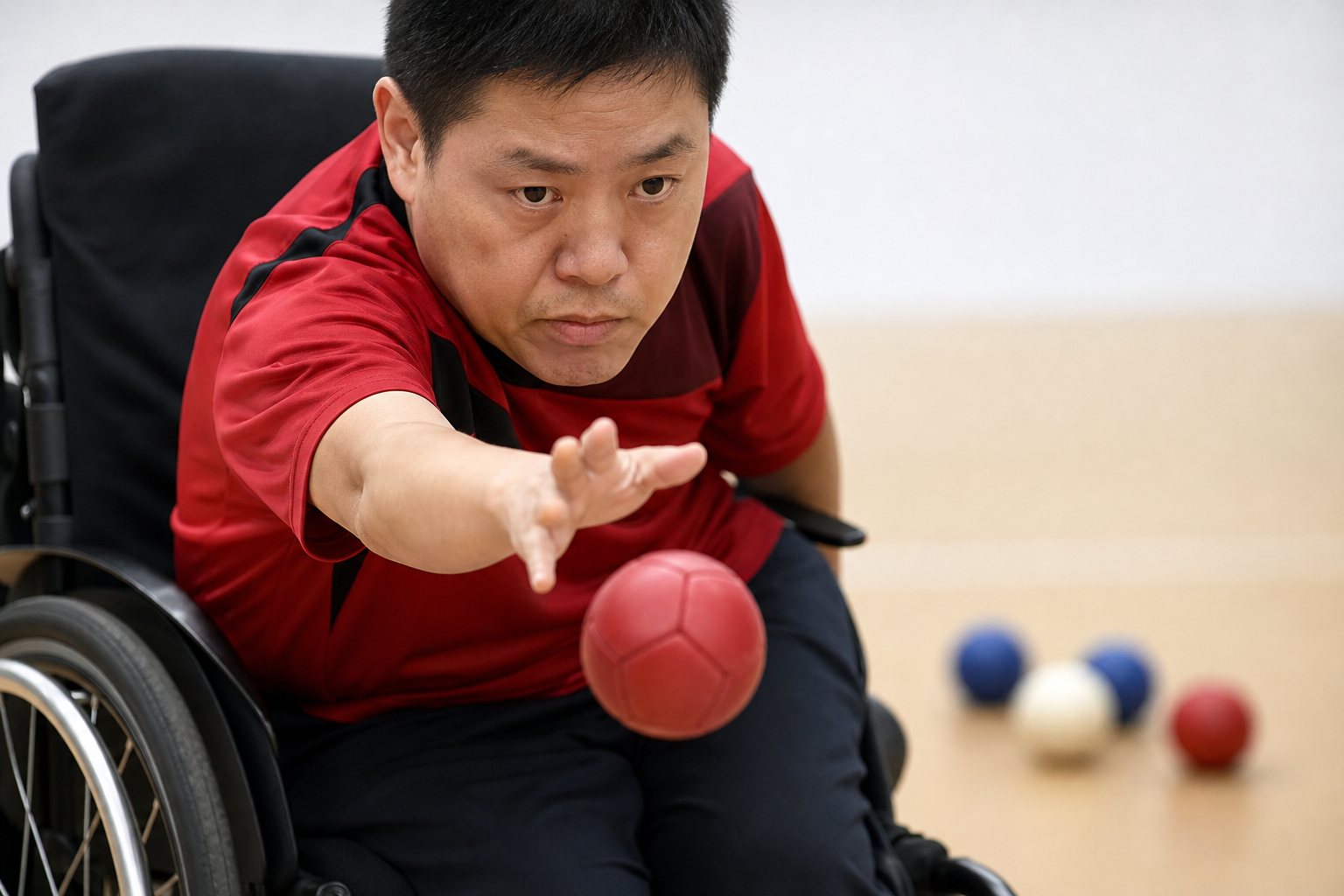
Two hours into a long tournament day, a boccia player notices the room has gotten warm, her shoulder is tight, and she has not shifted position in a while. None of it feels like an emergency, which is exactly why it is easy to miss. Injury prevention in boccia means the everyday habits and plans that lower the chance of problems for athletes who sit for long stretches, deliver a ball repeatedly and often manage conditions such as cerebral palsy or spinal cord injury. Prevention reduces risk; it cannot promise that nothing will happen.
Quick answer: Boccia is a low-impact sport, and we found no published injury surveillance specific to boccia, so there are no boccia injury rates to quote. The best-supported safety points come from wider para-sport sources: know your own medical plan (especially for autonomic dysreflexia and heat), look after your skin and seating, balance shoulder and arm load, and stop and get checked after any head impact. See a doctor, physical therapist or athletic trainer for pain that lingers, new weakness or numbness, skin that stays red, or a sudden pounding headache with sweating or flushing. Call emergency services (911 in the US) if the dysreflexia plan calls for it.
Back to the boccia hub. Details on what can go wrong are on the injuries page; this page is about lowering risk.
Know your own plan first
Boccia athletes are a mixed group, so a safety plan has to start with the individual. Ask your doctor or therapist what to watch for and write it down. Share it with your coach and sport assistant. Anyone who helps you at training or competition should know where your medications and plan are, who to call and what the early warning signs are.
Warm-up
We found no published warm-up programme made for boccia, so there is no “FIFA 11+” equivalent to quote. A general idea that many coaches use is a gradual build: easy joint movement for the shoulders, arms, neck and trunk (and legs where you use them), then a few slow practice deliveries before match pace. Ask your therapist which movements suit your range and tone, and which to avoid.
Technique and delivery
How you deliver the ball repeats hundreds of times a session, so small problems add up. A 2026 study of 30 wheelchair para-athletes found boccia players had about 30% upper-limb asymmetry (the authors set 15% as the line for asymmetry), and noted that unilateral technical demands and impairment level shape muscle adaptation. That is one small exploratory study, but it supports asking a therapist whether your technique, seating and strength work are balanced between sides, where your body allows. A coach who understands your class can also watch for compensations such as leaning, twisting or holding the breath.
Training load
Gradual progress matters, but no published rule for boccia exists, so we do not give percentages. A sensible approach is to add practice time slowly, include rest days and notice how your body feels the day after. Our training page has a general weekly structure. Sleep matters too; see the recovery page.
Strength and conditioning
A therapist can set up supporting work for the shoulders, arms and trunk. A small 2025 study of five world-class BC2 players with cerebral palsy found some had bone mineral density below the range expected for their age, and suggested that monitoring and strength training may be worth discussing; the authors say it is preliminary. Always have a clinician approve exercises if you have spasticity, a spinal cord injury or heart or blood pressure concerns.
Environment: heat, cold and the room
- Heat: a review of athletes with spinal cord injury notes that those with tetraplegia have a greater risk of heat illness than those with lower-level injuries, because of reduced sweating and blood-vessel control below the injury. Boccia is played indoors, but halls can be warm. Keep drinks within reach, watch the room temperature, and ask your medical team about cooling options. At Paris 2024, Team USA surveillance reported zero heat-related illnesses among Paralympic athletes, but that is one team in one summer and not a guarantee.
- Illness: the same Team USA study found respiratory illness was the most common illness type, affecting 7.4% of all athletes in the study. Wash hands, rest when sick and ask your doctor what to do before travel.
- Floor and chair space: the court is meant to be flat and smooth, and athletes need clear space around it. Check for cables, bags and other obstacles that could block a chair.
Skin and seating
People who sit for long hours, especially with reduced sensation, can develop pressure injuries. A 2026 scoping review found only ten sources on pressure-injury prevention in disability sport, across eight sports, and said the existing guidance drew on little sport-specific evidence. So rely on your own medical team’s plan: check skin regularly, use the cushion and positioning they recommend, and tell someone if a red area does not fade. Our gear page says why we do not recommend specific chairs or cushions.
Autonomic dysreflexia and other medical emergencies
The Christopher and Dana Reeve Foundation calls autonomic dysreflexia a medical emergency. It can affect people with spinal cord injury at T6 or above (and sometimes lower, T10 or above). Warning signs include a pounding headache, sweating, flushing and blurred vision. The foundation’s guidance is to sit upright, loosen anything tight, check for triggers and call 911 if blood pressure stays high or no cause is found. Coaches and assistants should know the athlete’s plan.
Head impacts
The Concussion in Para Sport Group says concussion is common in para athletes and that return to sport is decided case by case. CDC HEADS UP guidance is that anyone who may have a concussion stops playing and sees a healthcare provider before going back. Chair tips and falls happen in many para sports, so the rule applies to boccia too.
Equipment and fit
Ramps and assistive devices are fitted to the athlete and class. Check that they are stable, that parts are not loose, and that nothing rubs or pinches. Equipment must follow World Boccia rules for competition, so ask your coach or national federation before changing a setup. Maker claims are not safety standards; no boccia-specific equipment certification is known to us.
What prevention cannot do
Prevention lowers risk but does not remove it. Medical conditions, growth, fatigue and plain bad luck still play a part. If something hurts, stop and ask.
Boccia injury prevention FAQs
Is boccia safe?
It is a low-impact seated sport (the USOPC says it is not a high-impact sport). We found no boccia injury surveillance, so we cannot give rates. General para-sport precautions (heat, skin, head impacts, your medical plan) still apply.
What is autonomic dysreflexia?
A sudden rise in blood pressure that can follow a spinal cord injury, which the Reeve Foundation calls a medical emergency. Know the plan, and call emergency services if it is not resolved.
Should I warm up before a match?
Many athletes and coaches do some gentle joint movement and practice throws first. Ask your therapist what suits you.
Do I need protective gear?
No boccia-specific protective gear is required that we could confirm. Seating, skin protection and assistive devices should be set up with your clinician.
Who can help me build a safety plan?
A doctor, physical therapist or occupational therapist who works with para athletes, together with your coach and sport assistant.
Sources
- USOPC: Sport overview, boccia
- Upper-limb asymmetry in wheelchair para-athletes (PubMed)
- Health-related parameters in world-class boccia players using DXA (PubMed)
- Cooling athletes with a spinal cord injury (PubMed)
- Injury and illness patterns among Team USA athletes at Paris 2024 (PubMed)
- Pressure injury prevention in disability sport: scoping review (PubMed)
- Christopher and Dana Reeve Foundation: autonomic dysreflexia
- Concussion in para sport: position statement (PubMed)
- CDC HEADS UP
General information for education only, not medical advice. It does not replace a doctor, physical therapist, athletic trainer or classifier who knows you. See our editorial policy for how we write and source our pages.