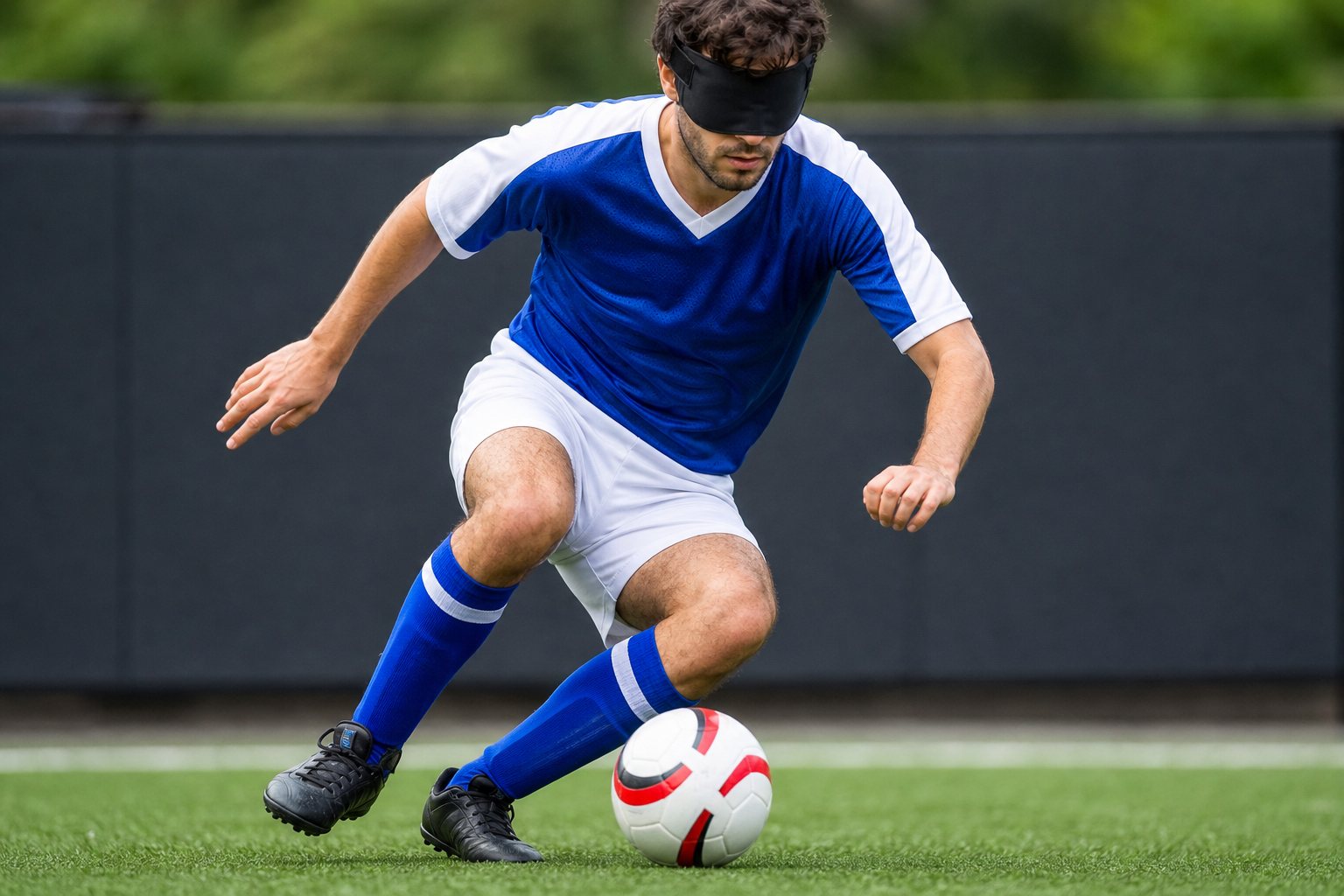
The bus leaves at seven, the first match is at nine, and breakfast is whatever the hotel put out. Tournament days in blind football can be short on sleep and long on waiting, which makes food and fluids easy to get wrong. Blind football nutrition is about eating enough, at the right times, for training and matches, and about protecting long-term athlete health. This page covers fuel and fluids, energy availability, heat, and supplements, with the cautions the sports medicine bodies give. It is general education, not a diet plan. The sport overview is in the blind football hub.
Quick answer: Most players are best served by regular meals that match training: carbohydrate for energy, protein spread across the day and fluids through the day. Eating too little for the work you do can harm health, so do not diet to change body size without a professional. Supplements are optional, can be contaminated, and anti-doping rules apply to Paralympic athletes, so talk to a doctor or registered dietitian first. See a professional for fatigue, missed periods, repeated injury or changes in eating.
Fuel for training and match days
The 2016 joint position of the American College of Sports Medicine (ACSM), the Academy of Nutrition and Dietetics and Dietitians of Canada says that carbohydrate needs depend on training volume, with more needed on hard or long days, and that athletes’ protein needs are generally about 1.2 to 2.0 grams per kilogram of body weight a day, spread through the day. A UEFA expert group statement on elite football (Collins and colleagues, British Journal of Sports Medicine, 2021) recommends a carbohydrate-rich pre-match meal about 3 to 4 hours before kick-off, built from foods the player has already tried in training, and carbohydrate and fluid after the match to refuel. Those statements are for sighted football, but the principles carry over: nothing new on match day.
A blind football match is two 20-minute halves, according to the International Blind Sports Federation (IBSA), with a half-time of up to ten minutes per Paralympic.org, which is short compared with a full football match. Many players will not need to eat during play, but tournaments with several matches in a day can. We did not find nutrition research on blind football itself, so ask a dietitian who works with para athletes.
A few practical points follow from how the sport works:
- Pack and organize food you can find easily. Use a consistent bag layout, labelled containers, and have a teammate or guide help in unfamiliar venues.
- Eat before you are hungry. Waiting-room days make it easy to skip meals.
- Keep a familiar meal for tournament mornings, such as oats, toast, rice or pasta with something salty and a drink.
- After matches, eat within a short time: carbohydrate with protein, and a drink. See recovery.
Hydration and heat
Most blind football is played on small outdoor or indoor pitches, and outdoor tournaments can be hot. The UEFA group notes that sweat rates vary widely between players and suggests avoiding fluid losses beyond about 2 to 3% of body mass; the National Athletic Trainers’ Association (NATA) position statement on exertional heat illnesses says that gradual acclimatization and hydration are central to prevention. Practically: drink through the day, check urine color as a rough guide, take a bottle to each break, and tell a coach if you feel dizzy, sick or confused in the heat. Heat illness is an emergency when someone is confused or collapses; call 911. A pitch bordered by kickboards can hold heat in, so ask for shade and extra breaks.
Energy availability and RED-S awareness
Energy availability is the energy left from food after paying for training. The International Olympic Committee (IOC) calls long-term low energy availability Relative Energy Deficiency in Sport (RED-S, also written REDs), and its 2023 consensus statement describes it as a syndrome of health and performance problems in both female and male athletes, affecting the menstrual cycle, bones, immunity and more. We found no blind football data on how common it is. That does not mean para athletes are exempt, so know the signs: missed or stopped periods, stress fractures, constant tiredness, frequent illness, unplanned weight loss, and stalled performance despite hard training. See a doctor if you notice them.
The IOC’s prevention experts recommend education and de-emphasizing body weight and leanness, and blind football is not a weight-class sport, so there is no reason for a player to cut weight for it. Coaches and parents should avoid weigh-ins and comments on bodies. If someone has an eating disorder or you are worried about someone, see a doctor or a mental-health professional. In the US, the ANAD Eating Disorders Helpline is 1-888-375-7767, and in a crisis call or text 988 (Suicide & Crisis Lifeline).
Supplements: a cautious view
Most players do not need any. The IOC’s 2018 consensus statement on dietary supplements and the high-performance athlete says supplements can help in specific situations, but that many are unnecessary, and some are contaminated; the athlete is responsible for what they take. One study cited by the UEFA group found that about 15% of 634 supplements from 13 countries contained undeclared prohormones. Under anti-doping “strict liability” rules, a positive test is the athlete’s problem even if the contamination was accidental. Third-party testing programs such as NSF Certified for Sport and Informed Sport lower the risk but do not remove it.
- Paralympic athletes are tested. National-team and international athletes can be drug tested; ask your national federation or the anti-doping agency to check any product before use.
- Look for third-party certification, and say “not certified” plainly when a product has none.
- Be careful with caffeine and stimulants. The UEFA group notes side effects of caffeine such as anxiety, nausea, insomnia and tremors. The American Academy of Pediatrics (AAP) says energy drinks have no place in the diets of children and adolescents.
- Young players: the AAP recommends against creatine in children and adolescents, and the UEFA group says general use of supplements by young players should be restricted.
- Check with a doctor or dietitian if you take medicine, have a heart or kidney condition, or are pregnant.
We do not list supplement products on this page.
Blind football nutrition FAQs
What should I eat before a match?
A carbohydrate-rich meal a few hours before, with foods you have already tried. The UEFA statement suggests 3 to 4 hours before kick-off for elite football.
Do blind football players need protein shakes?
Most can meet protein needs with food. The UEFA group says protein supplements are probably not needed for most players.
Is it safe to use supplements?
Some are fine for some people, but risks include contamination and anti-doping rules. Ask a doctor or dietitian and choose third-party tested products.
Do I need electrolyte drinks?
Water and food cover most needs for short sessions. In long, hot tournament days a dietitian may suggest more. Check labels for third-party testing.
Where can I get help with eating concerns?
Start with a doctor, who can connect you to a dietitian and a mental-health professional. In the US, ANAD’s helpline is 1-888-375-7767.
Sources
- ACSM, Academy of Nutrition and Dietetics and Dietitians of Canada: nutrition and athletic performance, 2016
- Collins et al., UEFA expert group statement on nutrition in elite football, Br J Sports Med 2021
- Mountjoy et al., IOC consensus statement on RED-S, Br J Sports Med 2023
- Torstveit et al., RED-S prevention, 2023
- IOC consensus statement: dietary supplements and the high-performance athlete, 2018
- NATA position statement: exertional heat illnesses
- AAP: sports drinks and energy drinks for children and adolescents, Pediatrics 2011
- AAP: use of performance-enhancing substances, Pediatrics 2016
- IBSA: football overview
- Paralympic.org: blind football
- 988 Suicide & Crisis Lifeline
General information for education only, not medical advice. It does not replace a visit with a doctor, physical therapist or athletic trainer. See how we write and check our pages in our editorial policy.