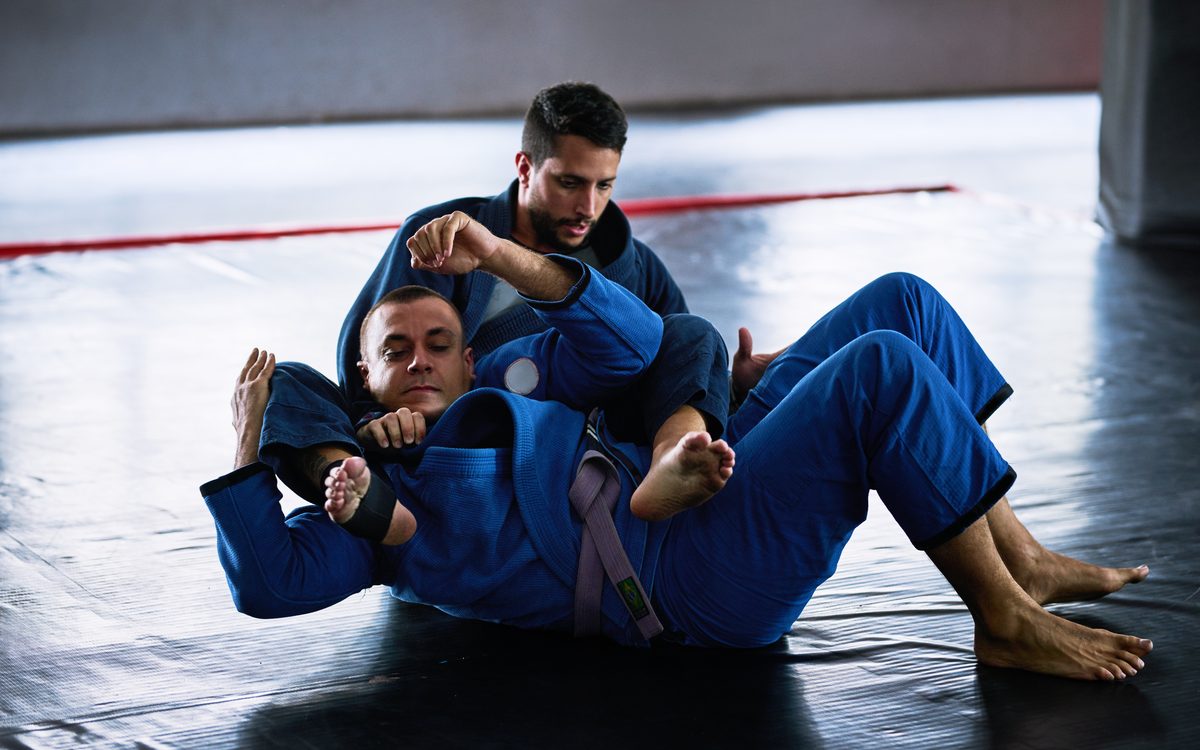
The referee says “combate,” and for a second everything in your head goes quiet, then loud. Your partner at practice never made your heart pound like this. BJJ mental training is the set of skills, focus, confidence, routines and ways of handling pressure, that help you perform as the situation gets harder. It is separate from mental health, which we cover below.
Quick answer: Pressure skills can be practised like any other: one focus cue at a time, a short pre-match routine, imagery, and goals about process, not only winning. Research in combat sports is mostly surveys, so it shows associations, not guarantees. Anxiety, depression, disordered eating or burnout are health matters for a qualified professional; in the US, call or text 988 in a crisis.
What the research can and cannot say
We found no study of a mental-training program in BJJ itself. The closest evidence is from combat sports in general. A 2025 study of 110 karate, taekwondo and judo athletes (Di Corrado and colleagues, Frontiers in Psychology) found that self-efficacy, the belief you can do the task, helped explain the link between imagery and stress. A 2026 survey of 489 combat athletes (Duyan and colleagues, Frontiers in Psychology) studied intrinsic motivation, mental toughness and wellbeing, and a 2026 study of 222 young Chinese judo athletes (Frontiers in Public Health) found that 63.5% fell into a supported and watchful profile, with lower depression and higher mental toughness. These are surveys, so they show links, not cause. A 2026 position statement of the Exercise and Sports Science Australia (Schweickle and colleagues, Sports Medicine) reviews performance under pressure in sport.
Confidence and focus
Confidence in BJJ is built from evidence: rounds survived, escapes drilled, matches finished. Keep a short training log of what went well. For focus, many coaches use one cue per drill or round, such as “hips under me” or “frames first”, rather than a list. That is common instructor practice, not a studied BJJ method. When your mind drifts to the scoreboard, a slow breath and the cue bring you back.
Motivation and goal setting
The 2026 study of 489 combat athletes looked at intrinsic motivation, meaning training for the enjoyment and the learning. A simple goal ladder is common practice: process goals (hold my frames, tap early), performance goals (escape bottom side control three times in a round) and outcome goals (win the division). Belts are results of years of mat time, and the professor decides promotions, so goals tied only to a belt date can lead to frustration.
Imagery and routines
Imagery means rehearsing a technique or match in your head. We found no study stating how large the benefit is in BJJ, so treat it as an extra, not a substitute for mat time. A pre-match routine is a short, repeatable sequence: a warm-up, a few breaths, a cue and a plan for the first grip. Keep it short so it still works when you are nervous. Our rules page helps you know the scoring plan before you step on.
Handling pressure and setbacks
A 2026 study of 379 Olympic combat sport athletes (Kacay and colleagues, Frontiers in Psychology) examined mindfulness, self-compassion and burnout. Treating a loss as information rather than a verdict is something many coaches teach. After a match, write down one thing that worked, one that did not and one drill for the week. Wait until the next day to analyse. If you lose to a submission, it is useful to note which position led to it.
Tactics and decision-making
BJJ is often called physical chess. Decisions come in layers: take the grip or avoid it, pull guard or wrestle up, push for points or stay safe once ahead. Because points are 2, 3 or 4 and advantages break ties, knowing the score matters. A pre-match plan with two or three options per position helps, and your professor is the best source for that plan. Logistics for the day are in our nutrition page (weigh-in and meals).
Young athletes
We found no study of a mental-training program for young BJJ competitors. A 2026 review of 13 karate studies in children and adolescents says conclusions on effectiveness cannot yet be drawn, and a review of 11 longitudinal studies found no consistent effect of martial arts on youth aggression. Look for an academy that praises effort, keeps competition optional and welcomes parents.
Mental health is not the same as mental performance
Anxiety that will not ease, low mood, disordered eating, constant dread before class or burnout are health matters. They are not weaknesses and they are not fixed with a routine. Talk to a doctor, psychologist or another qualified professional. In the US, the 988 Suicide and Crisis Lifeline takes calls and texts. The 2026 IOC consensus statement on mental health in elite athletes (Reardon and colleagues) is one place to read about the field. The Association for Applied Sport Psychology lists resources for finding a sport psychology professional.
FAQs
How do I stay calm before a BJJ match?
Use a short routine: a few slow breaths, one focus cue and a plan for the first grip. This is common practice, and nothing guarantees calm.
Does visualization work?
We found no BJJ study sizing the benefit. A 2025 combat sport study linked imagery and stress through self-efficacy. Treat it as an extra to practice.
How should I handle a loss?
Treat it as information. Write one thing that worked, one that did not and one drill for the week, then move on.
Is competition anxiety normal?
Nerves are common. If anxiety is constant or hurts your sleep, appetite or enjoyment, see a doctor or psychologist.
Where can I get help?
In the US call or text 988. A doctor or a qualified sport psychology professional can help; AASP lists resources.
Sources
- Di Corrado et al.: imagery, self-efficacy and stress in combat athletes (PubMed 40040664)
- Duyan et al.: intrinsic motivation, mental toughness and wellbeing (PubMed 42058302)
- Young judo athletes, support profiles (PubMed 42661691)
- Olympic combat athletes: mindfulness, self-compassion, burnout (PubMed 42755439)
- Martial arts and youth aggression, systematic review (PubMed 42539616)
- Karate in children and adolescents, scoping review (PubMed 42719739)
- ESSA position statement: performance under pressure (PubMed 42271117)
- IOC consensus statement on mental health in elite athletes (PubMed 42580854)
- 988 Suicide & Crisis Lifeline
- Association for Applied Sport Psychology: resources
- IBJJF: rule book and graduation system
General information for education only, not medical advice. It does not replace a sports medicine doctor, physical therapist or athletic trainer who knows you. Read how we work in our editorial policy. Back to the Brazilian jiu-jitsu hub or the sports hub.