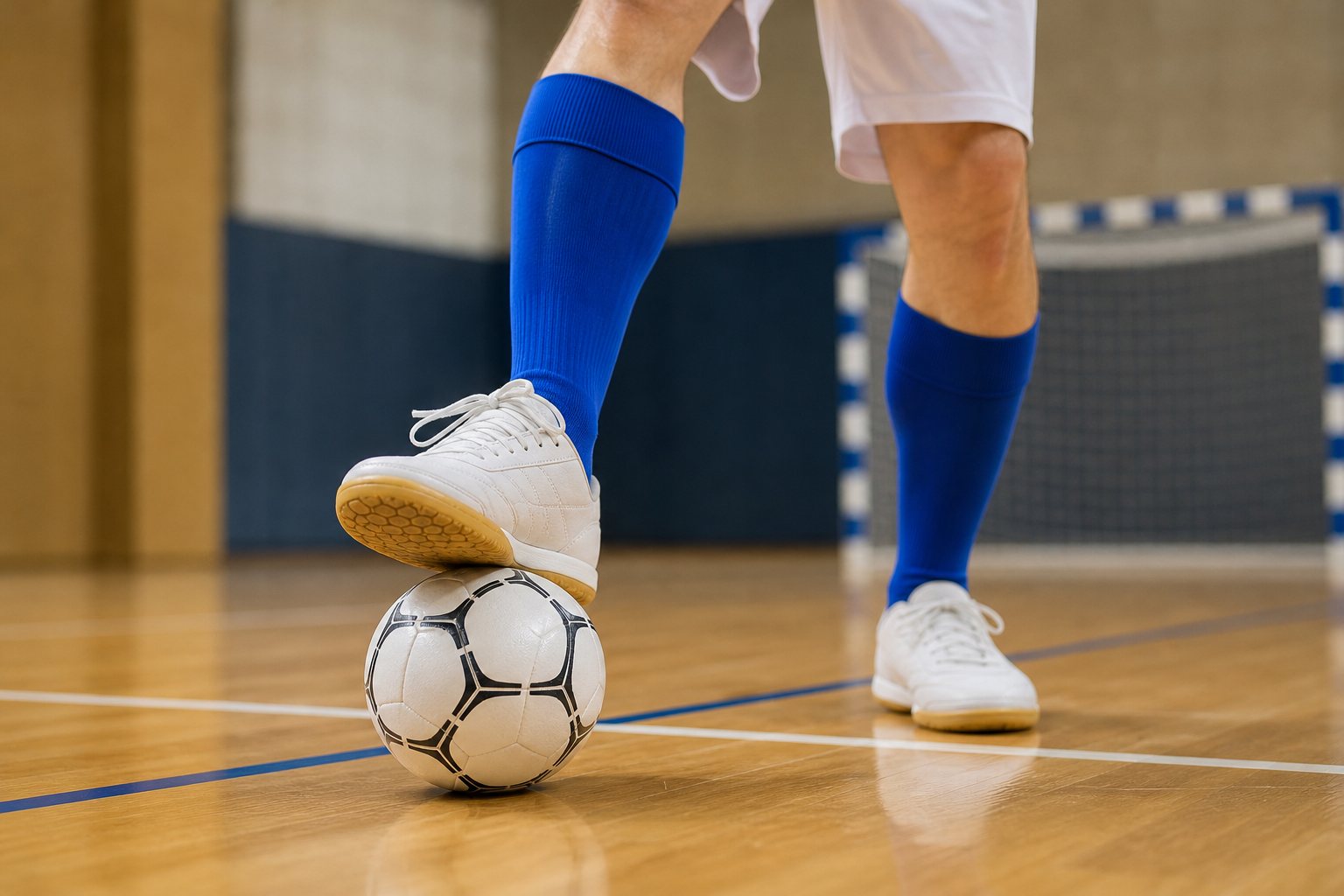
A first-timer walks into an indoor hall, laces up flat-soled shoes and is told the ball will not bounce much, there is no offside, and every restart has a clock on it. Ten minutes later the ball has rolled under their foot twice and a teammate is shouting for the pass. That is the quick way into futsal, the five-a-side indoor form of soccer played under FIFA’s own Futsal Laws. This page explains how a game works, the basic skills worth learning first, and how a beginner can find somewhere to play. For the bigger picture, start at the futsal hub.
Quick answer: Futsal is played five a side (one is the goalkeeper) on a hard court with a low-bounce ball. A match is two periods of 20 minutes of playing time, there is no offside, and a team’s sixth accumulated foul in a period gives the other side a free kick with no wall. Beginners can start at a local indoor facility or youth futsal club, and the FIFA Futsal Laws are free to read. See a sports medicine doctor, physical therapist or athletic trainer if you are hurt.
The game in a few lines
The rules below come from the FIFA Futsal Laws of the Game 2025/26, which took effect on 5 September 2025. Leagues, schools and youth organisations may change some details, so check the version your league uses.
- The court. Law 1 allows a non-international court of 25 to 42 m long by 16 to 25 m wide. International matches use 38 to 42 m by 20 to 25 m.
- The ball. Law 2 describes a ball 62 to 64 cm around, 400 to 440 g, which should bounce only 50 to 65 cm when dropped from 2 m.
- The players. Law 3 allows a maximum of five players per team, one of them the goalkeeper. Substitutions are unlimited, and a team may name up to nine substitutes in official competition.
- The clock. Law 7 sets two equal periods of 20 minutes of playing time. Each team gets a one-minute timeout per period.
- Offside. The Laws state that there is no offside in futsal.
- Equipment. Law 4 makes shin guards compulsory: suitable material, appropriate size, covered by socks.
Restarts and fouls beginners trip over
Most new players are caught out by restarts, not by the ball. When the ball crosses the touchline, play restarts with a kick-in, not a throw-in, and opponents must stand at least 5 m away. Kick-ins, goal clearances and free kicks have a four-second limit once the team is ready to take them; run the clock down and the other team can get the ball. The Laws also say what happens when the ball touches the ceiling of an indoor hall: play restarts from the touchline.
Fouls are counted. Each team’s fouls are added up per period, and from the sixth accumulated foul the other team takes a direct free kick that the defending team cannot block with a wall. A third official can signal when a team reaches five. In practice that makes the fifth foul a warning for coaches and a reason to defend with your feet and body position rather than lunges. The Laws cover many more details (penalties, cards, the goalkeeper), and the PDF linked under Sources is the place to read them.
Basic skills to learn first
The Laws do not list skills, so this section is common coaching practice rather than sourced fact. On a small court with a ball that stays low, beginners are usually pointed at a short list:
- Sole control. Rolling and stopping the ball with the bottom of the foot keeps it close, and it works well on a smooth floor.
- Short, firm passing along the floor, one or two touches, to a teammate who has already moved into space.
- Turning and shielding with your body between the ball and the defender.
- Moving without the ball. With no offside and few players, the player who keeps changing position creates the pass.
- Goalkeeper basics for whoever takes the gloves, including restarting quickly within the four-second limit.
The ball is built to bounce only 50 to 65 cm, so it stays on the floor, which is why close control and quick short passing are what many coaches teach first. Our futsal training page shows how to practise these skills across a week.
How a beginner gets started
- Try a local indoor facility. Many indoor sports centres run adult leagues and pick-up sessions. Ask which rules they use, because other indoor soccer formats may use boards, larger teams or different balls.
- Youth players can look at US Youth Futsal, which says its national championship series has run since 1994, and at US Youth Soccer, which has held Futsal National Championships since 2022 for boys and girls ages 13 to 17.
- Check your outdoor club. Many soccer clubs run winter futsal programs. Ask the coach rather than assuming.
- School and college. We could not confirm NCAA or NFHS futsal programs, so most American players join club or league teams.
- Bring the basics: flat-soled indoor shoes, shin guards, water. See our futsal gear page.
Levels, from the hall to the World Cup
Futsal runs from recreational leagues to FIFA competitions. The FIFA Futsal World Cup 2024 in Uzbekistan was the tenth edition, with 24 teams, and Brazil beat Argentina 2-1 in the final on 6 October 2024. FIFA also held its first Futsal Women’s World Cup in Manila, where Brazil beat Portugal 3-0 in the final on 7 December 2025. Futsal was played, for men and for women, at the 2018 Youth Olympic Games in Buenos Aires; we could not confirm it on the senior Olympic programme, so check the official programme for the current Games. It is not a Paralympic sport; the related Paralympic game is blind football. If you also play outdoors, see the soccer hub.
Reading the official rulebook
The Futsal Laws of the Game are published by the football rule-making bodies and are free to download. Read the sections on the court, the ball, the players, the duration of the match, fouls and misconduct, and the restarts. If you coach or referee, check whether your competition publishes its own modifications; US Youth Soccer, for example, plays its futsal championships under the FIFA Futsal Laws as modified by the organisation.
Futsal rules FAQs
Is futsal the same as indoor soccer?
Not always. Futsal follows FIFA’s Futsal Laws: five players, a low-bounce ball, no offside and kick-ins. Other indoor soccer formats vary by venue and may use boards or different balls, so ask your facility.
How many players are on a futsal team?
Up to five on the court at once, including the goalkeeper. Substitutes can come on and off at any time, and up to nine may be named in official competitions.
Is there offside in futsal?
No. The Laws state plainly that there is no offside in futsal.
How long is a futsal match?
Two periods of 20 minutes of playing time, with the clock stopped when the ball is out of play. Youth and recreational leagues often shorten the periods, so check your own competition.
What do I need to start playing futsal?
Flat-soled indoor shoes, shin guards (compulsory under the Laws) and water. Your league or facility may add requirements, so ask before the first session.
Sources
- FIFA Futsal Laws of the Game 2025/26
- FIFA: Brazil win sixth Futsal World Cup
- Philippine Football Federation: final of the first Futsal Women’s World Cup
- US Youth Futsal: Nationals
- US Youth Futsal: The Rules
- US Youth Soccer Futsal National Championship
- Olympics.com: futsal at the Youth Olympic Games
General information for education only, not medical advice. It does not replace a sports medicine doctor, physical therapist, athletic trainer or dietitian who knows you. See how we write and check our pages in our editorial policy. Keep exploring the futsal hub and the sports hub.