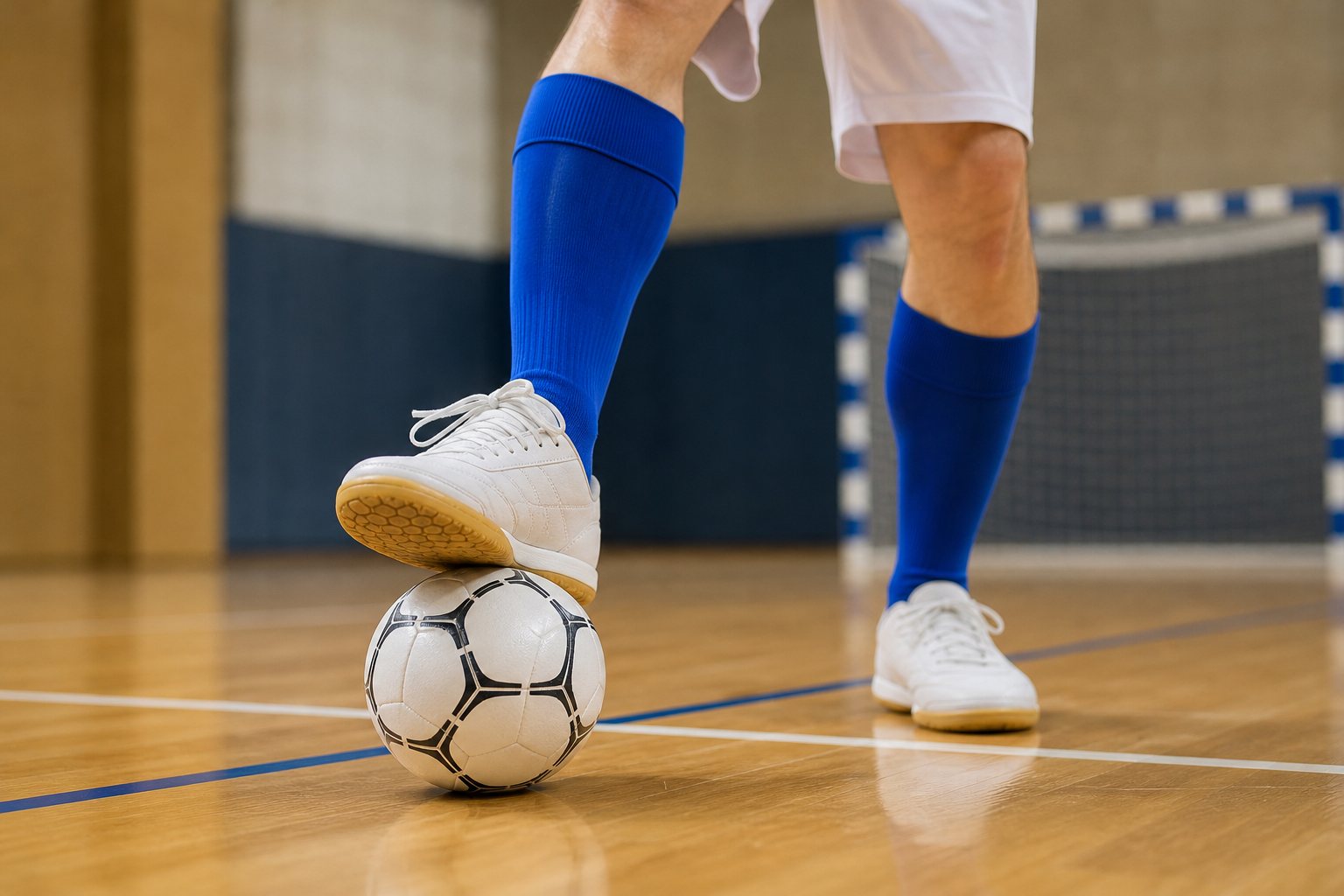
A 50-50 ball near the touchline, two players slide in on the hard floor, and one of them stays down holding her knee. Someone shouts for the ice pack. Futsal injuries are the sprains, strains, ligament tears, bruises and head knocks that come from fast, small-space soccer on a hard court. This page puts real numbers on where they happen and explains the general principles behind rehabilitation. It is general information, not a diagnosis; only a clinician can tell you what is wrong with your body. For ways to lower the odds, see our futsal injury prevention page.
Quick answer: In the best futsal study we found, 48% of Spanish under-19 players were injured in a season, mostly in the legs, with the ankle and knee leading. Head injuries were also frequent. Rehab usually means getting a proper diagnosis, protecting the joint, regaining motion and strength, then balance and sport-specific work, led by a clinician. Pain you cannot walk on, a knee that gives way or head-injury danger signs need prompt care.
What the surveillance numbers say
A 2026 study in Frontiers in Sports and Active Living followed 164 male under-19 players in Spain’s top youth futsal league through a full season. There were 111 injuries affecting 79 players (48% of the group), an overall rate of 4.96 injuries per 1,000 hours of exposure, with a far higher rate in matches than in training. Of the injuries, 80.1% were in the lower limbs, led by the ankle (23.4%) and the knee (20.7%). By type, muscle and tendon injuries were 36.9% and ligament injuries 36.0%. That is one group of teenage boys in one country, so women, adults and recreational players may differ.
Ankle sprains
The American Academy of Orthopaedic Surgeons (AAOS) says ankle sprains are most common in ball sports and that a sprain should be checked if you cannot put weight on the ankle or there is marked swelling. The National Athletic Trainers’ Association (NATA) position statement names a previous sprain as the most consistent risk factor for another, and recommends that athletes with previous sprains tape or brace for practices and games. It also recommends a multi-intervention balance and neuromuscular program of at least three months after a sprain, which is why rehab does not stop when the swelling does.
Knee injuries and the ACL
AAOS describes pivoting, cutting and jumping with a straight leg as common ways ACL tears happen, and says a sudden pop, swelling or a knee that gives way needs a professional. A 2022 meta-analysis of team ball sports (Chia and colleagues, Sports Medicine; 45 studies, 13 sports) found that 55% of ACL injuries were non-contact, with an overall incidence of 0.07 per 1,000 player-hours; it was not futsal-specific. A 2025 meta-analysis (Arthroscopy) found the highest relative risk for female adolescents in soccer, about three times that of males; we found no futsal-specific figure for that gap. The AAOS ACL page lists treatment options; a surgeon or sports medicine doctor makes that decision.
Muscle strains
Muscle and tendon injuries were the largest group in the Spanish futsal data. For hamstrings specifically, a soccer study (Ekstrand and colleagues, 2016) found a match rate of 4.77 injuries per 1,000 hours against 0.51 in training, about nine times higher, which fits with sprinting at full speed being the common cause. AAOS describes a sudden sharp pain at the back of the thigh, with swelling within hours, as a typical sign. A rest-and-return plan should come from a clinician.
Head injuries and concussion
A 2026 video study of FIFA tournaments in Knee Surgery, Sports Traumatology, Arthroscopy counted potential head injuries (a player staying down for more than five seconds or asking for medical attention for the head or neck). Futsal had 122.3 per 1,000 match-hours against 76.4 in outdoor football. Direct contact with an opponent caused 76.2% of them, and 16.7% were unintentional ball-to-head impacts. The CDC’s HEADS UP program says to recognize signs (headache, dizziness, confusion, balance problems), remove the player from the game that day, and let a health care provider decide when they may return. Call 911 for danger signs such as repeated vomiting, a seizure or a worsening headache.
General rehabilitation principles
- Get a diagnosis first. A swollen, painful joint can be a sprain, a fracture or a ligament tear. AAOS advises care if you cannot bear weight.
- Protect, then move. AAOS lists rest, ice, compression and elevation (RICE) as general first care for a sprain; a clinician then guides how soon to restore motion.
- Rebuild strength and balance. NATA’s three-month balance and neuromuscular recommendation after an ankle sprain shows the rehab is longer than the pain.
- Return in steps. A clinician decides when it is safe to return; we give no timeline because recovery times vary by injury and person. Re-injury risk is higher after a previous injury, as NATA notes for ankles.
- Do not self-clear. This page does not clear anyone to play.
When to see a professional
See a sports medicine doctor, physical therapist or athletic trainer if you cannot put weight on a limb, a joint looks out of shape, swelling or pain lingers, a knee pops or gives way, or you have had a head knock with any symptoms. Parents and coaches should err on the side of caution with young players.
Futsal injuries FAQs
What are the most common injuries in futsal?
In a 2026 study of Spanish under-19 players, four of five injuries were in the lower limbs, led by the ankle (23.4%) and knee (20.7%). Muscle, tendon and ligament injuries were the most common types.
Is futsal more dangerous than outdoor soccer?
We cannot say overall. One 2026 study found more potential head injuries per match-hour in futsal (122.3) than in outdoor football (76.4), and the Spanish study found far more injuries in matches than in training.
How long does an ankle sprain take to heal?
There is no universal time. Severity varies, and NATA recommends at least three months of balance and neuromuscular work after a sprain. A clinician can give you a plan.
When can I return to futsal after an injury?
Only a clinician can clear you. Returning too early raises the chance of re-injury, so follow the plan you are given.
Do I need to see a doctor for a head knock?
If there are any signs (headache, dizziness, confusion, balance problems), stop playing that day and see a health care provider, per CDC HEADS UP. Call 911 for danger signs.
Sources
- Epidemiology of injuries in male under-19 futsal players in Spain, 2026 (PMID 42421836)
- Potential head injuries in football, futsal and beach soccer, 2026 (PMID 41144707)
- Exercise-based programmes and injury incidence in futsal players, systematic review 2026 (PMID 42651353)
- AAOS OrthoInfo: Sprained Ankle
- AAOS OrthoInfo: ACL Injuries
- CDC HEADS UP: Signs and Symptoms of Concussion
- NATA position statement: ankle sprains, Kaminski 2013 (PMID 23855363)
- Chia et al. 2022: Non-contact ACL injury in team ball sports (PMID 35622227)
- Adolescent ACL injury incidence meta-analysis, Arthroscopy 2025 (PMID 38692337)
- Ekstrand et al. 2016: Hamstring injuries in soccer (PMID 26746908)
- AAOS OrthoInfo: Hamstring Muscle Injuries
General information for education only, not medical advice. It does not replace a sports medicine doctor, physical therapist, athletic trainer or dietitian who knows you. See how we write and check our pages in our editorial policy. See also the futsal recovery page and the hub.